
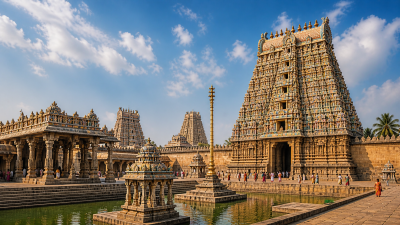
Dravidian architecture, a distinct style of Hindu temple construction, flourished in South India between the 7th and 17th centuries CE. Unlike the Nagara style of the North, it is characterized by monumental gateways, pyramid-shaped towers, and large temple complexes enclosed by high compound walls. Its evolution is largely categorized by the patronage of four major dynasties: the Pallavas, Cholas, Pandyas, and the Vijayanagara Empire.
Principal Components of a Dravida Temple
Standard Dravidian temples are built according to the Agama Shastras and consist of several specific structural elements.
- Vimana: The main temple tower over the Garbhagriha. It is a stepped pyramid that rises geometrically, unlike the curvilinear Shikhara of the North.
- Garbhagriha: The innermost square sanctum housing the primary deity. In the Dravida style, it is often topped by the tallest tier of the Vimana.
- Gopuram: The massive entrance gateway. Over time, Gopurams became larger and more ornate than the Vimana itself.
- Mandapa: A pillared hall leading to the sanctum, used for public rituals and ceremonies.
- Prakara: High boundary walls enclosing the entire temple complex, a feature absent in the Nagara style.
- Temple Tank (Pushkarni): A ritual water body located within the enclosure, essential for temple activities.
- Shikhara (Crowing Element): In South Indian terminology, the “Shikhara” refers only to the octagonal, cupola-shaped crowning element at the very top of the Vimana.
Dynastic Contributions and Architectural Milestones
The Pallava Phase (600–900 CE)
The Pallavas pioneered South Indian stone architecture, transitioning from rock-cut caves to structural temples.
- Mahendra Group: Initial rock-cut temples known as Mandapas.
- Mamalla Group: Features the monolithic Rathas (Chariots) and Mandapas at Mahabalipuram. The Five Rathas are carved from single granite boulders.
- Rajasimha Group: Transition to structural temples. Example: The Shore Temple at Mahabalipuram and the Kailasanathar Temple at Kanchipuram.
The Chola Phase (900–1150 CE)
Considered the “Golden Age” of Dravidian architecture, the Cholas perfected the Vimana and introduced colossal proportions.
- Brihadisvara Temple (Thanjavur): Built by Rajaraja I. The Vimana rises to 66 meters, and the monolithic Kumbam (cap stone) at the top weighs approximately 80 tons.
- Gangaikonda Cholapuram: Built by Rajendra I to commemorate his victory in the North.
- Bronze Casting: This era produced the world-famous Nataraja sculptures using the Cire Perdue (Lost Wax) technique.
The Pandya Phase (1100–1350 CE)
Under the Pandyas, the focus shifted from the central shrine (Vimana) to the periphery.
- Dominant Gopurams: They introduced massive, multi-storied gateways that dwarfed the main shrine.
- Example: The Meenakshi Amman Temple in Madurai (though much of the current structure is later Nayaka work, the plan was established earlier).
Vijayanagara and Nayaka Phase (1350–1700 CE)
Architecture during this period became highly ornate, characterized by secular themes and massive pillared halls.
- Kalyana Mandapa: Elaborate halls for the symbolic marriage of deities.
- Yali Pillars: Pillars carved with mythical creatures (half-lion, half-horse).
- Example: Vittala Temple at Hampi (famous for its stone chariot and musical pillars) and the Virupaksha Temple.
Technical Comparison: Nagara vs. Dravida Style
| Feature | Nagara Style (North) | Dravida Style (South) |
| Main Tower | Curvilinear (Shikhara) | Pyramidal/Stepped (Vimana) |
| Gateways | Simple and modest | Towering and ornate (Gopuram) |
| Boundary Walls | Generally absent | Essential (Prakara) |
| Water Tank | Rare within complex | Always present (Temple Tank) |
| Entrance Figures | River Goddesses (Ganga, Yamuna) | Dwarapalas (Guardians) |
| Pedestal | High platform (Jagati) | Built on the ground or low base |
Unique Sub-Styles and Variations
- Vesara Style: A hybrid form found in the Deccan (Chalukyas, Hoysalas) that combines the Nagara Shikhara with the Dravida Vimana.
- Kerala Style: Distinct for its sloped, tiled roofs (to withstand heavy rainfall) and use of wood and laterite. Example: Vadakkunnathan Temple.
- Jaffna Style: A regional variation in Sri Lanka influenced by Pandya and Chola traditions.
Fact-Check and Trivia for UPSC Prelims
- Nandi: In almost every Dravidian temple, a monolithic Nandi (bull) sits in a separate Mandapa facing the main Garbhagriha.
- Brihadisvara Fact: The shadow of the main Vimana of the Thanjavur temple is said to never fall on the ground at noon during any season.
- UNESCO Sites: The “Great Living Chola Temples” (Thanjavur, Gangaikonda Cholapuram, and Darasuram) are UNESCO World Heritage sites.
- Dravida Shikhara Shape: While the Nagara Shikhara is square at the base, the crowning “Shikhara” (cupola) of a Dravidian temple can be square, octagonal, or circular.
- The Stone Chariot: The Stone Chariot at Hampi is actually a shrine dedicated to Garuda, the vahana of Vishnu.
- Musical Pillars: The 56 pillars in the Vittala Temple at Hampi produce musical notes (Saptaswara) when tapped gently.