
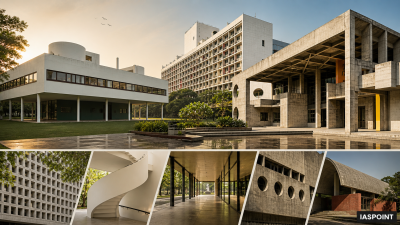
Modernist architecture in India emerged as a break from the colonial past, seeking to define the identity of a newly independent nation. It prioritized functionalism, structural honesty, and the use of modern materials like reinforced cement concrete (RCC), glass, and steel. Moving away from the ornamentation of the Indo-Saracenic and Art Deco periods, Modernism embraced the “International Style,” which was later adapted to India’s tropical climate through “Brutalism” and “Critical Regionalism.”
The Nehruvian Vision and Le Corbusier
Prime Minister Jawaharlal Nehru viewed modern architecture as a “temple of the new age,” symbolizing a departure from tradition toward scientific temper and progress.
- Chandigarh City Plan: Designed by the French architect Le Corbusier, Chandigarh remains the most significant experiment in global Modernism.
- The Capitol Complex: A UNESCO World Heritage site consisting of the Legislative Assembly, the Secretariat, and the High Court.
- Key Innovations: Use of “Béton brut” (raw concrete), the Modulor scale of proportions, and the Brise-soleil (sun-breaking fins) to manage heat without sacrificing light.
- The Open Hand Monument: A recurring motif in Le Corbusier’s work in India, symbolizing “peace and reconciliation; open to give and open to receive.”
Brutalism and Institutional Building
From the 1960s to the 1980s, India saw the rise of Brutalism—a style characterized by massive, monolithic forms and exposed concrete surfaces.
- Louis Kahn and IIM Ahmedabad: Kahn utilized geometric forms (circles and arches) and exposed red brick to create a sense of monumental austerity. His design prioritized natural light and ventilation through massive circular openings in the walls.
- The Hall of Nations (Delhi): Designed by Raj Rewal, this was the world’s first large-scale space-frame structure in reinforced concrete. It was built to commemorate 25 years of independence but was controversially demolished in 2017.
- IIT Kanpur: Designed by Achyut Kanvinde, one of the pioneers of functionalist architecture in India, emphasizing the “form follows function” mantra.
Critical Regionalism: Adapting Modernism to India
In the later phase of Modernism, Indian architects sought to balance global techniques with local climate, materials, and cultural contexts.
- Charles Correa: Known as “India’s Greatest Architect,” he focused on the “Open-to-Sky” concept.
- Gandhi Smarak Sangrahalaya (Sabarmati Ashram): Uses modular units, tiled roofs, and open brick walls to maintain the simplicity of Gandhi’s philosophy.
- Jawahar Kala Kendra (Jaipur): Based on the Navagraha (nine planets) concept of the original city plan of Jaipur.
- Kanchanjunga Apartments (Mumbai): A breakthrough in high-rise design using interlocking sections to ensure cross-ventilation.
- B.V. Doshi: The first Indian to win the Pritzker Architecture Prize (2018).
- Amdavad ni Gufa: An underground gallery with shell-like structures, merging digital design with local tribal craftsmanship.
- Sangath (Ahmedabad): His own studio, featuring sunken vaults covered in China mosaic to reflect heat.
Comparative Evolution of Styles
| Feature | International Style (Early Modern) | Critical Regionalism (Late Modern) |
| Primary Material | Glass, Steel, Raw Concrete | Brick, Stone, Terracotta, Concrete |
| Philosophy | Universal application; “Machine for living” | Site-specific; Climate-responsive |
| Key Architect | Le Corbusier | Charles Correa, B.V. Doshi |
| Approach to Climate | Artificial cooling/Mechanical fins | Courtyards, Verandahs, Thermal mass |
| Example | Secretariat, Chandigarh | Sangath, Ahmedabad |
Post-Modernism and Sustainable Architecture
Since the 1990s, Indian architecture has branched into Post-Modernism—incorporating historical references—and a strong movement toward sustainability.
- Laurie Baker: Often called the “Gandhi of Architecture,” he pioneered low-cost, sustainable building in Kerala. He used “Rat-trap bond” brickwork for insulation and “Brick Jali” for natural cooling, eschewing the use of energy-intensive cement where possible.
- Lotus Temple (Delhi): Designed by Fariborz Sahba in the Expressionist style, utilizing 27 free-standing marble-clad “petals” to form a Bahá’í House of Worship.
- Sustainable Cities: The development of Amaravati and GIFT City represents the new “Smart City” paradigm, blending high-tech Modernism with green building standards (LEED ratings).
Notable Modernist Landmarks and Architects
- Vidhan Bhavan (Bhopal): Designed by Charles Correa; a circular structure that interprets the concept of the “Mandala” in a modern context.
- National Crafts Museum (Delhi): Designed by Charles Correa, organized around a central “path” resembling an Indian village street.
- Indian Institute of Science (Bangalore): Features the “Main Building” which represents a transition from Classical to Modernist aesthetics.
- Lotus Mahal (Hampi) Influence: Modern structures often reference the stepped profiles of ancient Indian temple bases (Adhisthana) in contemporary concrete.
Facts and Trivia for UPSC Prelims
- Pritzker Prize: Balkrishna Vithaldas (B.V.) Doshi is the only Indian architect to have received this honor, often considered the “Nobel of Architecture.”
- Béton Brut: A French term meaning “raw concrete,” which gave rise to the term “Brutalism.”
- The Modulor: A scale of proportions developed by Le Corbusier based on the human body and the golden ratio, used extensively in the design of Chandigarh.
- Achyut Kanvinde: He was mentored by Walter Gropius (founder of the Bauhaus movement), bringing the Bauhaus philosophy to Indian soil.
- The “Baker Model”: Laurie Baker’s philosophy emphasized that “small is beautiful” and that architecture should be accessible to the poor, not just the elite.
- UNESCO Recognition: The Capitol Complex in Chandigarh was inscribed as a World Heritage site in 2016 as part of “The Architectural Work of Le Corbusier.”