
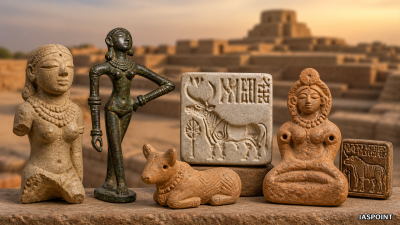
The Indus Valley Civilization (IVC), flourishing around 2500 BCE to 1700 BCE, represents the zenith of Bronze Age artistic achievement. Unlike the monumental architecture of contemporary Mesopotamia or Egypt, Harappan sculpture is characterized by its small-scale, utilitarian, and highly naturalistic approach. Artists utilized a diverse range of materials including stone, bronze, terracotta, and steatite, demonstrating advanced knowledge of metallurgy and anatomical proportions.
Stone Statuary: The Art of Realism
Stone sculptures in the IVC are rare but significant for their detailed 3D modeling. Two primary examples found at Harappa and Mohenjo-daro showcase the technical prowess of the era.
- Bearded Nobleman (Steatite): Found in Mohenjo-daro, this figure is often interpreted as a ‘Priest-King.’
- Features: Eyes are elongated and half-closed as if in meditation; a well-groomed beard; a shawl draped over the left shoulder decorated with trefoil patterns.
- Male Torso (Red Sandstone): A remarkable specimen from Harappa showing physical realism.
- Features: Socket holes in the neck and shoulders for attaching the head and arms, indicating a sophisticated understanding of joinery.
Bronze Casting: The Lost Wax Technique
Harappan artisans were pioneers in the Cire Perdue (Lost Wax) process. This involved creating a wax model, coating it in clay, melting the wax out, and pouring molten metal into the hollow mold.
- The Dancing Girl: This 4-inch bronze statue from Mohenjo-daro is arguably the most famous IVC artifact.
- Anatomy: She stands in a tribhanga (thrice-bent) posture with her right hand on her hip.
- Adornment: Her left arm is almost entirely covered in bangles, a stylistic feature still seen in tribal art in parts of Gujarat and Rajasthan today.
- Animal Figurines: Bronze figures of buffaloes and bulls demonstrate a high degree of “animalism,” capturing the raw strength and muscularity of the beasts.
Terracotta Sculpture: The People’s Art
While stone and bronze were likely for elite or ritualistic use, terracotta was the medium of the masses. These were handmade using the pinching method rather than a potter’s wheel.
- Mother Goddess: These figurines are found in large numbers, suggesting a cult of fertility. They are typically characterized by elaborate fan-shaped headdresses and heavy ornamentation.
- Toy Culture: A variety of terracotta toys have been unearthed, including:
- Whistles shaped like birds.
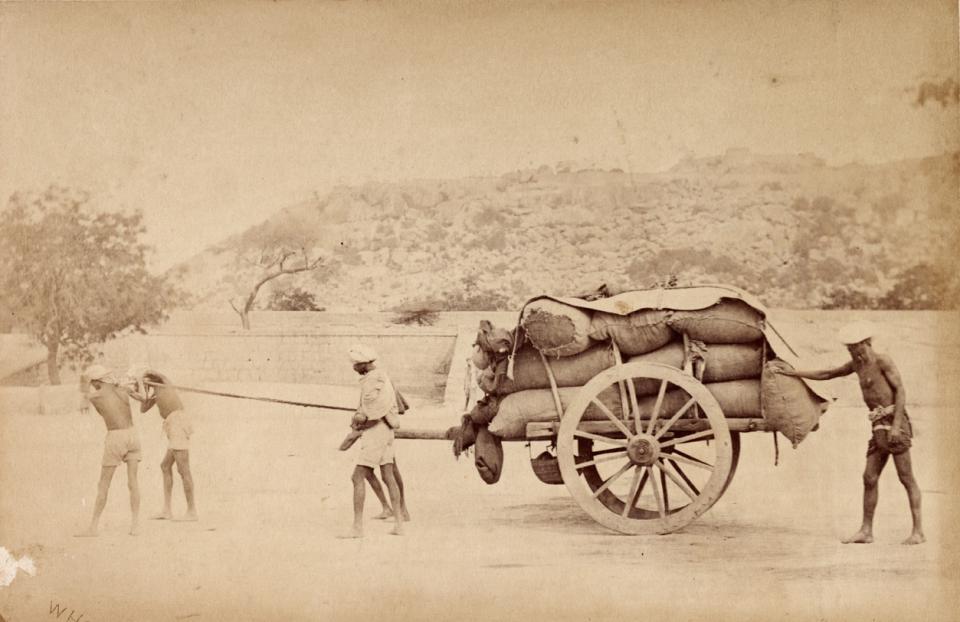
- Movable carts with wheels.
- Climbing monkeys and dogs.
- Masks with horns (likely for ritualistic performances).
Comparative Analysis of Materials and Techniques
| Feature | Stone Sculpture | Bronze Sculpture | Terracotta Sculpture |
| Common Material | Steatite, Red Sandstone | Copper-Bronze Alloy | Fire-baked Clay |
| Primary Technique | Carving and Polishing | Lost Wax Process | Pinching/Hand-modeling |
| Key Examples | Priest-King, Male Torso | Dancing Girl, Bronze Bull | Mother Goddess, Toy Carts |
| Detailing | High (Anatomical) | High (Fluidity) | Crude but Expressive |
The Art of Seals and Amulets
Seals represent the most versatile form of Harappan sculpture. Usually made of steatite, they served commercial, religious, and administrative purposes.
- Shape and Size: Mostly square or rectangular, ranging from 2×2 cm to 5×5 cm.
- The Pashupati Seal: Depicts a seated figure in a yogic posture (Mulabandhasana) surrounded by animals: an elephant, a tiger, a rhinoceros, and a buffalo, with two antelopes below the seat. This is often cited as a precursor to the Hindu deity Shiva.
- Unicorn Seal: The most common motif, featuring a mythical one-horned animal.
- Script: Seals carry a pictographic script that remains undeciphered to this day.
Harappan Pottery and Ornamentation
Harappan pottery was predominantly Red and Black Ware. The pots were treated with a red slip and painted with black designs depicting geometric patterns, pipal leaves, and interlocking circles.
- Jewellery: Both men and women wore ornaments. Beads were made of carnelian, lapis lazuli, jasper, and quartz.
- The Bead Factory: Evidence from Chanhudaro and Lothal indicates large-scale production of beads, which were exported as far as Mesopotamia.
Fact Sheet for UPSC Prelims
- Material Origin: Lapis Lazuli was imported from Badakshan (Afghanistan); Turquoise from Persia; Copper from Khetri (Rajasthan).
- Technological Trivia: The IVC people were among the first to use the potter’s wheel in the Indian subcontinent.
- Distribution: While stone and bronze are found mostly in urban centers like Mohenjo-daro, terracotta is found ubiquitously across rural and urban sites.
- Aesthetic Continuity: The trefoil motif on the Priest-King’s shawl and the bangles on the Dancing Girl’s arm represent cultural continuities found in later Indian traditions.