

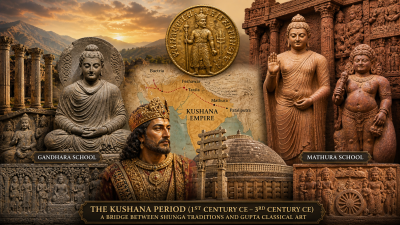
The Kushana Period (1st Century CE – 3rd Century CE) represents the “Golden Age” of early Indian sculpture, acting as a bridge between the archaic traditions of the Shungas and the classical perfection of the Guptas. Under the patronage of the Kushana dynasty—originally a nomadic Yuezhi tribe from Central Asia—India witnessed a 360° evolution in artistic expression. This era is characterized by the coexistence and flourishing of two distinct schools: the Gandhara School in the Northwest and the Mathura School in the Gangetic plains.
Major Schools of Kushana Art: A Comparative Study
The Kushana Empire facilitated a unique artistic dichotomy where Hellenistic realism and indigenous Indian vitality developed simultaneously.
| Feature | Gandhara School | Mathura School |
| Geographic Hub | Modern-day Peshawar, Taxila, and Swat Valley. | Mathura, Sonkh, and Kankali Tila. |
| Influence | Greco-Roman / Hellenistic (Greco-Buddhist). | Entirely Indigenous (Yaksha tradition). |
| Primary Material | Blue-Grey Schist; later Stucco (plaster). | Spotted Red Sandstone. |
| Religious Focus | Exclusively Mahayana Buddhist. | Buddhist, Jain, and Brahmanical (Hindu). |
| Anatomical Style | Realistic, muscular, and athletic. | Fleshy, robust, and voluminous. |
| Facial Features | Sharp nose, thin lips, wavy hair (Apollo-like). | Round face, thick lips, shaven/snail-curl hair. |
| Drapery | Heavy, thick folds resembling a Roman Toga. | Transparent, thin, clinging to the body. |
The Mathura School: Indigenous Innovation
The Mathura School was a melting pot of religious iconography, producing the first human representations of the Buddha, Tirthankaras, and Hindu deities.
Buddhist Iconography in Mathura
- The Kapardin Style: Early Mathura Buddhas feature a shaven head with a single spiral knot (Ushnisha).
- Physicality: The Buddha is depicted with a “smiling” countenance and a robust physique with a slightly protruding belly, symbolizing Prana (life-breath).
- Aura: The halos (Prabhamandala) are large and intricately decorated with geometric and floral patterns.
- The Katra Buddha: A hallmark example showing the Buddha seated on a lion throne (Simhasana) under a Bodhi tree, flanked by attendants.
Jain and Brahmanical Art
- Ayagapattas: Mathura was the center for Jain “votive tablets” used for worship, decorated with the Tirthankara images and auspicious symbols like the Swastika.
- Earliest Hindu Images: The school produced the first standard images of Shiva (in Linga and Mukhalinga forms), Vishnu (with four arms), Surya (wearing Central Asian boots), and Balarama.
The Gandhara School: Hellenistic Realism
Centered in the Northwest, this school applied Western aesthetic principles to Eastern spiritual themes.
- The Fasting Siddhartha: A masterpiece from Sikri that demonstrates intense anatomical detail, depicting the Buddha’s emaciated body during his period of extreme asceticism.
- The Buddha’s Appearance: He is often shown with a mustache, wavy hair, and a somber, spiritual expression, bearing a striking resemblance to the Greek god Apollo.
- Introduction of Stucco: In the later Kushana period, schist was replaced by stucco, which allowed for mass production and softer facial expressions.
Secular and Royal Portraiture
A unique contribution of the Kushana period was the introduction of royal portraiture, reflecting the “Devaputra” (Son of God) status of the kings.
- The Mat Statue: Found near Mathura, the headless statue of King Kanishka is a significant historical marker. He is depicted in Central Asian dress: a heavy quilted long coat, trousers, and massive padded boots, holding a mace and a sword.
- Yakshis and Vrikshikas: The railings at Bhutesar feature sensuous female figures in various secular activities like bathing, looking in a mirror, or playing with birds, representing the pinnacle of feminine grace in Kushana art.
Technical Trivia and Prelims Facts
- Mahayana Influence: The Kushana period coincided with the Fourth Buddhist Council and the rise of Mahayana Buddhism, which shifted the focus from symbolic (Aniconic) to image-based (Iconic) worship.
- The Silk Road Connection: The trade routes facilitated the import of artistic ideas from the Roman Empire and Persia, influencing the “international” style of Gandhara.
- Kanishka’s Casket: A bronze reliquary found at Shah-ji-ki-Dheri containing Buddha’s relics, featuring an inscription mentioning Kanishka and the Greek artist Agesilas.
- Mudras Standardized: The four major Mudras—Abhaya (fearlessness), Dhyana (meditation), Dharmachakra (preaching), and Bhumisparsha (earth-touching)—were largely standardized during this era.
- Turquoise and Lapis: Increased trade led to the frequent use of semi-precious stones for inlay work in smaller sculptural artifacts.
Legacy of Kushana Sculpture
The Kushana period established the iconographic “alphabet” of Indian art. The robust vitality of Mathura and the aesthetic refinement of Gandhara eventually merged during the Gupta period to create the “Classical” Indian style. The influence of Kushana art extended beyond Indian borders, traveling via the Silk Road to influence the Buddhist art of China, Korea, and Japan.
Last Modified: May 5, 2026