

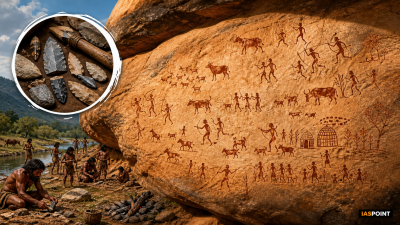
The Mesolithic period (Middle Stone Age), dating approximately from 10,000 BCE to 4,000 BCE, marks a pivotal transition in Indian rock art. Unlike the Upper Paleolithic era, which focused on large, solo animal figures, Mesolithic paintings exhibit a dramatic shift toward smaller, more dynamic compositions. These works serve as a primary visual record of the socio-economic transition from nomadic hunting-gathering to early pastoralism and incipient sedentary life.
Technical Characteristics of Mesolithic Art
The Mesolithic artists refined their tools and techniques, leading to a distinct style identifiable by specific technical traits:
- Miniaturization of Figures: Figures became significantly smaller than their Paleolithic predecessors, often referred to as “microlithic” in artistic scale to match the stone tool technology of the time.
- Pigment Composition: Colors were derived from minerals found in the local environment. Red was obtained from hematite (iron oxide/Geru), white from kaolin or magnesium, and green from chalcedony.
- Binding Agents: To ensure the longevity of the paintings, pigments were mixed with water and organic binders such as animal fat, plant resin, or egg whites.
- Linear Style: Figures are often rendered in a stylized, stick-like manner, yet they convey a high degree of movement and energy.
Thematic Evolution: 360° Perspective
The Mesolithic period expanded the thematic range of Indian art from pure naturalism to complex social narratives.
Hunting and Gathering Scenes
- Group Dynamics: Paintings frequently depict communal hunting strategies where groups of men use spears, bows and arrows, and pointed sticks to trap large prey.
- Tool Detail: Clear depictions of barbed spears and arrows indicate the technological advancement of the Mesolithic people.
- Trap Mechanisms: Some scenes illustrate the use of pits and nets, showing a sophisticated understanding of animal behavior.
Social and Domestic Life
- Gender Roles: Women are depicted both in domestic settings (grinding grain or cooking) and participating in communal activities.
- Family Units: Rare but significant depictions of pregnant women, children, and nursing mothers appear during this period.
- Clothing and Ornamentation: Evidence of loincloths, headgear, and ornaments like necklaces and armlets made of bone or stone are visible in the stick figures.
Ritualistic and Aesthetic Expressions
- Dancing: Figures are often shown in rhythmic, hand-linked rows, suggesting the performance of ritual dances or celebratory gatherings.
- Musical Instruments: Crude depictions of percussion-like instruments indicate the early development of rhythmic music.
- Abstract Symbols: Geometric patterns, including honeycombs, triangles, and intricate line work, suggest the beginning of symbolic or abstract thought.
Key Geographical Clusters and Sites
| Region | Primary Sites | Significance |
| Madhya Pradesh | Bhimbetka, Adamgarh, Lakhajoar | The largest concentration of rock shelters; UNESCO World Heritage status. |
| Uttar Pradesh | Mirzapur (Vindhyan Range), Morhana Pahar | Famous for depicting the transition from hunting to herding. |
| Rajasthan | Alwar (Bhaja), Darra | Features paintings of tigers, panthers, and antelopes in vibrant red. |
| Odisha | Gudahandi, Yogimatha | Known for geometric patterns and stylized human forms. |
| Kerala | Edakkal Caves (Wayanad) | Notable for its Neolithic-Mesolithic overlap and deep incisions. |
Spotlight: Bhimbetka Rock Shelters
Located in the Raisen District of Madhya Pradesh, Bhimbetka is the most significant repository of Mesolithic art in India.
- Discovery: Discovered by V.S. Wakankar in 1957-58.
- Superimposition: One of the most unique features of Bhimbetka is the layering of paintings. Mesolithic art is often found painted directly over Paleolithic figures, providing a chronological map of human habitation.
- The Zoo Rock: A specific shelter at Bhimbetka depicting 458 figures, including 252 animals of 16 different species, showcasing the vast biodiversity of the era.
Comparative Analysis: Paleolithic vs. Mesolithic Painting
| Feature | Paleolithic Paintings | Mesolithic Paintings |
| Size of Figures | Large, often life-sized. | Small, miniature, and stylized. |
| Subject Matter | Mainly large animals (Bison, Elephants). | Humans in social groups, hunting, and dancing. |
| Complexity | Simple, individual figures. | Complex narrative scenes and interactions. |
| Human Depiction | Rare and very basic. | Frequent, showing action and clothing. |
| Colors | Mostly dark red and green. | Predominantly bright red, white, and occasionally yellow. |
Flora and Fauna in Mesolithic Art
The Mesolithic artist was a keen observer of nature. The animals depicted were not just prey but part of a complex ecosystem.
- Common Animals: Chital, Sambhar, Wild Boar, Rhinoceros, Elephant, and various types of monkeys.
- Birds and Fish: There is an increased frequency of aquatic life and avian species compared to earlier periods, indicating a broader diet and habitat range.
- Nature Worship: Elements like the sun and trees begin to appear in stylized forms, hinting at the roots of animistic beliefs.
Critical Facts for UPSC Prelims
- V.S. Wakankar: Often called the “Father of Indian Rock Art” for his pioneering work at Bhimbetka.
- Microliths: The presence of tiny stone tools (microliths) at these painting sites helps archaeologists date the art to the Mesolithic period.
- Superimposition Technique: The practice of painting over older images is called palimpsest, which is a key method for relative dating in rock art studies.
- Mesolithic Economy: The paintings confirm that while hunting remained central, the gathering of wild fruits, honey, and seeds became equally vital for survival.
- X-Ray Style: Some Mesolithic paintings show the “X-ray style,” where the internal organs of animals are visible, indicating an advanced anatomical understanding for the period.