
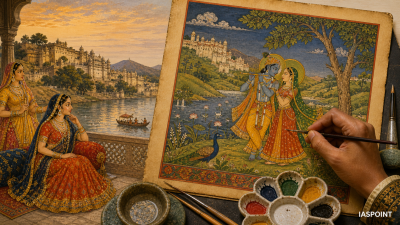
The Mewar School of Painting is the most significant and oldest sub-school of the Rajasthani School of Art. Emerging from the ancient principality of Medapata, it is considered the purest form of Rajasthani art as it remained relatively free from Mughal influence for a longer duration compared to other schools like Jaipur or Bikaner.
Key Phases of Development
The school underwent a distinct transition from the early 16th-century “Chaurapanchasika” style to a more refined courtly style.
- Early Phase (Pre-17th Century): Characterized by the Chavand Ragamala (1605) painted by Nasiruddin. This phase reflects the resistance against Mughal hegemony and retains a bold, indigenous character.
- Golden Age (17th Century): Under the patronage of Maharana Jagat Singh I (1628–1652), the school reached its zenith. Sahibdin became the most prominent artist of this era, illustrating the Ragamala, Rasikapriya, and the Bhagavata Purana.
- Later Phase (18th-19th Century): Increased focus on courtly life, hunting scenes (Shikar), and festivals. The influence of the Nathdwara sub-school (Pichwai paintings) became prominent.
Distinctive Stylistic Features
Mewar paintings are identified by their emotional intensity and vibrant use of color.
- Color Palette: Dominant use of bright red and yellow backgrounds to highlight figures.
- Physiognomy: Figures feature oval faces, fish-shaped eyes (Meen-Netra), prominent noses, and short statures. Male figures often wear traditional turbans and long tunics.
- Backgrounds: Decorative representation of flora and fauna. Trees are often stylized, and skies are depicted in layers of deep blue or gold.
- Composition: Large-scale illustrations of epic poetry. The use of compartmentalization to show different time sequences within a single frame is a unique trait.
Major Themes and Literary Inspirations
The Mewar School was deeply rooted in Bhakti and Shringar (erotic/romantic) traditions.
- Religious Texts: Extensive illustrations of the Ramayana, Mahabharata, Bhagavata Purana, and Gita Govinda.
- Ragamala: Musical modes depicted through human situations, usually involving a hero (Nayaka) and heroine (Nayika).
- Barahmasa: Representation of the twelve months and the changing moods of nature and humans.
- Court Life: Portraits of the Maharanas, royal processions, and intricate hunting scenes.
Prominent Artists and Their Contributions
| Artist | Notable Works | Significance |
| Nasiruddin | Chavand Ragamala (1605) | Established the early Mewar idiom. |
| Sahibdin | Bhagavata Purana, Rasikapriya | Refined the school; master of complex compositions. |
| Manohar | Ramayana (Bal-Kanda) | Known for detailed architectural backgrounds. |
| Jagannath | Bihari Satsai (1719) | Continued the tradition into the 18th century. |
Sub-schools of Mewar
The Mewar style branched into several influential regional centers:
- Nathdwara: Famous for Pichwai paintings—large cloth backdrops depicting Shrinathji (Lord Krishna).
- Devgarh: Known for a mix of Mewar, Marwar, and Jaipur styles; characterized by distinct shades of green and yellow.
- Shahpura: Specializes in Phad paintings, which are long scroll paintings used by folk singers to narrate stories of local deities like Pabuji and Devnarayan.
Comparison: Mewar vs. Mughal Influence
While many Rajasthani schools adopted Mughal naturalism, Mewar maintained its traditional roots.
- Mewar: Focused on flat perspectives, symbolic colors, and poetic themes.
- Mughal Influence: Some later Mewar works adopted the Mughal practice of “Stippling” (Pardaz) for shading, but the core iconography remained Hindu/Rajput.
Important Facts for UPSC Prelims
- Sahibdin’s Unique Style: Unlike Mughal artists who signed their names, Sahibdin is one of the few Rajasthani artists whose name and dates are well-documented.
- The Arsha Ramayana: A famous manuscript of the Ramayana illustrated in the Mewar style, currently housed in the British Library.
- Pichwai Art: Noted for its use of natural colors and gold leaf, specifically dedicated to the Pushtimarg sect of Vaishnavism.
- Paper and Materials: Artists used Vasli (handmade paper made of layers of rags) and natural pigments derived from minerals, stones, and plants.