
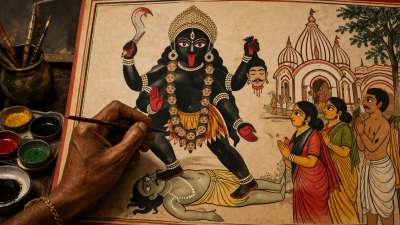
Kalighat painting originated in the 19th century in the vicinity of the Kalighat Temple in Calcutta (now Kolkata). It represents a critical transition in Indian art history from the traditional rural Patachitra (scroll painting) to a modern, urban “Bazaar” style. As the British established Calcutta as a commercial hub, traditional scroll painters (Patua artists) from rural Bengal migrated to the city, adapting their art to suit the tastes of pilgrims and urban dwellers.
Transition from Rural to Urban Idiom
- From Scrolls to Single Sheets: Unlike the traditional Patas which were long scrolls used for storytelling, Kalighat paintings were executed on single sheets of paper to facilitate quick production and low-cost sales.
- Patronage Shift: The transition marked a shift from rural community patronage to a burgeoning urban market consisting of pilgrims, traders, and British officials.
- Material Innovation: Artists abandoned traditional cloth backdrops for cheap, mill-made paper and replaced vegetable dyes with factory-made watercolours and imported pigments.
Distinctive Stylistic Features
The Kalighat school is celebrated for its minimalist yet powerful aesthetic, characterized by bold lines and rhythmic movements.
- Technique of Shading: Artists used a unique method of shading where the edges of the figures were darkened to give a three-dimensional, “rounded” effect, despite the flat background.
- Minimalist Background: To ensure rapid production, the backgrounds were usually left blank or monochromatic, focusing entirely on the central figure.
- The “Patuas” Lineage: The paintings are characterized by swift, sweeping brushstrokes. The outlines were typically drawn in black ink with a single, continuous motion.
- Physiognomy: Figures possess large, expressive eyes and rhythmic body postures, often reflecting the influence of traditional clay idol-making from the Pal community.
Thematic Diversity: Sacred and Profane
Kalighat art is categorized into two primary thematic streams: the religious and the contemporary-secular.
Religious and Mythological Themes
Initially, the paintings focused on Hindu deities to cater to the pilgrims visiting the Kalighat Temple.
- Goddess Kali: The most frequent subject, depicted in her fierce form.
- Krishna Leela: Scenes from the life of Krishna, often emphasizing his childhood or his dalliances with the Gopis.
- Ramayana and Mahabharata: Iconic episodes such as Hanuman’s leap or Durga’s victory over Mahishasura.
Secular and Satirical Themes
As the school matured, it became a powerful medium for social commentary and satire regarding the “Babu Culture” of colonial Bengal.
- Social Satire: Depictions of the Westernized Bengali “Babu”—a class of men who mimicked British habits—were often portrayed as effeminate or foolish.
- The “Elokeshi” Scandal: The “Tarakeswar Scandal” of 1873, a famous contemporary criminal case involving a priest and a housewife, became a sensational theme depicted in various stages by Kalighat artists.
- Domestic Life: Representations of the “modern” woman (often shown combing hair or looking in a mirror) and her changing role in the urban household.
- Wildlife and Nature: Simple yet artistic portrayals of cats, fish, prawns, and birds.
Comparison: Kalighat vs. Traditional Bengal Patachitra
| Feature | Kalighat Painting | Traditional Bengal Patachitra |
| Format | Single sheets of paper | Long scrolls of cloth/paper |
| Context | Urban (Calcutta) / Bazaar art | Rural (Birbhum, Medinipur) / Folk storytelling |
| Perspective | Hints of three-dimensional shading | Entirely flat and two-dimensional |
| Subject Matter | Social satire, scandals, and deities | Primarily mythological and folk legends |
| Line Work | Sweeping, bold, and continuous | Detailed, fine, and decorative |
Global Influence and Modern Legacy
The Kalighat school is recognized as the precursor to modern Indian art.
- Influence on Jamini Roy: The most famous Modernist to be influenced by Kalighat was Jamini Roy, who abandoned Western academic realism to return to the bold lines and flat colors of this folk tradition.
- European Recognition: British collectors and artists recognized the “modernity” in Kalighat’s simplicity, leading to large collections being housed in the Victoria and Albert Museum (London).
- Global Modernism: The school’s focus on the essence of the form rather than minute detail mirrors the developments in 19th-century European modernism.
Fact Sheet for UPSC Prelims
- The Patuas: The artists of this school are traditionally called Patuas or Chitrakars, a community that often blurred the lines between Hindu and Muslim identities.
- Medium: Use of watercolours on mill-made paper; notable for being the first Indian school to use factory-made paper extensively.
- Bazaar Art: Often referred to as “Bazaar Paintings” because they were sold cheaply in the markets surrounding the temple.
- The “Babu” Motif: A central figure in Kalighat art representing the decadent and Westernized Bengali elite of the 19th century.
- Anonymity: Like most Indian folk traditions, individual Kalighat artists rarely signed their works, though families like the Ghosh and Dutta are known to have been prominent.
Trivia: The “Cat and Fish” Motif
One of the most iconic images of Kalighat art is the “Cat with a Fish in its Mouth.” This was not just a naturalistic sketch but a subtle satire. It symbolized the hypocrisy of certain religious “ascetics” (the cat) who pretended to be vegetarians but indulged in worldly pleasures (the fish) in secret.
Last Modified: May 5, 2026