
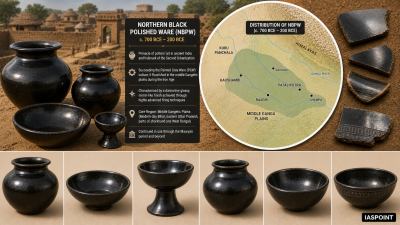
Northern Black Polished Ware (NBPW) represents the pinnacle of the potters’ art in ancient India, marking the transition into the Second Urbanization of the Indian subcontinent. Succeeding the Painted Grey Ware (PGW) culture, NBPW is an Iron Age pottery style that flourished primarily in the middle Gangetic plains between 700 BCE and 200 BCE, though its influence extended well into the Mauryan period. It is characterized by a distinctive glossy, mirror-like finish that remains a subject of technological interest for archaeologists today.
Chronological and Geographical Distribution
The NBPW phase is divided into two broad periods: the early phase (700–400 BCE), which coexisted with the late phase of PGW, and the late phase (400–100 BCE), which aligns with the peak of the Mauryan Empire.
Primary Core Areas
The heartland of NBPW production was the Middle Ganga Valley, specifically the regions of modern-day Bihar and Uttar Pradesh. Major centers included:
- Pataliputra (Patna) and Vaishali in Bihar.
- Kashi (Varanasi), Kaushambi, and Shravasti in Uttar Pradesh.
Expansion and Reach
Due to the expansion of trade routes (Uttarapatha) and the Mauryan administration, NBPW reached distal corners of the subcontinent:
- North: Taxila (Pakistan) and Udegram.
- South: Amaravati and Dharanikota in Andhra Pradesh.
- West: Bharuch and Ujjain.
- East: Chandraketugarh (West Bengal) and Mahasthangarh (Bangladesh).
Distinctive Physical and Chemical Features
NBPW is classified as a “deluxe ware,” intended for the elite classes rather than everyday use. Its technical excellence distinguishes it from all preceding and succeeding pottery traditions in India.
- Fabric and Texture: It is made of highly levigated, fine alluvial clay with little to no impurities. The pottery is thin-walled and sturdy.
- Surface Finish: The most striking feature is the lustrous metallic finish, which can appear in shades of coal-black, silvery, golden, or bronze.
- Manufacturing Technique: It was turned on a fast wheel. The “gloss” was likely achieved by applying a liquid clay slip containing ferrous oxides and then firing the pot in a kiln under high temperatures in a reducing atmosphere.
- Variety of Forms: The most common shapes found are hemispheroidal bowls, footed bowls, and dishes with incurved rims. Larger storage jars are rarely found in this specific fabric, reinforcing its status as “tableware.”
Socio-Economic and Political Significance
The emergence of NBPW is intrinsically linked to the rise of the Mahajanapadas and the eventual formation of the Mauryan Empire.
- Indicator of Urbanization: NBPW sites are almost always associated with permanent settlements, fortification walls, and organized town planning, signaling the shift from rural to urban life.
- Monetary Economy: This period saw the introduction of Punch-Marked Coins (PMC), which are frequently found in the same stratigraphic layers as NBPW.
- Social Stratification: Archaeologists believe NBPW was a luxury item used by the aristocracy and the merchant class (Setthis), while the common people used contemporary Red Ware or Black and Red Ware.
- Evidence of Repair: Uniquely, some NBPW fragments show signs of copper wiring or “riveting,” suggesting that even broken pieces were considered too valuable to discard and were repaired for continued use.
Comparative Analysis: PGW vs. NBPW
| Feature | Painted Grey Ware (PGW) | Northern Black Polished Ware (NBPW) |
| Period | c. 1200 BCE – 600 BCE | c. 700 BCE – 200 BCE |
| Associated Metal | Early Iron Age (limited use) | Advanced Iron Age (weapons & tools) |
| Region | Upper Ganga Valley (Doab) | Middle Ganga Valley to Pan-India |
| Appearance | Grey with black geometric patterns | Jet black/metallic with mirror-like shine |
| Settlement Type | Semi-urban/Rural | Highly Urbanized (Second Urbanization) |
| Political Context | Later Vedic Period | Mahajanapadas and Mauryan Empire |
Historical Trivia and Facts for Prelims
- Taxila Connection: The presence of NBPW in Taxila serves as evidence of the ancient trade highway, the Uttarapatha, connecting the Northwest to the Magadha heartland.
- Technological Mystery: Despite modern chemical analysis, the exact composition of the NBPW slip remains debated. Some suggest the use of plant juices or Sajjimitti (natural soda) combined with iron-rich clay.
- Post-Mauryan Decline: The quality of NBPW began to decline after the 2nd century BCE. The pottery became thicker, and the luster faded, eventually being replaced by the Red Polished Ware of the Kushana period.
- Archaeological Sites: Major excavations revealing NBPW include Hastinapur, Ahichchhatra, Rajgir, and Kumrahar. In the Deccan, its presence at sites like Sisupalgarh suggests cultural diffusion rather than mass local production.
Summary of Archaeological Context
NBPW serves as a “fossil guide” for Indian historians. Wherever NBPW is found, it provides a reliable dating mechanism for the 1st millennium BCE. It represents the transition from the simple, agrarian life of the Vedic era to the complex, bureaucratic, and commercially vibrant era of the Mauryas, acting as a material witness to the birth of the first great Indian empires.
Last Modified: May 5, 2026