
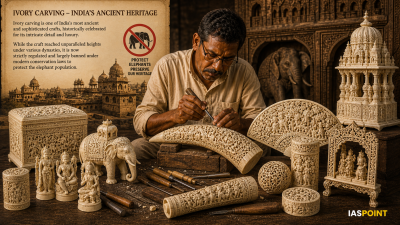
Ivory carving is one of India’s most ancient and sophisticated crafts, historically celebrated for its intricate detail and luxury. While the craft reached unparalleled heights under various dynasties, it is now strictly regulated and largely banned under modern conservation laws to protect the elephant population.
Historical Evolution of Ivory Carving
Ivory has been a medium of artistic expression in India for over five millennia, evolving from simple tools to complex sculptural masterpieces.
Ancient India
- Indus Valley Civilization (2500–1700 BC): Ivory was used for making animal figurines, jewelry, dice, hairpins, and combs. Artifacts found at Harappa and Mohenjo-Daro suggest a well-established ivory industry.
- Mauryan and Shunga Periods: Ivory was used for making snuffle rings for horse bridles and royal seals. Guilds of ivory carvers (Dantakaras) are mentioned in early Buddhist literature and inscriptions (e.g., Sanchi Stupa).
- Kushana Period: High-quality ivory combs and plaques have been found near Taxila (modern Pakistan) and Begram, showing Greco-Roman and Indian stylistic influences.
- Trade: Indian ivory was a major export to the Persian court of Darius I (6th Century BC) and the Roman Empire.
Medieval and Early Modern India
- Mughal Era (16th–19th Century): The craft flourished under royal patronage. Mughals introduced Persian styles, focusing on floral motifs and painting on ivory. Popular items included gunpowder flasks, dagger hilts, and back-scratchers.
- Regional Flourishing (13th–18th Century):
- Odisha: Produced some of the world’s finest ivory objects, including ornate throne legs, palanquins, and erotic sculptures.
- South India (Travancore & Mysore): Specialized in ivory shrines and deities (e.g., the Dashavatara shrine).
- Murshidabad (Bengal): Famous for ivory “Peacock Barges” (Mayurpankhi) and bullock carts.
Major Centers and Traditional Styles
Historically, different regions developed unique specializations in ivory work:
| Region | Key Characteristics / Famous Products |
| Murshidabad (WB) | Intricate models of boats (Mayurpankhi), elephants with howdahs, and bullock carts. |
| Mysore (Karnataka) | Inlay work in rosewood; carving of Hindu deities and royal emblems. |
| Kerala (Travancore) | Carving of realistic human and divine figures; focus on Christian and Hindu icons. |
| Odisha | Famous for the “Gaja-Simha” (Elephant-Lion) motif and intricate furniture legs. |
| Delhi & Jaipur | Known for Mughal-style miniature paintings on ivory sheets and jewelry boxes. |
| Varanasi (UP) | Small decorative toys, bangles, and cigarette holders (historically). |
Legal Framework and Conservation
The trade and craft of ivory in India are now governed by stringent domestic and international laws due to the endangered status of the Asian Elephant (Elephas maximus).
Domestic Legislation
- Wild Life (Protection) Act, 1972 (WPA):
- Elephants are listed under Schedule I, providing them the highest level of legal protection.
- Section 40 & 42: Restricts the ownership and transfer of ivory.
- 1986 & 1991 Amendments: Effectively banned the trade in Indian ivory and later prohibited the trade in “imported ivory” (African ivory) to curb poaching.
- Government Property: Any ivory found or seized is considered the property of the State.
International Regulations
- CITES (Convention on International Trade in Endangered Species):
- India joined CITES in 1976.
- Asian Elephants have been in Appendix I since 1975, which prohibits all commercial international trade.
- In 1989, African elephants were also moved to Appendix I, leading to a global ban on commercial ivory trade.
- MIKE (Monitoring the Illegal Killing of Elephants): An international program under CITES to track poaching trends; India participates with several designated MIKE sites (e.g., Chirang-Ripu in Assam, Mayurbhanj in Odisha).
Technical Facts and Trivia for UPSC
- Composition: Ivory is primarily composed of dentine. While elephant tusks are the primary source, the term can technically apply to the teeth of walruses, hippos, and narwhals.
- The Begram Ivories: A famous collection of ivory plaques discovered in Afghanistan (1st century AD) that demonstrates the wide reach and influence of Indian ivory craftsmanship in antiquity.
- Guild System: Ancient Indian inscriptions (like those at Sanchi) record that the guild of ivory carvers from Vidisha donated a portion of the stone carvings for the Great Stupa, showcasing their wealth and social standing.
- Substitution: Due to the ban, traditional carvers have largely shifted to alternative materials such as Sandalwood, Rosewood, or Camel Bone to mimic the texture of ivory.
- Cultural Symbolism: In Indian culture, the elephant is associated with Lord Ganesha (remover of obstacles) and Airavata (the mount of Indra), making ivory a material of spiritual and royal significance.
Contemporary Status
The traditional craft of ivory carving is considered a “dying art” in the formal sense. Artisans who once belonged to ivory-carving families now produce bone-carved replicas or wood-inlay work. Government museums, such as the National Museum in New Delhi, house the most significant collections of historical ivory artifacts, preserving the heritage for public viewing.
Last Modified: May 5, 2026