
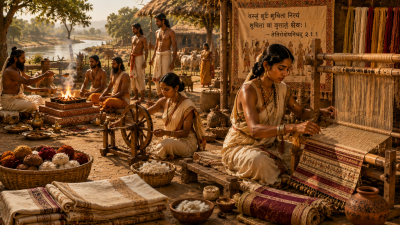
The Vedic Period (c. 1500–600 BCE) witnessed the transition from the pastoral lifestyle of the Early Vedic (Rig Vedic) era to the settled, agrarian, and urbanizing society of the Later Vedic era. Textiles during this period were not merely functional but were deeply intertwined with ritualistic purity, social hierarchy, and the evolving aesthetic of the Indo-Aryan civilization.
Primary Raw Materials and Fibers
The Vedic people utilized a variety of natural fibers, with a significant emphasis on animal hair and plant-based materials.
- Urna (Wool): The most frequently mentioned fiber in the Rig Veda. Sheep were reared in the Gandhara region (modern-day Pakistan/Afghanistan) for their high-quality wool.
- Karpasa (Cotton): While cotton was the mainstay of the Indus Valley, its mention in early Vedic texts is limited, becoming more prominent in the Later Vedic period.
- Kshauma (Linen/Flax): Derived from the stalks of the flax plant, this fabric was prized for its luster and was often used in ritualistic ceremonies.
- Tarpya: A special type of silken or linen garment mentioned in the Brahmanas, often associated with royal rituals like the Rajasuya sacrifice.
- Hiranya-Drapi: References to “golden cloaks” suggest the use of gold threads or wire (Zari precursors) woven into garments for the nobility.
The Three-Piece Attire: Vedic Clothing Structure
Clothing in the Vedic period was generally unstitched, consisting of three primary components that defined the standard silhouette for both men and women.
| Component | Description |
| Nivi | The innermost garment or undergarment, wrapped around the hips and fastened with a knot. |
| Vasas | The lower garment or main body covering, similar to a dhoti or a wrap-around skirt. |
| Adhivasa | An upper garment or cloak/shawl draped over the shoulders, often elaborately decorated. |
| Atka | A garment mentioned in the Rig Veda that functioned as a close-fitting tunic or a long robe. |
| Usnisa | A turban or headgear worn by both sexes, signifying status and used during sacrificial rites. |
Weaving and Craftsmanship (Vaya)
Textile production was a domestic craft that eventually evolved into a specialized profession as the society moved toward the Mahajanapada era.
- Weaving as a Female Domain: In the Early Vedic period, weaving (Vaya) was primarily a feminine pursuit. The Rig Veda uses the metaphor of “Night and Day” as two sisters weaving the “web of the year.”
- Professionalization: Terms like Vayitri (female weaver) and Siri (female weaver of gold thread) appear in the texts. By the Later Vedic period, specialized guilds began to form.
- The Loom: The loom was referred to as Veman, and the shuttle used for weaving was called Tasara.
- Embroidery: The term Peshas refers to embroidered garments. A Peshaskari was a female embroiderer who decorated the borders and bodies of garments with intricate designs.
Dyeing and Aesthetics
The Vedic people had a sophisticated understanding of natural dyes and color symbolism.
- Colors: Frequently mentioned colors include Parivasa (white), Maharajat (saffron/gold), and Nila (blue).
- Ritual Colors: Red was often associated with fertility and life, while white represented purity (Sattva). Saffron-dyed garments were typically reserved for the warrior class (Kshatriyas) and later, ascetics.
- Vegetal Dyes: Dyes were extracted from flowers like Kusumbha (safflower) and madder.
Socio-Religious Significance of Textiles
In Vedic culture, clothing was a marker of Dharma (duty) and Varna (social order).
- Sacrificial Purity: During Yagyas (sacrifices), the sacrificer and his wife were required to wear new, unwashed Kshauma (linen) or Urna (wool) garments to maintain ritual purity.
- Upayana Ceremony: The sacred thread ceremony involved specific types of skins or fabrics based on the Varna: Brahmins wore black antelope skin (Ajina), Kshatriyas wore spotted deer skin, and Vaishyas wore goat skin.
- Transition to Stitched Clothing: While unstitched fabric remained the norm for rituals, the contact with Central Asian tribes toward the end of the Vedic period introduced rudimentary stitching and tailored garments.
Important Facts for UPSC Prelims
- Gandhari Wool: The Rig Veda specifically praises the wool from the sheep of the Gandhara region for its softness.
- Shulba Sutras: These texts, while primarily mathematical, provide indirect evidence of the precision required in creating patterns for ritualistic cloths and altars.
- The Term ‘Vastra’: It is the generic Vedic term for clothing, which evolved into the modern Hindi word ‘Vastra’.
- Skin Garments: The term Ajina refers to the use of animal skins, particularly by Rishis (sages) and ascetics, symbolizing their connection to nature and rejection of urban luxury.