
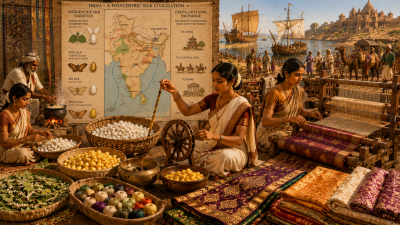
The evolution of silk in India is a saga of indigenous biological diversity and cross-cultural exchange. Unlike the monopolistic “Seres” (Chinese) silk tradition, India developed a unique polycentric silk culture involving both domesticated and wild varieties.
Early Evidence and Indigenous Origins
- Harappan Silk: Microscopic analysis of copper ornaments from Harappa and Chanhu-daro (c. 2500 BCE) revealed silk fibers from the Antheraea species (wild silk), proving that silk production predates the formalized Silk Road in India.
- Vedic References: Ancient texts mention Kausheya (silk from cocoons) and Chinasura (Chinese silk), distinguishing between local wild silk and imported mulberry silk.
- Classical Literature: The Manusmriti and Arthashastra categorize silk as a “pure” fabric, establishing its role in Hindu ritualistic life.
Biological Diversity: The Four Commercial Silks
India is the only country in the world that commercially produces all four known varieties of silk.
| Silk Type | Source Silkworm | Primary Regions | Characteristics |
| Mulberry | Bombyx mori | Karnataka, Andhra Pradesh, Tamil Nadu, West Bengal | Soft, lustrous, and most common; accounts for 70% of production. |
| Eri | Samia ricini | Assam, Meghalaya (North East) | Known as “Peace Silk” or “Ahimsa Silk” because the moth leaves the cocoon naturally. |
| Tasar | Antheraea paphia | Jharkhand, Chhattisgarh, Odisha | Copperish color, coarse texture; produced by wild silkworms feeding on Asan/Arjun trees. |
| Muga | Antheraea assamensis | Assam (Endemic) | Naturally golden, high durability; recently granted a Geographical Indication (GI) tag. |
Evolution Through the Medieval and Mughal Eras
The medieval period saw the refinement of silk weaving techniques and the establishment of “Karkhanas” (royal workshops).
- Sultanate Influence: The introduction of the horizontal draw-loom facilitated the weaving of complex patterns and figured silks.
- Mughal Patronage: Emperors like Akbar and Shah Jahan incentivized Persian weavers to settle in India. This led to the birth of Zari (metallic thread) work and the Kinkhwab (brocade), which literally translates to “a fabric of dreams.”
- Regional Specialization:
- Varanasi (Banaras): Became the hub for heavy silk brocades and floral “Butidar” patterns.
- Gujarat (Patan): Developed the Patola, a double-ikat silk weaving technique involving high-precision geometry.
- Paithan: Under the Marathas, developed the Paithani silk with its signature peacock motifs and solid gold borders.
The Colonial Impact and Industrial Transition
The British East India Company shifted the focus of Indian silk from finished goods to the export of raw silk to feed European mills.
- Bengal Silk Industry: The British heavily promoted mulberry cultivation in Murshidabad and Rajshahi to compete with Italian and French silk.
- Tipu Sultan’s Contribution: In the late 18th century, Tipu Sultan sent emissaries to Bengal and Persia to bring silkworms and technology to Mysore, laying the foundation for Karnataka becoming India’s largest silk producer today.
- Decline of Weavers: High colonial taxes and the influx of factory-made European fabrics led to the “de-industrialization” of traditional silk weaving centers in the 19th century.
Post-Independence and Modern Sericulture
Since 1947, India has focused on scientific sericulture and the protection of traditional weavers through legislative frameworks.
- Central Silk Board (1948): A statutory body established under the Ministry of Textiles to coordinate research, development, and quality control.
- Silk Mark Organization of India: Created to protect consumers from synthetic imitations and ensure the purity of natural silk.
- The Ahimsa Silk Movement: Popularized by Kusuma Rajaiah in the 1990s, this technique involves harvesting silk without killing the pupae, aligning with Gandhian principles of non-violence.
GI Tags in Indian Silk (UPSC Fact List)
The Geographical Indication (GI) tag protects the unique identity of regional silk traditions.
- Muga Silk: Assam (The only golden silk in the world).
- Kancheepuram Silk: Tamil Nadu (Known for heavy borders and “Temple” motifs).
- Chanderi Silk: Madhya Pradesh (A blend of silk and cotton with sheer texture).
- Bhagalpuri Silk: Bihar (Also known as “Tussar” silk city).
- Mysore Silk: Karnataka (Known for minimalist designs and pure gold zari).
- Salem Silk: Tamil Nadu (Famous for its white silk ‘dhoti’ with gold borders).
Key Facts for UPSC Prelims
- Global Standing: India is the second-largest producer of silk globally, after China, and the largest consumer of silk.
- Vanya Silk: A term used for “Wild Silks” (Tasar, Eri, and Muga), which are primarily produced by tribal communities in India’s forest belts.
- Seri-biotechnology: Recent advancements include the development of “Bivoltine” silkworm hybrids that produce high-quality silk comparable to international standards.
- Silk Road Legacy: While the northern Silk Road bypassed the Indian heartland, the “Maritime Silk Road” and the “Southern Silk Road” (through Yunnan to Assam) were critical for the exchange of Indian textiles.