
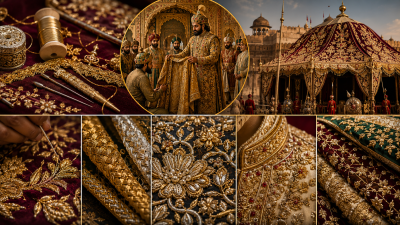
The integration of metals into textiles, known as Zardozi or Zari work, represents the pinnacle of luxury in Indian heritage. While the use of gold and silver threads is mentioned in the Rig Veda as Hiranya-Drapi (golden cloaks), the craft reached its technical zenith during the Mughal Era. Historically, these textiles were not merely attire but symbols of political power, used for royal tents, canopies, and “Robes of Honor” (Khilat).
The Anatomy of Zari: Materials and Composition
Zari is the primary metallic thread used in Indian weaving and embroidery. Its quality is traditionally categorized based on the purity of the metal used.
- Real Zari: Made of pure silver wire drawn from silver bars, which is then flattened and wound around a silk yarn core. For gold Zari, the silver wire is electroplated with unadulterated gold.
- Imitation Zari: Uses copper wire electroplated with silver or gold; it is more economical and widely used in contemporary handlooms.
- Metallic Zari (Plastic Zari): A modern invention using polyester metallized film, which is durable and resistant to tarnishing, but lacks the prestige of real Zari.
Major Forms of Metal-Based Textile Crafts
| Craft Name | Primary Region | Technique and Material |
| Zardozi | Lucknow, Agra, Delhi | Heavy 3D embroidery using Salma (coils), Sitara (spangles), and Badla (flat wire). |
| Gota Patti | Rajasthan (Jaipur) | Appliqué technique using small pieces of gold/silver ribbon (Gota) to create floral patterns. |
| Kinkhwab | Varanasi | A heavy brocade where the Zari is so dense that the silk base is barely visible. |
| Mukaish/Badla | Lucknow | Metal wire is twisted into tiny dots (Fardi) or patterns, usually on fine chiffon or muslin. |
| Kashmiri Tilla | Kashmir | Gold or silver thread embroidery traditionally used on Pherans and shawls, using a specialized needle. |
Regional Specializations and Weaving Styles
Metal crafts are often inseparable from the weaving traditions of specific geographic clusters.
Varanasi (Banaras) Brocades
Varanasi is the global hub for Zari-weaving. The Karwa or Jala technique allows for the integration of metallic threads into the warp and weft to create motifs like Asharfi (coin), Shikargah (hunting scenes), and Jhallar (borders).
Paithani (Maharashtra)
Known for its “Solid Gold” borders and Pallus. The Zari used in Paithani was historically made from pure silver and gold, woven with silk to create motifs like the Bangadi-mor (peacock in a bangle).
Kanjeevaram (Tamil Nadu)
In Kanjeevaram sarees, the Zari is traditionally a silk thread twisted with a silver wire and then gilded with gold. A distinguishing factor is the three-ply silk and the heavy metallic content, which makes these sarees significantly heavier than their northern counterparts.
Surface Ornamentation Techniques
Beyond weaving, metal is applied to the surface of the finished fabric through various specialized tools.
- Aari Work: Utilizes a long hooked needle to create fine chain stitches using Zari. It is common in Kutch (Gujarat) and Delhi.
- Dabka Work: A type of Zardozi that uses a thin, tightly coiled metal wire. The wire is cut into small pieces and sewn onto the fabric like a bead, creating a high-relief effect.
- Salma-Sitara: A combination of “Salma” (gold wires) and “Sitara” (small metallic stars or sequins), frequently seen in Rajasthani bridal wear.
The Socio-Economic Significance and GI Tags
The metal craft industry provides a livelihood for millions of artisans, particularly in the Oudh and Deccan regions. To protect the purity and legacy of these crafts, the Government of India has granted several Geographical Indication (GI) tags:
- Lucknow Zardozi: Recognized for its unique five-step process involving Karchob (wooden frame).
- Surat Zari: Surat is the world’s largest producer of Zari threads and has a GI tag for its specialized manufacturing process.
- Varanasi Glass Beads: While not a textile, these are often integrated into metallic textile handicrafts.
UPSC Fact-File and Trivia
- The ‘Parsi Gara’ Connection: Parsi embroidery often combines Chinese motifs with Indian Zardozi techniques, creating a unique cross-cultural metallic textile.
- Dabka vs. Nakshi: While both are coiled wires, Dabka is smooth and round, whereas Nakshi is faceted to reflect light more brilliantly.
- Testing Purity: In traditional markets, Real Zari is often tested by burning a small piece of the thread; if it leaves behind a pure silver or gold bead without a chemical smell, it is considered authentic.
- Vocal for Local: The “One District One Product” (ODOP) scheme heavily promotes Zari-Zardozi from districts like Bareilly, Shahjahanpur, and Lucknow to boost exports.