
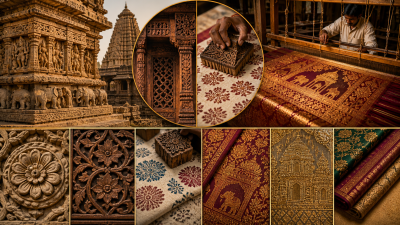
Indian textile traditions have long been intertwined with secondary crafts like stone and wood, creating a symbiotic relationship between architecture and fabric. Historically, motifs found in 11th-century temple friezes and medieval wooden palaces have directly influenced the patterns of Indian weaves. This intersection is most visible in the development of block printing (wood) and the architectural inspiration behind heavy silk weaving (stone).
Wood Craft in Textiles: The Art of Block Printing
The most direct application of wood craft in textiles is through Khat (Wood Blocks). This involves precision carving of seasoned teak or shisham wood by specialized artisans known as Phetia.
Techniques and Regions
- Ajrakh (Gujarat/Rajasthan): Utilizes complex geometric wooden blocks to print patterns on both sides of the fabric. The wood blocks must align perfectly to maintain the mathematical symmetry characteristic of Islamic architecture.
- Sanganeri and Bagru (Rajasthan): Known for fine floral patterns (Butas) and zigzag lines (Leheriyas). Sanganer uses white backgrounds, while Bagru uses indigo and earthy tones.
- Kalamkari (Andhra Pradesh): While known for pen-work, the Machilipatnam style uses intricate wooden blocks for outlining figures before hand-painting.
Technical Specifications of Block Making
| Feature | Description |
| Material | Teak, Shisham (Indian Rosewood), or Rohida. |
| Preparation | Wood is soaked in oil for 10–15 days to prevent warping and increase durability. |
| Design Types | Rekh (outline block), Gad (background filling block), and Datta (color filling block). |
| Air Vents | Small holes are drilled through the blocks to allow air to escape, ensuring uniform dye application. |
Stone Craft Influence: Architectural Motifs in Weaving
While stone is not used to print on fabric directly, Indian stone architecture provides the visual vocabulary for traditional weaves. The rigidity of stone carving is translated into the fluidity of thread through intricate drafting techniques.
Architectural Parallels in Textiles
- Temple Borders (Kanchipuram): The ‘Gopuram’ or temple tower motif is a hallmark of Tamil Nadu’s silk sarees. The triangular patterns (Mokku) mimic the tiered stone structures of Dravidian temples.
- Jali Work (Chanderi/Maheshwari): The intricate stone latticework found in Mughal and Rajput monuments is replicated in the ‘Jali’ patterns of Chanderi sarees.
- Paithani Motifs: The ‘Asavali’ (flowering vine) motif seen in Paithani sarees is inspired by the stone carvings of the Ajanta and Ellora caves in Maharashtra.
Tools and Ancillary Crafts
The production of textiles relies on wooden implements that are masterpieces of woodcraft in their own right.
- The Charkha: A wooden spinning wheel, ranging from the traditional large floor models to the portable Amber Charkha.
- Handlooms (Pit Looms/Frame Looms): Constructed primarily from seasoned wood like Sal or Teak. The ‘Heddle’ and ‘Reed’ (often made of fine bamboo or wood) are critical for thread tension.
- Stone Beaters: In certain indigenous tribal weaving traditions of Northeast India, smooth river stones are used to beat and flatten the weave, or as weights to maintain warp tension.
Fact Sheet for UPSC Prelims
- GI Tagged Blocks: Pethapur in Gujarat is renowned as the “Hub of Wood Block Making” and holds a Geographical Indication (GI) tag for its craftsmanship.
- Phulkaris and Wood: In Punjab, wooden blocks were historically used to mark patterns on the fabric before the manual embroidery was executed.
- Toda Embroidery: This craft from the Nilgiris mimics the stone-wall patterns of Toda huts (Dogles), using a counting-thread method that creates a structured, geometric appearance.
- Chamba Rumal: The patterns are often based on the wall paintings and stone carvings of the Lakshmi Narayan Temple in Chamba.
Regional Distribution of Integrated Crafts
- Farrukhabad (UP): Famous for large-scale wooden block making, specifically for bedspreads and heavy drapery.
- Kumbakonam (Tamil Nadu): A center where the wood-carving of temple chariots (Rathas) and the weaving of silk sarees share the same artisan guilds, leading to a cross-pollination of designs.
- Dhamadka (Gujarat): A primary center for Ajrakh block printing where wooden blocks are treated as sacred tools.
Modern Conservation and Challenges
The shift toward screen printing and digital printing has reduced the demand for high-quality wooden blocks. However, initiatives by the Development Commissioner for Handicrafts and organizations like Dastkar aim to preserve these “tools of the trade” as heritage artifacts. The sustainability of wood-based textile crafts is now being linked to the planting of fast-growing sustainable timber to ensure the raw material for block makers remains available.
Last Modified: May 6, 2026