
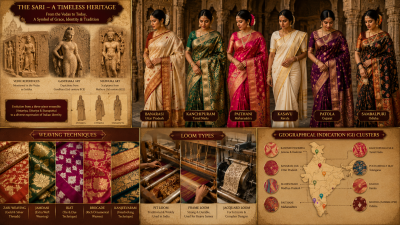
The Sari (derived from the Sanskrit Sattika) represents one of the world’s oldest continuously worn garments. Historically mentioned in the Vedas and depicted in Gandhara and Mathura art, the sari has evolved from a simple three-piece set (Antariya, Uttariya, and Stanapatta) into a sophisticated symbol of regional identity. In the Indian Art and Heritage context, sari traditions are classified by their weaving techniques, loom types, and the distinct geographical clusters that hold Geographical Indication (GI) status.
Northern Indian Traditions: Architectural Grandeur and Zari
The Northern belt is characterized by heavy ornamentation, Persian influences (introduced during the Sultanate and Mughal eras), and the use of high-quality silk and metallic threads.
- Banarasi Silk (Uttar Pradesh): Known for Kalabattu (gold/silver silk threads). Key features include Jhallar (upright leaf motifs at the border) and Amru (pure silk without zari).
- Chanderi (Madhya Pradesh): Famed for its “woven air” quality. It uses a blend of silk and fine cotton with Nalferma (floral) motifs and a characteristic translucent texture.
- Maheshwari (Madhya Pradesh): Traditionally featuring reversible borders (Bugdi), these saris were popularized by Queen Ahilyabai Holkar. The designs are inspired by the stone carvings of Maheshwar Fort.
- Kota Doria (Rajasthan): Recognized by the Khat (square pit) pattern. The weaver uses a blend of cotton for strength and silk for luster.
Western Indian Traditions: Tie-Dye and Complex Geometry
Western traditions focus on resistance-dyeing techniques and the use of indigenous flora and fauna in motifs.
- Patola (Gujarat): A “Double Ikkat” silk sari where both warp and weft are dyed before weaving. The Patan Patola is famous for its mathematical precision—if a thread is displaced, the entire pattern fails.
- Paithani (Maharashtra): Known for the Kath (border) and Padar (pallu) made of pure silk and gold. Signature motifs include the Muniya (parrot) and Ajanta lotus.
- Bandhani and Leheriya (Gujarat/Rajasthan): A tie-dye technique (Bandhej). Bandhani involves “dots” while Leheriya involves diagonal “waves” representing water.
- Gharchola (Gujarat): A grid-patterned sari traditionally gifted by mothers-in-law to brides, symbolizing the joining of two families.
Southern Indian Traditions: Temple Motifs and Heavy Silk
Southern saris are distinguished by their “Temple Borders” (Gopuram), heavy ply silk, and the use of the Kora (unbleached) silk technique.
- Kanchipuram (Tamil Nadu): Distinguished by the Korvai technique where the border and pallu are woven separately and then joined to the body. It uses three plies of silk and heavy gold zari.
- Kasavu (Kerala): The Mundu-Veshti tradition. It is characterized by its plain off-white cotton base and a thick gold border (Sarkara).
- Pochampally and Gadwal (Telangana): Pochampally uses “Single Ikkat” (where only the warp or weft is dyed). Gadwal saris are unique for having a cotton body and a silk border/pallu joined by the Kutthi stitch.
- Mysore Silk (Karnataka): Known for its minimalist elegance and high-quality mulberry silk, often featuring solid colors with gold borders.
Eastern and North-Eastern Traditions: Tribal Art and Fine Muslin
The East focuses on supplementary weft techniques and the use of wild silks like Muga and Tussar.
- Jamdani (West Bengal): A “discontinuous supplementary weft” technique. It is often called “figured muslin,” where motifs appear to float on the transparent fabric.
- Baluchari (West Bengal): Famous for depicting scenes from the Ramayana and Mahabharata on the Pallu. Historically produced in Murshidabad.
- Sambalpuri (Odisha): Uses the Bandha (Ikkat) technique. Distinctive motifs include the Shankha (shell) and Chakra (wheel).
- Muga Silk (Assam): Naturally golden silk derived from the Antheraea assamensis silkworm. It is known for its extreme durability and luster that increases with every wash.
Comparative Matrix of Major Sari Traditions
| Sari Type | Region | Primary Material | Unique Technique |
| Banarasi | Uttar Pradesh | Silk | Naksha (Draw-loom) / Zari |
| Patan Patola | Gujarat | Silk | Double Ikkat (Warp & Weft dye) |
| Kanchipuram | Tamil Nadu | Mulberry Silk | Korvai (Interlocking joint) |
| Jamdani | West Bengal | Fine Cotton | Supplementary Weft (Hand-needle) |
| Muga | Assam | Wild Silk | Natural Golden Pigment |
| Pochampally | Telangana | Silk/Cotton | Single Ikkat (Tie-dye) |
Key Motifs and Symbolic Meanings
- Buti: Small floral sprigs representing fertility and nature.
- Kalash: A water pot motif signifying prosperity.
- Hans (Swan): A symbol of spiritual purity and wisdom (Saraswati).
- Paisley (Kalka/Keri): A mango-shaped motif representing the cycle of life.
- Rudraksha: A seed motif often found in the borders of Odisha and South Indian saris, representing Lord Shiva.
Fact Sheet for UPSC Prelims
- GI Tag Hub: Sanganer (Rajasthan), Chanderi (MP), and Kanchipuram (TN) were among the earliest textile traditions to receive the Geographical Indication tag.
- The “Vishwa Shanti” Sari: Traditionally, Odisha weavers create saris with the verses of Gita Govinda woven into the fabric.
- UNESCO Recognition: The traditional art of Jamdani weaving has been inscribed on the UNESCO Representative List of the Intangible Cultural Heritage of Humanity.
- The Tanechoi Technique: Introduced by three Parsi brothers (the Choi brothers) who learned the technique in China; it is a specialized Banarasi silk that features no floats on the back of the fabric.
- Paithani’s “Tapestry” Look: Because the weft is woven with multiple colored threads using small shuttles (Tilis), the reverse of a Paithani looks exactly like the front.