
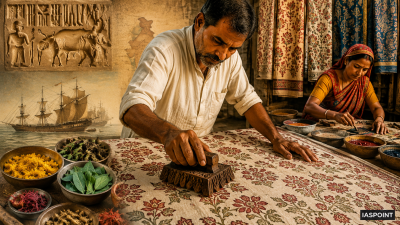
Textile printing in India is an ancient craft, with archaeological evidence from the Indus Valley Civilization suggesting the use of mordants and vegetable dyes. Historically, India was the world’s primary exporter of printed cottons, known as “Chintz” in Europe and “Sarasa” in Japan. The craft is deeply rooted in the socio-cultural fabric of various communities, often using indigenous knowledge passed down through generations.
Classification of Printing Techniques
Indian textile printing can be broadly categorized into three distinct methods based on the application of color and design.
- Block Printing: The most traditional form, involving the use of hand-carved wooden blocks to press designs onto fabric.
- Resist Printing: Involves applying a substance (wax, clay, or tie) to the fabric to prevent dye from reaching certain areas.
- Discharge Printing: A process where chemicals are used to remove color from a pre-dyed fabric to create a pattern.
Major Regional Traditions of Block Printing
Block printing is synonymous with the North-Western belt of India, particularly Rajasthan and Gujarat. Each center has a distinct visual language.
| Tradition | State | Unique Characteristics |
| Sanganeri | Rajasthan | Uses white or off-white backgrounds with delicate floral (buttas) and folk motifs. Does not use a resist; uses direct printing. |
| Bagru | Rajasthan | Characterized by dark backgrounds (indigo or black) and bold geometric or floral patterns. Employs the ‘Dabu’ resist technique. |
| Ajrakh | Gujarat/Sindh | Complex geometric patterns printed on both sides of the fabric (double-sided). Uses deep crimson and indigo dyes. |
| Farrukhabad | Uttar Pradesh | Known for the “Tree of Life” motif and bold, large-scale prints often used for bedspreads and curtains. |
| Bagh | Madhya Pradesh | Uses black and red natural dyes on white or cream backgrounds. Geometric and floral patterns are inspired by nature and local architecture. |
Resist Printing Traditions: Dabu and Kalamkari
Resist printing showcases the chemical and artistic ingenuity of Indian artisans through the use of natural barriers.
Dabu Printing
Originating from Akola in Rajasthan, Dabu is a mud-resist hand-block printing technique.
- The Process: A thick paste of clay, sawdust, and guar gum is applied using blocks. After the fabric is dyed, the “Dabu” area remains white or the original color.
- Visual Aesthetic: It produces a unique “cracked” look where the dye seeps into the dried mud, giving it a rustic appeal.
Kalamkari (Srikalahasti and Machilipatnam)
Kalamkari translates to “pen-work.” It is a unique blend of printing and hand-painting.
- Machilipatnam Style: Involves the use of wooden blocks to create the outlines and main patterns, primarily found in Andhra Pradesh.
- Srikalahasti Style: Entirely hand-drawn using a bamboo pen (kalam). This style is deeply religious, often depicting scenes from the Ramayana and Mahabharata.
Tie and Dye (Bandhani and Leheriya)
Though often categorized under weaving/dyeing, these techniques are essential forms of pattern-making on textiles.
- Bandhani (Gujarat/Rajasthan): Involves tying tiny knots on the fabric with thread before dyeing. The finer the knots, the more expensive the fabric. Major centers include Jamnagar and Bhuj.
- Leheriya (Rajasthan): A unique technique resulting in diagonal stripes that resemble waves (Leher). It is traditionally practiced in Jaipur and Jodhpur.
- Shibori Influence: While Japanese, many Indian clusters in Gujarat have integrated Shibori-style stitch-resist printing into their traditional repertoire.
Natural Dyes and Minerals in Indian Printing
A hallmark of traditional Indian printing is the exclusive use of natural sources for color, which ensures the textiles are eco-friendly and skin-safe.
- Indigo (Blue): Derived from the Indigofera tinctoria plant.
- Madder/Manjistha (Red): Extracted from the roots of the Rubia cordifolia plant.
- Hardat/Myrobalan (Yellow/Black): Used as a mordant and for yellow hues.
- Iron Filings (Black): Fermented with jaggery to produce deep black ink (Syuhi).
- Alum: The most common mordant used to fix dyes to the fiber.
Challenges and Modern Innovations
The printing industry faces competition from screen printing and digital printing, which are faster and cheaper but lack the soul of hand-crafted textiles.
- Screen Printing: While mimicking block designs, it lacks the depth and slight irregularities that define authentic hand-block prints.
- Digital Printing: Used for high-fashion “Fast Fashion” garments, it can replicate complex Kalamkari motifs without the labor-intensive natural dyeing process.
- Sustainable Shifts: There is a renewed global demand for “Slow Fashion,” leading to the revival of natural indigo vats and organic cotton printing in clusters like Bagru and Ajrakhpur.
UPSC Trivia and Key Facts
- GI Tags: Several printing traditions hold Geographical Indication tags, including Bagh Prints (MP), Ajrakh (Gujarat), and Sanganeri Hand Block Prints (Rajasthan).
- Khatri Community: The Khatri community of Gujarat and Rajasthan is historically the primary practitioner of the Ajrakh and Bandhani crafts.
- Mata ni Pachedi: Often called the “Kalamkari of Gujarat,” this is a sacred textile printing/painting tradition used to create temple hangings for the Mother Goddess.
- Role of Water: The chemical composition of local water (iron or calcium content) in rivers like the Jojari (Rajasthan) or Baghini (MP) is crucial for the final shade of the natural dyes.