
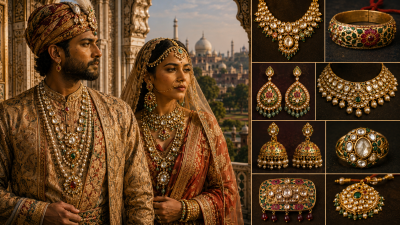
The Medieval period (c. 8th to 18th Century CE) witnessed a radical transformation in Indian jewellery. The arrival of the Delhi Sultanate and later the Mughal Empire introduced Persian and Central Asian motifs, which fused with indigenous Hindu and Buddhist traditions. This era is defined by the transition from purely gold-based ornaments to the extensive use of uncut gemstones and the mastery of enameling.
The Sultanate Period: Cross-Cultural Aesthetics
Under the Delhi Sultanate, jewellery design began to move away from the figurative sculptures of the Gupta era toward geometric and floral patterns, adhering to Islamic artistic sensibilities.
- Materials: Increased use of turquoise, lapis lazuli, and spinels imported via the Silk Road.
- Techniques: The introduction of more sophisticated stone-setting methods and the increased use of silver in daily ornamentation.
- Key Ornaments: The Sarpech (turban ornament) and the Guluband (choker) began to take their proto-modern forms during this period.
The Mughal Era: The Zenith of Lapidary Excellence
The Mughals were connoisseurs of gemstones, viewing them not just as wealth but as spiritual and cosmic entities. Under patrons like Akbar, Jahangir, and Shah Jahan, India became the global center for jewellery craftsmanship.
The Development of Kundan and Meenakari
The Mughals perfected two specific techniques that remain the hallmark of Indian jewellery today:
- Kundan Setting: A method of setting stones where highly refined, 24k gold foil (Kundan) is pressed around the stone at room temperature. This allowed for the setting of uncut “Polki” diamonds without the need for high-heat soldering.
- Meenakari (Enameling): Introduced by Persian artisans, this involved fusing colored glass minerals onto metal surfaces. Usually, the reverse side of a Kundan-set ornament was decorated with Meenakari, making the piece a reversible work of art.
Imperial Gemology and the “Great Mughals”
The Mughal treasury was arguably the wealthiest in the world, holding legendary stones that are now part of global history.
| Famous Gemstone | History and Significance |
| Koh-i-Noor | “Mountain of Light”; likely mined in Kollur. Passed from the Kakatiyas to the Mughals, later taken by Nadir Shah. |
| Darya-i-Noor | “Sea of Light”; one of the largest pink diamonds in the world, once part of the Mughal collection. |
| Shah Jahan Diamond | A table-cut diamond engraved with the Emperor’s name. |
| The Timur Ruby | Actually a red spinel; it bears inscriptions of various Mughal emperors including Jahangir and Aurangzeb. |
Regional Traditions in Medieval India
While the Mughal court set the trend in the North, distinct regional styles flourished in the South and West.
Vijayanagara and Nayaka Styles (South India)
- Temple Jewellery: Crafted primarily for deities and later adopted by Devadasis (temple dancers). It is characterized by heavy gold work with rubies, emeralds, and pearls.
- Manga Malai: A necklace featuring mango-shaped motifs, symbolizing fertility and prosperity.
- Thali/Mangalsutra: The regional evolution of the sacred wedding thread into elaborate gold pendants.
Rajputana Traditions (Rajasthan and Gujarat)
- Thewa Art: Originating in Pratapgarh, this involved fusing intricate gold foils onto colored glass.
- Aad: A traditional Rajasthani choker, often covering the entire neck, heavily encrusted with stones.
- Bichhiya and Pajeb: Elaborate silver ornaments for the feet, as gold was traditionally not worn below the waist in Rajput culture.
Classification of Medieval Ornaments by Anatomy
Head and Hair
- Jhummar/Passa: A fan-shaped ornament worn on the side of the head, a quintessential Mughal-Islamic contribution.
- Sisphul: A circular gold boss worn on the crown of the head.
- Tikary: A forehead ornament similar to the modern Maang Tikka.
Neck and Ears
- Kanusi: Ear ornaments with chains that hook into the hair to support the weight of heavy gems.
- Champa Kali: A necklace representing the buds of the Champaka flower.
- Panchmani/Satmani: Five-strand or seven-strand pearl necklaces.
Arms and Hands
- Bajuband: Armlets worn on the upper arm, often featuring a central “talisman” stone.
- Arsi: A thumb ring fitted with a mirror, allowing the wearer to discreetly view their face or the surroundings.
- Hathphul: A hand-chain connecting a bracelet to the finger rings.
Technical Trivia for UPSC Prelims
- Tavernier’s Travels: Jean-Baptiste Tavernier, a 17th-century French gem merchant, provided the most detailed Western accounts of Mughal gemstones and the Peacock Throne.
- The Peacock Throne (Takht-i-Taus): Commissioned by Shah Jahan, it was encrusted with hundreds of carats of emeralds, rubies, and the famous Koh-i-Noor.
- Jadau: This is the specialized craft of embedding stones into gold; a combination of the Kundan, Meenakari, and stone-setting processes.
- Golconda Mines: The primary source of the world’s finest diamonds during the Medieval period, located in the Krishna River basin.
- Varna of Gems: Despite Islamic influence, the Hindu classification of stones based on purity and “flaws” (as per the Agni Purana) continued to guide the local craftsmen.