
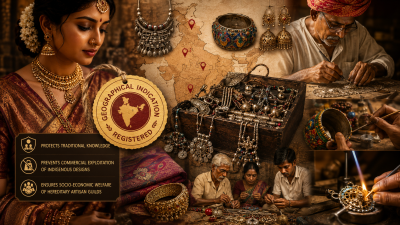
A Geographical Indication (GI) tag is a sign used on products that have a specific geographical origin and possess qualities or a reputation that are due to that origin. Under the Indian Jewellery and Ornamentation unit, GI tags protect traditional knowledge (TK), prevent the commercial exploitation of indigenous designs, and ensure the socio-economic welfare of hereditary artisan guilds.
Legal Framework and Significance for UPSC
- Governing Act: The Geographical Indications of Goods (Registration and Protection) Act, 1999.
- Administration: Controlled by the Controller General of Patents, Designs, and Trade Marks under the Ministry of Commerce and Industry.
- Validity: A GI tag is valid for a period of 10 years, renewable indefinitely.
- Heritage Preservation: In the context of Indian art and culture, GI tags safeguard the “intangible cultural heritage” associated with specific smelting, casting, and lapidary techniques.
Major GI Protected Jewellery Crafts of India
India possesses several GI-protected jewellery traditions, each defined by unique metallurgical compositions and regional aesthetics.
| GI Tagged Jewellery / Craft | State of Origin | Distinctive Feature |
| Cuttack Silver Filigree (Chandi Tarakasi) | Odisha | Intricate lace-like patterns made from drawn silver wires. |
| Pratapgarh Thewa Work | Rajasthan | Fusion of 23k gold film onto multicolored molten glass. |
| Karimnagar Silver Filigree | Telangana | Fine silver wire-work, historically patronized by the Nizams. |
| Bastar Dhokra | Chhattisgarh | Lost-wax metal casting featuring primitive, non-ferrous motifs. |
| Bidriware | Karnataka | Silver inlay on a blackened alloy of zinc and copper. |
| Temple Jewellery of Nagercoil | Tamil Nadu | Gold-leaf covered silver ornaments encrusted with ‘Kemp’ stones. |
| Mughal Silver Meenakari | Uttar Pradesh (Varanasi) | Pink enameling (Gulabi Meenakari) on silver surfaces. |
Detailed Technical Analysis of GI Jewellery Traditions
Cuttack Silver Filigree (Chandi Tarakasi)
- Technique: Artisans draw silver through series of smaller holes in a steel plate to create extremely thin wires (Tarakasi).
- Design Motifs: Predominantly features ‘Kadami’ flowers, peacocks, and chariot wheels inspired by the Konark Sun Temple.
- Historical Context: Believed to have links with Indonesian filigree traditions through ancient maritime trade routes (Bali Yatra).
Pratapgarh Thewa Work
- Materiality: Uses “Thewa Ki Patti” (thin gold sheets) and “Samosa” (colored glass).
- Process: The artisan (Raj-Soni) etches a design on a gold leaf and fuses it to glass using a secret heating process.
- Exclusivity: The technique is traditionally passed only from father to son within the Soni family of Pratapgarh.
Temple Jewellery of Nagercoil
- Composition: Historically crafted from silver and coated with gold leaf to ensure durability and affordability for temple dancers.
- Stones: Characterized by the use of red ‘Kemp’ stones (synthetic or natural rubies) and pearls.
- Cultural Use: Originally intended for decorating deities; now an essential part of the Bharatanatyam dance costume.
Bidriware (Bidar)
- Alloy: A unique combination of Zinc (approx. 94%) and Copper (approx. 6%).
- The Soil Secret: The final blackening of the ornament is achieved using soil from the unlit areas of the Bidar Fort, which contains oxidizing chemicals not found elsewhere.
- Inlay: Pure silver wire or sheets are hammered into the engraved grooves of the alloy.
Tribal GI Crafts: The Dhokra Tradition
Dhokra is the only tribal jewellery form in India with multiple regional GI registrations, highlighting the diversity of the “lost-wax” casting method.
- Bastar Dhokra (Chhattisgarh): Known for its minimalist, elongated human and animal figurines used in pendants and neckpieces.
- Adilabad Dhokra (Telangana): Often features bells and hollow anklets with intricate geometric mesh-work.
- Santi Niketan Dhokra (West Bengal): Influenced by the local Santhal motifs and often integrated with modern artistic sensibilities.
Comparative Study of Filigree: Cuttack vs. Karimnagar
| Feature | Cuttack Silver Filigree | Karimnagar Silver Filigree |
| History | Linked to maritime trade and Odisha temples. | Patronized by the Nizams of Hyderabad. |
| Wire Type | Focus on crimped and twisted wires. | Focus on flat and straight wire trellis. |
| Modern Application | Extensive use in Odissi dance jewellery. | Majorly used for utility items like Attardans and trays. |
Key Facts and Trivia for UPSC Prelims
- First GI Tag in India: Darjeeling Tea (2004), but Silver Filigree was among the earliest craft-based registrations.
- Varanasi Gulabi Meenakari: This is unique because unlike traditional Meenakari which uses multiple colors, the Varanasi style is dominated by a transparent pink enamel.
- Kemp Stones: The word ‘Kemp’ in Tamil refers to the color red; these stones are a staple in GI-protected South Indian jewellery.
- The Cire Perdue Process: The scientific name for the “lost-wax” technique used in Dhokra; it is considered the oldest known method of metal casting in the world.
- Sreemant Ornaments: In Maharashtra, the GI protection of certain traditional designs like the ‘Kolhapuri Saaj’ is currently under discussion to protect the interests of local goldsmiths.
Summary of GI Importance in Heritage Exams
- Economic Impact: GI tags allow Indian artisans to access international luxury markets (like the EU) with protected status.
- Authenticity: For a student of Art and Culture, GI tags serve as a verified list of “authentic” Indian traditions that have remained unchanged for centuries.
- UPSC Perspective: Questions often link the GI tag of a jewellery form with its corresponding state, dynasty, or specific technical term (e.g., Tarakasi or Bidri).