
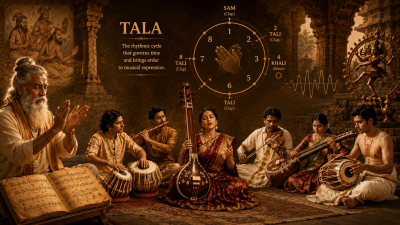
In the study of Indian Art, Culture, and Heritage, Tala (or Taal) represents the rhythmic framework that regulates the temporal aspect of music. While Raga provides the melodic soul, Tala provides the structural heartbeat. Derived from the Sanskrit word Tala (meaning palm), it originates from the ancient practice of clapping hands to keep time.
Philosophical and Vedic Origins
The concept of Tala is deeply rooted in the Vedic idea of Laya (rhythm/tempo), which mirrors the cosmic cycles of creation and destruction.
- Tandava and Lasya: Etymologically, “Tala” is often derived from the first syllables of Tandava (the vigorous dance of Shiva) and Lasya (the gentle dance of Parvati), symbolizing the union of male and female cosmic energies.
- Gandharva Veda: The primary Upaveda dealing with music and rhythm, establishing the mathematical precision of Indian percussion.
- Mridangam and Pushkara: Ancient texts like the Natya Shastra identify these as the primary instruments for maintaining Tala in antiquity.
Structural Components of a Tala (Angas)
A Tala is a cyclical rhythmic pattern consisting of a specific number of beats (Matras). To understand its complexity, one must recognize its constituent parts:
- Matra: The smallest unit of time (a beat).
- Vibhag (Khand): The division of a Tala into sections. In Hindustani music, these are marked by Tali (clap) and Khali (void/wave).
- Avartan: One complete cycle of the Tala from the first beat to the last.
- Sam: The first beat of the Tala cycle. In Hindustani music, it is the point of highest emphasis where the soloist and percussionist meet.
- Khali: An “empty” beat, usually indicated by a wave of the hand, serving as a structural marker to help the musician keep track of the cycle.
- Laya (Tempo): The speed of the performance, categorized into:
- Vilambit: Slow tempo (used in Khayal).
- Madhya: Medium tempo.
- Drut: Fast tempo.
Ten Elements of Tala (Tala Pranas)
Ancient treatises like the Sangita Ratnakara describe the Dashapranas (Ten Lifelines) of Tala, which are essential for its execution:
- Kala: Time units.
- Marga: The “path” or direction of the rhythm.
- Kriya: The physical act of keeping time (clapping or waving).
- Anga: The constituent limbs or parts.
- Graha: The starting point of the melody relative to the Tala cycle.
- Jati: The classification based on the number of beats in a unit.
- Kala (different from the first): Specific rhythmic nuances.
- Laya: The consistent speed.
- Yati: The manipulation of tempo (e.g., accelerating or decelerating).
- Prastara: The mathematical permutations of rhythmic patterns.
Major Talas in Hindustani and Carnatic Music
The two traditions of Indian classical music use different systems for organizing rhythm.
Common Talas in Hindustani Music
| Tala | Matras (Beats) | Division (Vibhag) | Usage |
| Teental | 16 | 4+4+4+4 | Most popular; used in Khayal and instrumental music. |
| Ektaal | 12 | 2+2+2+2+2+2 | Common in both Vilambit and Drut Khayal. |
| Jhaptal | 10 | 2+3+2+3 | Known for its asymmetrical and sophisticated structure. |
| Rupak | 7 | 3+2+2 | Unique because the ‘Sam’ (first beat) is a ‘Khali’. |
| Dhamar | 14 | 5+2+3+4 | Associated with the ancient and vigorous Dhamar style. |
| Dadra | 6 | 3+3 | Used in semi-classical forms like Thumri and Ghazal. |
The Carnatic Suladi Sapta Tala System
Carnatic music follows a highly mathematical system of 7 primary Talas, which expand into 35 variations based on Jati (the count of the Laghu).
- The 7 Basic Talas: Dhruva, Matya, Rupaka, Jhampa, Triputa, Ata, and Eka.
- Adi Tala: The most common Tala in Carnatic music, which is a variation of Triputa Tala (8 beats: 4+2+2).
Rhythmic Instruments (Avanaddha Vadya)
The evolution of Tala is inseparable from the instruments designed to play them.
- Tabla: The primary percussion instrument of North India; consists of the Dayan (treble) and Bayan (bass). Popularized during the medieval period (often attributed to Amir Khusrau).
- Mridangam: The “King of Percussion” in South India; a double-headed barrel drum of ancient origin.
- Pakhawaj: A barrel-shaped drum used primarily for Dhrupad and Odissi dance; the precursor to the Tabla.
- Ghatam: An earthenware pot used in Carnatic music, played with fingers and palms.
Key Historical Trivia for UPSC Prelims
- Amir Khusrau: Credited with the invention of the Tabla by allegedly cutting the Pakhawaj into two pieces.
- Purandara Dasa: Known as the Pitamaha of Carnatic music, he codified the fundamental lessons including the Alankaras set to the Sapta Talas.
- Bols: These are the mnemonic syllables (like Dha, Dhin, Ta) used to represent different strokes on percussion instruments. The collection of Bols for a Tala is called a Theka.
- Chakradhar: A rhythmic composition that repeats three times and ends exactly on the Sam.
- Layakari: The art of rhythmic play or virtuosity where the musician performs complex mathematical divisions of the beat.