
Sufi music in the Indian subcontinent represents a profound synthesis of Islamic mysticism and indigenous musical traditions. Emerging prominently during the Delhi Sultanate (13th century), it served as a bridge between Persian-Arabic influences and the Indian classical system. The core philosophy of Sufi music is Sama—the practice of listening to music to attain a state of spiritual ecstasy and proximity to the Divine (Wajad).
Core Genres of Sufi Music
The Indian subcontinent fostered unique Sufi musical forms that transitioned from the inner circles of Khanqahs (hospices) to the public sphere.
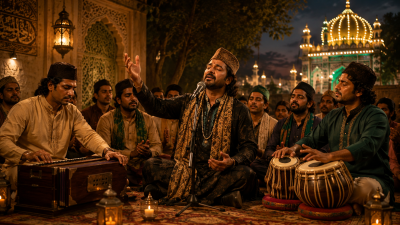
- Qawwali: The most recognized form of Sufi devotional music. It is a group performance characterized by a lead singer, a chorus, and rhythmic hand-clapping. It traditionally begins with a Hamd (praise of Allah) or Naat (praise of the Prophet).
- Kafi: Originating in the Sindh and Punjab regions, Kafi is a solo or group singing style based on the verses of Sufi saints like Bulleh Shah and Shah Hussain. It is less structured than Qawwali and focuses on the emotional depth of the lyrics.
- Sufiana Kalam: A classical Sufi genre from Kashmir. It uses a specific set of Ragas (known as Maqams) and is traditionally accompanied by the Santoor and Sehtar.
- Baul-Sufi Synthesis: In Bengal, the Baul tradition often merges with Sufi mysticism (Murshidi and Marfati songs), focusing on the internal search for the “Man of the Heart.”
Amir Khusrau: The Architect of Indo-Muslim Music
Often referred to as Tuti-e-Hind (Parrot of India), Amir Khusrau (1253–1325), a disciple of Nizamuddin Auliya, is the foundational figure of Sufi music in India.
- Musical Inventions: He is credited with the invention of the Sitar (by modifying the Veena) and the Tabla (by splitting the Pakhawaj).
- Genre Innovation: Khusrau introduced the Qaul (ancestor of Qawwali), Tarana, and Tillana.
- Melodic Synthesis: He blended Persian Maqams with Indian Ragas to create new melodies like Yaman, Zeelaf, and Sarparda.
- Linguistic Contribution: He pioneered the use of Hindavi (a precursor to Urdu/Hindi) in devotional poetry, making Sufism accessible to the Indian masses.
Key Elements and Terminology
The technical structure of Sufi music relies on specific components that facilitate spiritual elevation.
| Term | Definition |
| Sama | The spiritual assembly or the act of listening to music for divine contemplation. |
| Zikr | The rhythmic repetition of the names of God or religious formulae, often forming the rhythmic base of Sufi songs. |
| Murshid/Pir | The spiritual teacher whose praise is a central theme in Sufi compositions. |
| Fana | The concept of “annihilation of the self” in the Divine, which music aims to induce. |
| Halki Gayan | A lighter style of Sufi singing compared to the rigorous classical Maqam system. |
Major Sufi Silsilas and Their Musical Preferences
Different Sufi orders (Silsilas) in India had varying approaches toward the use of music in worship.
- Chishti Order: The most influential Silsila in India (founded by Moinuddin Chishti). They championed Sama and Qawwali as legitimate means of spiritual growth.
- Suhrawardi Order: Initially cautious but later accepted music in controlled spiritual environments.
- Naqshbandi Order: Generally avoided vocal and instrumental music, preferring silent Zikr (meditation), though some regional branches later adopted subtle melodic forms.
Prominent Sufi Saint-Poets and Regional Influences
The literary backbone of Sufi music consists of the verses written by great mystics across the subcontinent.
- Baba Farid (Punjab): His verses are included in the Guru Granth Sahib and form a significant part of the Punjabi Sufi repertoire.
- Bulleh Shah (Punjab): Known for his “Kafi” poetry that challenged orthodox rituals and emphasized universal love.
- Shah Abdul Latif Bhittai (Sindh): His work Shah Jo Risalo is a cornerstone of Sindhi Sufi music, often sung in the Wai style.
- Lalon Shah (Bengal): A mystic who transcended religious boundaries, his songs are central to the Sufi-Baul tradition of the East.
Musical Instruments in Sufi Traditions
Sufi music utilizes instruments that emphasize rhythm and drone to facilitate the hypnotic state of Zikr.
- Santoor: A 72-stringed hammered dulcimer, central to the Sufiana Kalam of Kashmir.
- Dholak/Tabla: Used to provide the driving, repetitive beats essential for Qawwali.
- Harmonium: Introduced in the 19th century, it became the melodic lead in modern Qawwali and Bhajan-Sufi blends.
- Ektara: Frequently used by wandering Sufi dervishes and Bauls in rural Bengal and Punjab.
- Rubab: A short-necked lute used in the frontier regions and Kashmir for Sufi melodies.
Historical Facts and Trivia for Aspirants
- Khusrau’s Khayal: While Khayal is a pillar of Hindustani Classical music, its origins are traced back to the “Qaul” and “Qalvana” introduced by Amir Khusrau.
- Gharanas of Qawwali: The Qawwal Bachon ka Gharana of Delhi, founded by disciples of Amir Khusrau, is the oldest lineage of Qawwali singers.
- The Urs Festivals: The death anniversary of a Sufi saint is celebrated as Urs (meaning “union with the Divine”), where overnight Qawwali sessions are the primary ritual.
- Persian-Sanskrit Synthesis: Sufi music was instrumental in the development of the Ghazal, a poetic form that eventually became a major semi-classical musical genre in India.
- Nizamuddin Auliya: He was famously criticized by orthodox clerics for his love of music, leading to a historic defense of Sama in the Sultan’s court.