
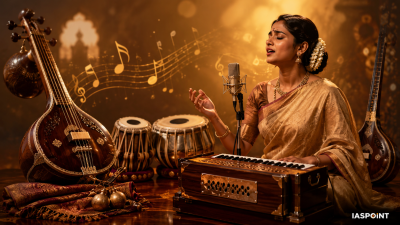
Semi-Classical music, often referred to as Sugam Sangeet or Up-shastriya Sangeet, occupies the space between pure classical (Shastriya) and folk music. While these genres are based on classical Ragas and Talas, they allow for greater flexibility, emphasizing emotional expression (Bhav) over technical structural rigidity. These forms are characterized by their lyrical beauty, often focusing on themes of love, separation, and devotion.
Thumri: The Expression of Romanticism
Thumri is the most prominent semi-classical vocal genre, originating in the eastern parts of Uttar Pradesh (Lucknow and Benaras) during the 19th century under the patronage of Nawab Wajid Ali Shah.
- Linguistic Basis: Composed primarily in Braj Bhasha, Avadhi, and Bhojpuri.
- Thematic Content: Usually revolves around the Shringar Rasa (romance), depicting the love of Radha and Krishna.
- Key Feature: The concept of Bol-Banao, where the singer interprets a single line of text in multiple ways to convey different emotional shades.
- Prominent Schools (Gharanas):
- Lucknow Thumri: Known for elegance and grace (Nazakat).
- Benaras Thumri: Characterized by a more robust, earthy folk influence.
- Legendary Proponents: Girija Devi (The Queen of Thumri), Begum Akhtar, and Siddheshwari Devi.
Dadra: The Rhythmic Relative of Thumri
Dadra is closely linked to Thumri but is distinguished by its rhythmic structure and faster tempo.
- Tala: Performed primarily in Dadra Tala (6 beats) or sometimes Kaherva Tala (8 beats).
- Structure: While Thumri is more expansive, Dadra is concise and follows a more fixed melodic structure.
- Themes: Similar to Thumri, it focuses on love and beauty but often includes more playful and light-hearted lyrics.
Tappa: The Punjab Influence
Tappa is a sophisticated and difficult semi-classical style that originated from the songs of camel riders in the Northwest (Punjab region).
- Origin: Popularized in the late 18th century by Shhori Miyan (Ghulam Nabi) of Lucknow.
- Technicality: It is characterized by rapid, jumpy, and zigzag melodic phrases known as Zamzama. It requires immense breath control and vocal agility.
- Ragas: Usually set in lighter Ragas like Kafi, Khamaj, or Bhairavi.
- Language: Mostly sung in Punjabi.
Ghazal: The Poetic Masterpiece
The Ghazal is an Indo-Persian form of vocal music that is essentially a poetic recitation set to music.
- Structure: A Ghazal consists of independent couplets called Sher. Every Ghazal must follow a strict rhyming scheme (Radif and Kaafiya).
- Thematic Range: Traditionally focuses on unrequited love and Sufi mysticism, but modern Ghazals also address social and philosophical issues.
- Musical Treatment: Unlike Khayal, the music in a Ghazal is secondary to the lyrics (Lafz).
- Famous Artists: Mirza Ghalib (Poet), Mehdi Hassan, Jagjit Singh, and Pankaj Udhas.
Regional Semi-Classical Forms
Several regional styles have gained national classical status due to their complexity and adherence to Ragas.
| Genre | Region | Characteristics |
| Hori | Braj (UP) | Sung during the festival of Holi; describes the play of Krishna with colors. |
| Kajri | Mirzapur/Varanasi | A seasonal song of the monsoon; expresses the longing of a woman for her lover. |
| Chaiti | Eastern UP | Sung in the month of Chaitra (spring); often ends with the word ‘Rama’. |
| Abhang | Maharashtra | Devotional poetry sung in praise of Lord Vitthal; popularized by saints like Tukaram and Namdev. |
| Bhajan | Pan-India | Purely devotional music; focuses on the “Name” of God. |
Comparison of Classical vs. Semi-Classical Music
| Feature | Classical (Khayal/Dhrupad) | Semi-Classical (Thumri/Dadra) |
| Priority | Raga purity and technicality | Emotional expression and lyrics |
| Improvisation | Elaborate Vistar and Taans | Bol-Banao and Thumka |
| Tala | Complex (Ektal, Jhumra, Tilwada) | Simpler (Teental, Dadra, Kaherva) |
| Raga Usage | Strict adherence to rules | Frequent “mixing” of Ragas (Rag-Sagar) |
Important Facts for UPSC Prelims
- Nawab Wajid Ali Shah: The last Nawab of Awadh was a prolific composer (pen name ‘Akhtarpiya’) and is considered the greatest patron of Thumri and Kathak.
- Instrumental Accompaniment: While the Sarangi was the traditional companion for semi-classical music, the Harmonium and Violin are now commonly used.
- The 8 Rasas: Semi-classical music predominantly explores the Shringar (Erotic/Love), Karuna (Pathos), and Bhakti (Devotion) rasas.
- Sufiana Kalam: A semi-classical genre from Kashmir that blends Persian poetry with Indian Ragas, traditionally accompanied by the Santoor.
- Natya Sangeet: A unique semi-classical tradition from Maharashtra used in musical theatre, blending elements of Khayal and Thumri.