
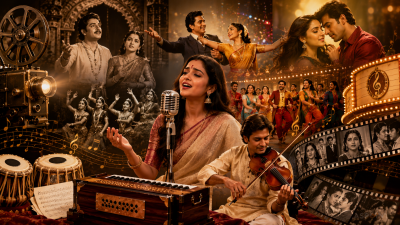
The relationship between Indian cinema and music is symbiotic, dating back to the inception of “talkies” in 1931. Unlike Western cinema, where music often serves as a background score, Indian cinema integrated music as a primary narrative tool, evolving from the traditions of Parsi Theatre and Sanskrit Drama.
The Early Era: The Transition from Silence to Sound
The introduction of sound revolutionized Indian cinema, making music an inseparable component of the cinematic experience.
- Alam Ara (1931): Directed by Ardeshir Irani, it was India’s first talkie. It featured seven songs, the most famous being “De De Khuda Ke Naam Pe,” sung by Wazir Mohammed Khan, marking the birth of the “Playback” era.
- Indra Sabha (1932): A landmark musical film containing a staggering 71 songs, setting a record for the highest number of musical pieces in a single movie.
- New Theatres (Kolkata): This studio played a pivotal role in the 1930s by introducing systematic background scoring and refining the use of Rabindra Sangeet in films.
Evolution of Playback Singing
Initially, actors were required to sing their own songs on set. The technical breakthrough of “playback singing” allowed for professional vocalists to record in studios while actors mimed on screen.
- Introduction of Playback: The film Dhoop Chhaon (1935) is credited with the first use of playback singing in India.
- Golden Age of Melodies (1950s-60s): This period saw the rise of legendary playback singers like Lata Mangeshkar, Mohammed Rafi, Kishore Kumar, Manna Dey, and Asha Bhosle. Their work was deeply rooted in classical Ragas but adapted for mass appeal.
- Technological Shift: The transition from monophonic recording to stereophonic and eventually digital Dolby Atmos has drastically altered the acoustic quality of cinematic music.
Influence of Classical Music on Film Songs
Indian film music (often termed Filmi Sangeet) has traditionally drawn heavily from Hindustani and Carnatic classical frameworks.
| Film Song | Movie | Based on Raga |
| Madhuban Mein Radhika Nache | Kohinoor | Raga Hamir |
| Mohe Panghat Pe | Mughal-e-Azam | Raga Gara |
| Kuhu Kuhu Bole Koyaliya | Suvarna Sundari | Raga Sohini/Bahar/Jaunpuri |
| Tu Ganga Ki Mauj | Baiju Bawra | Raga Bhairavi |
| Ketaki Gulab Juhi | Basant Bahar | Raga Desh |
Major Composers and their Contributions
The Music Director or Composer serves as the architect of the film’s auditory identity.
- Naushad Ali: Known for bringing Indian classical music to the masses. He was the first to use a 100-piece orchestra in Aan (1952).
- S.D. Burman: Blended Baul and Bhatiali folk traditions of Bengal with mainstream cinematic music.
- R.D. Burman (Pancham Da): Revolutionized the industry by introducing Western rock, jazz, and electronic sounds, making music more “hip” and rhythmic.
- A.R. Rahman: A pioneer in integrating world music and electronic synthesis with Indian classical roots. His work in Roja (1992) set a new global standard for Indian sound engineering.
- Ilaiyaraaja: A maestro of the South Indian film industry, renowned for his seamless fusion of Western classical symphonic orchestration with Carnatic melodies.
Cinema and the Preservation of Classical Traditions
While mainstream cinema often dilutes classical forms, several “Musical Biopics” and art-house films have actively preserved and promoted classical heritage.
- Baiju Bawra (1952): Centered on the life of the legendary Dhrupad singer; it brought classical music competitions to the silver screen.
- Basant Bahar (1956): Focused entirely on the struggle and triumphs of a classical musician.
- Shankarabharanam (1980): A Telugu masterpiece that revitalized public interest in Carnatic classical music.
- The Disciple (2020): A modern take on the rigors and internal conflicts of a Hindustani classical vocalist in the contemporary world.
Regional Cinema and Folk Music Integration
Regional film industries have been instrumental in keeping local folk music alive by giving them a national platform.
- Marathi Cinema: Uses Natya Sangeet (musical theatre) and Lavani extensively.
- Bengali Cinema: Heavily influenced by Rabindra Sangeet and Nazrul Geeti.
- Assamese Cinema: Frequently incorporates Bihu and Borgeet (devotional songs).
- South Indian Cinema: Maintains a very strong link with Carnatic music, specifically in the use of Kritis and Varnams in film scores.
Technical and Legal Aspects for Prelims
- Copyright Act, 1957: Protects the rights of composers, lyricists, and singers. Recent amendments have ensured that creators receive royalties for the commercial use of their work outside the film.
- National Film Awards: Since 1954, awards for Best Music Direction and Best Playback Singing have been highlights, recognizing artistic excellence in cinematic music.
- The “Item Song”: A socio-cultural phenomenon in Indian cinema where a standalone musical performance is used as a promotional tool, often drawing from folk traditions like Nautanki or Tamasha.
- First Film to Win Academy Award for Best Score: Slumdog Millionaire (2009), composed by A.R. Rahman, marked a significant milestone for Indian music on the global stage.
Trivia and Factoids
- Lata Mangeshkar: Often called the “Nightingale of India,” she recorded songs in over 36 Indian and foreign languages.
- Synthesizer Introduction: The first Indian film to use a synthesizer was Laila Majnu (1976), composed by Madan Mohan.
- Symphony Integration: K. Pyarelal (of Laxmikant-Pyarelal) was one of the few composers who could conduct a full Western symphony orchestra for a Bollywood background score.
- The Sarangi Controversy: For many years, the Sarangi was avoided in film music due to its association with “kothas” (brothels), until composers like Madan Mohan and Roshan reclaimed it for its soulful quality.