
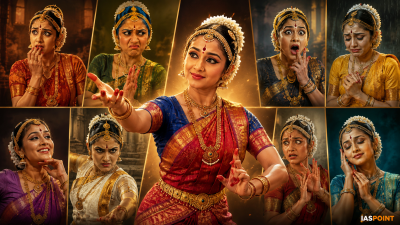
The Navarasa (Nine Sentiments) represent the emotional core of Indian performing arts, particularly classical dance. Codified primarily in the Natya Shastra by Bharata Muni and later expanded by Abhinavagupta, the Rasas are the “aesthetic flavors” experienced by the audience (Rasika) as a result of the dancer’s portrayal of various Bhavas (emotions). The transition from the internal state of the performer (Bhava) to the external experience of the spectator (Rasa) is the ultimate goal of any Indian classical performance.
The Origin and Evolution of Rasas
While the initial text of the Natya Shastra identified eight Rasas, the evolution of Indian aesthetics eventually stabilized at nine.
- The Original Eight: Bharata Muni identified eight Rasas based on the eight Sthayi Bhavas (dominant mental states) that are inherent in human nature.
- The Ninth Rasa (Shanta): The sentiment of Peace or Tranquility (Shanta Rasa) was formally introduced by the Kashmiri philosopher Abhinavagupta in his commentary, the Abhinavabharati. It is now universally accepted as the ninth Rasa.
- Secondary Sentiments: Later medieval texts occasionally mention Bhakti (Devotion) and Vatsalya (Maternal Love) as Rasas, though in classical grammar, these are often treated as aspects of Shringara or Shanta.
Comprehensive Table of the Navarasas
Each Rasa is associated with a specific presiding deity and a symbolic color, which often influences the Aharya Abhinaya (costume and make-up) of the dancer.
| Rasa (Sentiment) | Sthayi Bhava (Emotion) | Presiding Deity | Associated Color | Theme/Description |
|---|---|---|---|---|
| Shringara | Rati (Love) | Vishnu | Light Green | The “Queen of Rasas”; encompasses erotic, romantic, and devotional love. |
| Hasya | Hasa (Mirth) | Pramata | White | Humor, satire, and laughter; often used for social commentary. |
| Karuna | Shoka (Sorrow) | Yama | Grey/Ash | Pathos, compassion, and grief arising from loss or separation. |
| Raudra | Krodha (Anger) | Rudra | Red | Fury, rage, and destruction; prominent in Tandava movements. |
| Veera | Utsaha (Energy) | Mahendra | Pale Yellow | Heroism, bravery, and chivalry; emphasizes strength and determination. |
| Bhayanaka | Bhaya (Fear) | Kala | Black | Terror and anxiety; often depicted through trembling and wide eyes. |
| Bibhatsa | Jugupsa (Disgust) | Mahakala | Blue | Aversion and loathing; used to depict foul or immoral scenarios. |
| Adbhuta | Vismaya (Wonder) | Brahma | Yellow | Amazement, mystery, and curiosity at the supernatural or grand. |
| Shanta | Sama (Peace) | Buddha/Vishnu | White/Clear | Serenity, detachment, and spiritual calm; the state of being at rest. |
Export to Sheets
The Mechanism of Rasa Realization: Rasa-Sutra
The Natya Shastra provides a formula for the evocation of Rasa, known as the Rasa-Sutra: “Vibhavanubhava Vyabhichari Samyogad Rasa Nishpatti.”
Components of the Rasa Experience
- Vibhavas (Determinants): The physical causes or triggers of an emotion (e.g., the setting, the season, or the presence of a beloved).
- Anubhavas (Consequents): The outward physical manifestations of the emotion (e.g., a smile, a tear, or a glance).
- Vyabhichari Bhavas (Transitory States): Fleeting emotions that support the dominant Sthayi Bhava (e.g., anxiety, shame, or joy).
- Sthayi Bhava (Dominant Emotion): The stable, underlying emotion that is transformed into Rasa.
Application in Classical Dance Forms
The Navarasas are not applied uniformly across all dance forms; different styles prioritize different sentiments based on their regional and philosophical roots.
- Kathakali: Famous for its extreme stylization of Rasas. Dancers use rigorous eye exercises (Netra Sadhana) to switch between Raudra (Anger) and Veera (Heroism) during epic battles.
- Bharatanatyam: Heavily emphasizes Shringara (Love) in the form of Bhakti (Devotion), where the dancer (as the Nayika) longs for the divine (the Nayaka).
- Odissi: Known for its soft and lyrical portrayal of Shringara and Adbhuta, particularly themes from the Gita Govinda.
- Manipuri: Centers primarily on Bhakti and Shanta Rasas through the Raslila of Radha and Krishna.
Fact Sheet and UPSC Trivia
- The Rasa-Raja: Shringara Rasa is considered the most important or “King of Rasas” because it has the widest range of human experience.
- Abhinavabharati: This 11th-century commentary on the Natya Shastra is the primary reason we study nine Rasas today instead of eight.
- The Role of Music: Rasas are supported by specific Ragas in Indian classical music. For example, Raga Revati may evoke Karuna, while Raga Bilahari evokes Veera.
- The Goal of Art: According to the theory, art should lead the spectator to Rasananda, a state of blissful consciousness similar to spiritual enlightenment.
- Natyadharm: This refers to the stylized, artistic representation of emotions, as opposed to Lokadharmi, which is the realistic portrayal of everyday behavior.