
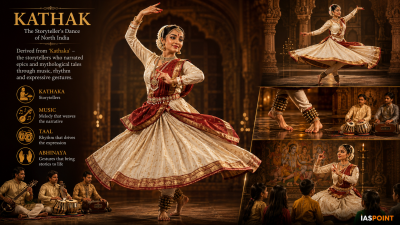
Kathak is the premier classical dance form of North India, predominantly practiced in Uttar Pradesh, Rajasthan, and Delhi. The name is derived from the Sanskrit word Kathaka (storyteller), referring to a community of professional storytellers who narrated epics and mythological tales in temples, supplemented by music and gestures.
From Temples to Mughal Courts
- Ancient Roots: Historically, Kathak began as a devotional temple dance illustrating the stories of the Puranas, specifically the Bhagavata Purana.
- Persian Influence: During the Mughal era, Kathak transitioned from temples to royal courts. This period introduced the Gharana system and shifted the focus from purely devotional themes to sophisticated entertainment, adding intricate footwork and Persian rhythmic patterns.
- The British Era and Decline: Like other classical forms, Kathak suffered during the “Anti-Nautch” movement of the 19th century but was revived through the efforts of royal patrons and dedicated artistic lineages.
Core Philosophical and Technical Elements
Kathak is unique among Indian classical dances for its blend of Hindu devotional themes and Persian aesthetic influences.
Stylistic Components
- Nritta (Pure Dance): Characterized by high-speed footwork (Tatkar) and lightning-fast pirouettes (Chakkars). Dancers maintain a straight-legged posture, avoiding the bent-knee positions seen in South Indian forms.
- Nritya (Expressive Dance): Uses subtle facial expressions and hand gestures (Mudras). It often portrays the Gat Nikas (suggestive gait) and Gat Bhav (enacting a story without song).
- Musical Synergy: It is the only classical dance form intrinsically linked to Hindustani Classical Music. It is typically accompanied by the Tabla or Pakhawaj, Sarangi, and Sitar.
Fundamental Terminology
- Tatkar: The foundational footwork where the dancer produces rhythmic sounds using the entire sole of the foot.
- Chakkar: The signature vertical spins that end in a dramatic, frozen pose (Sam).
- Thaat: The initial segment where the dancer enters the stage with stylized movements of the eyes, neck, and shoulders.
- Amad: The formal entry of the dancer into the rhythmic cycle of the performance.
- Tora, Tukra, and Paran: Complex rhythmic compositions of varying lengths and speeds.
- Kavit: Compositions where the dancer recites poetic verses and simultaneously performs their meaning.
The Three Major Gharanas of Kathak
The evolution of Kathak led to the development of regional “Gharanas” (schools), each emphasizing different aspects of the dance.
| Gharana | Origin/Patronage | Key Focus/Characteristics |
| Lucknow Gharana | Wajid Ali Shah (Nawab of Awadh) | Known for Nazakat (delicacy) and Bhava (expression). It emphasizes the Lasya (graceful) aspect. |
| Jaipur Gharana | Courts of Rajasthan Kings | Focuses on Layakari (rhythmic virtuosity), powerful footwork, and vigorous Tandava elements. |
| Benares Gharana | Janaki Prasad | Emphasizes the use of the floor and precision in footwork; noted for its unique use of the Natwari bol (syllables). |
Costume and Aharya Abhinaya
Kathak costumes reflect the synthesis of Hindu and Muslim cultures.
- Hindu Style: Female dancers wear a Lehenga-Choli with an Odhni (veil). Male dancers often wear a Dhoti and Bandi (vest).
- Muslim/Mughal Style: Both men and women may wear the Anarkali or Angarkha (a long, flowing tunic) with tight-fitting Churidar pajamas.
- The Ghungroo: Kathak dancers wear a high number of ankle bells (ranging from 100 to 200 on each leg) to accentuate the complex footwork.
Key Themes and Narrative Structure
The repertoire of Kathak revolves around the “Radha-Krishna” theme, specifically the Bhakti movement.
- Vaisnavite Influence: Themes often include the Raas-Lila, the stealing of butter by Krishna, and the teasing of Gopis.
- Dhrupad and Thumri: The dance sequences are often set to Dhrupad (ancient, austere style) or Thumri (lyrical, romantic style) music.
- Jugalbandi: A competitive and playful dialogue between the dancer and the percussionist (Tabla/Pakhawaj), where the dancer mimics the complex beats played by the instrumentalist.
Fact Sheet for UPSC Prelims
- Founder of Modern Kathak: The Maharaj family of the Lucknow Gharana, specifically Ishwari Prasad, is credited with the revival of the modern form.
- Major Proponents: Pandit Birju Maharaj (Lucknow), Lacchu Maharaj, Shambhu Maharaj, Sitara Devi (called the “Kathak Queen” by Rabindranath Tagore), and Damayanti Joshi.
- Ankiya Nat Connection: While Kathak is North Indian, it shares some storytelling parallels with the Sattriya of Assam.
- Nishabd: Kathak is known for its “stillness” in between high-speed movements, emphasizing the concept of Khali (empty beat) and Sam (first beat).
- Tarana: A fast-paced technical sequence often used towards the end of a performance, focusing on syllables like “tan,” “der,” and “na.”
Comparison: Kathak vs. Other Forms
Unlike Bharatanatyam or Kuchipudi, Kathak does not traditionally use the Araimandi (half-squat) position. It is the only form where the dancer recites the rhythmic bols (syllables) aloud before or during the performance. It also allows for more spontaneous improvisation compared to the strictly codified sequences of Odissi.
Last Modified: May 6, 2026