

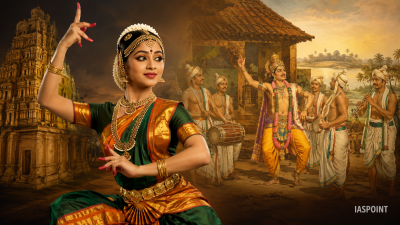
Kuchipudi is a classical dance form that originated in the Krishna district of Andhra Pradesh. It takes its name from the village of Kuchelapuram (also known as Kuchipudi). Historically, it was a dance-drama tradition performed by groups of Brahmin men known as Bhagavatulu, who traveled from village to village to propagate Vedic themes.
Origins and Siddhendra Yogi
While the roots of the dance are found in the ancient Natya Shastra, the modern format is credited to Siddhendra Yogi (14th–17th century CE). Legend states that he was inspired by Lord Krishna to create the dance-drama Bhamakalapam, which remains the cornerstone of the Kuchipudi repertoire.
Royal Patronage and Survival
- Vijayanagara Empire: The dance received significant support from the kings of Vijayanagara.
- Golconda Sultanate: In a famous historical anecdote, Abul Hasan Tana Shah (the last Qutb Shahi ruler) was so impressed by a Kuchipudi performance that he granted the village of Kuchipudi to the Brahmin families as an endowment (Agrahara).
- Modern Revival: In the 20th century, the dance transitioned from a male-dominated group drama to a solo classical form, largely due to the efforts of Vempati Chinna Satyam and Vedantam Lakshminarayana Sastri.
Technical Features and Philosophy
Kuchipudi is distinct because it perfectly balances the four types of Abhinaya (Angika, Vachika, Aharya, and Sattvika). It is the only classical dance form where the dancer frequently sings the lyrics alongside the vocalists (Vachika Abhinaya).
Core Elements of Performance
- Nritta, Nritya, and Natya: Kuchipudi is a holistic blend of pure dance (rhythm), expressive dance (emotion), and drama (narrative).
- Element of Earth: Among the Panchabootham (five elements), Kuchipudi is associated with the element of Earth.
- Bhamakalapam: The most celebrated dance-drama, depicting the story of Satyabhama (Krishna’s consort) and her longing for Lord Krishna.
Signature Sequences
- Tarangam: The most famous feature of a Kuchipudi recital. The dancer performs intricate rhythmic patterns while standing on the sharp edges of a brass plate, often balancing a pot of water on the head. This demonstrates absolute control over gravity and rhythm.
- Manduka Shabdam: Tells the story of a Frog Queen in the forest of the elephant king, showcasing the dancer’s ability to mimic animal movements and sounds.
- Jala Chitra Nrityam: An artistic feat where the dancer draws a picture (often a lion or a lotus) on the floor with their toes while dancing.
Comparative Structure: Kuchipudi vs. Bharatanatyam
Though both share a South Indian heritage, Kuchipudi is characterized by more fluid, rounded movements compared to the linear, geometric precision of Bharatanatyam.
| Feature | Kuchipudi | Bharatanatyam |
| Origin | Andhra Pradesh (Kuchelapuram) | Tamil Nadu (Temples) |
| Posture | More fluid, rounded, and bouncy. | Linear, geometric, and firm (Araimandi). |
| Vachika Abhinaya | Dancer sings the lyrics. | Vocalist sings; dancer expresses. |
| Traditional Performers | Groups of Brahmin men (originally). | Female Devadasis (originally). |
| Element | Earth | Fire |
The Kuchipudi Repertoire
A standard solo Kuchipudi performance follows a structured path of devotion and technical display.
- Purvaranga: The introductory ritual where the dancer invokes the gods and the stage is consecrated.
- Sollakattu: The recitation of rhythmic syllables.
- Shabdam: A dance piece where the expressive aspect (Abhinaya) begins, often praising a deity or a patron.
- Kautuvam: A rhythmic piece dedicated to a specific deity.
- Slokam and Padam: Deeply emotional segments focusing on the Shringara (love) or Bhakti (devotional) rasas.
Musical and Visual Accompaniment
- Music Style: Accompanied by Carnatic Music, typically in the Telugu language, though Sanskrit is also common.
- Instruments: The primary instruments include the Mridangam, Violin, Flute, and the Cymbals played by the conductor (Nattuvanar).
- Costume: Similar to Bharatanatyam but with slight variations in the fan and the jewelry. A distinctive feature is the Kakasera (hair ornament) used during Bhamakalapam to represent Satyabhama’s pride.
Key Proponents and Figures
- Traditional Pioneers: Siddhendra Yogi, Vedantam Lakshminarayana Sastri.
- Revivalists: Vempati Chinna Satyam (credited with refining the modern solo format).
- Famous Dancers: Raja and Radha Reddy, Yamini Krishnamurthy (master of both Bharatanatyam and Kuchipudi), Swapnasundari, and Shobha Naidu.
Fact Sheet for UPSC Prelims
- Bhagavata Mela: A related dance-drama tradition in Tanjore, Tamil Nadu, which shares common roots with Kuchipudi.
- Siddhendra Yogi’s Vow: He reportedly made the Brahmin boys of the village take a vow to perform this dance at least once a year.
- Solo Transformation: Vedantam Lakshminarayana Sastri is credited with introducing women to this traditionally male-only art form and developing the solo repertoire.
- Nattuvanar: In Kuchipudi, the lead conductor who plays the cymbals and recites the bols is essential for maintaining the complex synchronization between the dancer and the orchestra.
- Daruvu: A unique introductory sequence where each character in a dance-drama introduces themselves through a specific rhythmic pattern and song.