
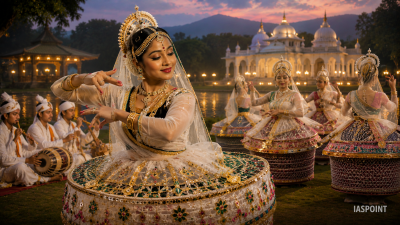
Manipuri dance, specifically the Raas Leela, originates from the northeastern state of Manipur and is deeply embedded in the religious fabric of the Meitei community. Unlike other classical dances that originated in temples, Manipuri was a collaborative communal expression that evolved into a highly stylized classical form.
The Influence of Vaishnavism
While the dance has roots in the pre-Hindu “Lai Haraoba” festival, its modern classical form was catalyzed by the advent of Gaudiya Vaishnavism in the 15th century. It shifted focus toward the devotion of Radha and Krishna. King Bhagyachandra (1763–1798 CE) is credited with the formal systematization of the Raas Leela, reportedly inspired by a vision of Lord Krishna.
Core Philosophy and Movement Aesthetics
The essence of Manipuri dance lies in Bhakti (devotion) and Rasa (sentiment). It is characterized by a fluid, serpentine movement that avoids sharp edges or jerky transitions.
Tandava and Lasya Aspects
Manipuri uniquely balances two contrasting styles of movement:
- Lasya: Represented by the Ras Leela, it is delicate, graceful, and predominantly soft. It emphasizes the “Chali” or basic stepping pattern characterized by fluid curves.
- Tandava: Represented by the Cholom (Pung Cholom and Kartal Cholom), featuring vigorous movements, jumps, and acrobatic elements performed by male dancers.
Distinctive Postures and Techniques
- The Figure of Eight: The movements follow a winding path resembling the number 8, representing the infinite nature of the divine.
- Low Impact Footwork: Unlike Kathak or Bharatanatyam, the feet never strike the ground loudly. The dancer typically moves on the balls of the feet to maintain a sense of weightlessness.
- Gati (Gait): The gait is inspired by nature, mimicking the movement of animals like the elephant, swan, or crane.
The Five Varieties of Raas Leela
The Raas Leela is not a single performance but a category of dance-dramas performed at specific times of the lunar calendar.
| Variety | Occasion / Timing | Theme |
| Maharaas | Kartik Purnima (Full Moon) | The supreme dance of Krishna with Radha and the Gopis. |
| Vasantaraas | Chaitra Purnima (Spring Full Moon) | Celebration of the spring season and Holi. |
| Kun jaraas | Ashwin Purnima | Portrays the daily life and play of Radha-Krishna in the bower. |
| Nityaraas | Any time of the year | Can be performed on any auspicious occasion. |
| Divaraas | Day time | Performed during the daylight hours, unlike others which are nocturnal. |
Costume and Ornamentation: The Kumil
The Manipuri costume is perhaps the most distinct among all Indian classical dances, designed to hide the dancer’s lower body movements and enhance the ethereal quality of the performance.
- Potloi: The bridal costume of Radha and the Gopis.
- Kumil: A barrel-shaped, stiffened skirt decorated with sequins, mirrors, and gold embroidery. It is designed to sway gently without revealing the legs.
- Odhna: A transparent silk veil worn over the head, signifying modesty and divinity.
- Khaon: A rectangular embroidered piece worn by Krishna around the waist.
- Mukut: The crown decorated with peacock feathers, specific to the Krishna character.
Musical Instruments and Vocal Accompaniment
The music of Manipuri Raas Leela belongs to the Nat-Sankirtana tradition, which is recognized by UNESCO as an Intangible Cultural Heritage of Humanity.
- Pung: A barrel-shaped drum that is the soul of Manipuri music. The “Pung Cholom” is a spectacular performance where the drummer dances while playing.
- Kartal: Large cymbals used by male dancers during Sankirtana.
- Pena: A traditional single-stringed fiddle used for melodic accompaniment.
- Flute and Conch: Used to signal transitions and create a divine atmosphere.
- Jayadeva’s Gita Govinda: Most lyrics are drawn from this 12th-century text, along with works by Vidyapati and Chandidas.
Noteworthy Facts and Trivia for Aspirants
- Lai Haraoba: This is the earliest form of dance in Manipur, dedicated to the forest deities (Umang Lai). It serves as the precursor to the modern Raas Leela.
- Rabindranath Tagore’s Role: Tagore was instrumental in bringing Manipuri dance to the global stage after witnessing a performance in Sylhet in 1919. He introduced it into the curriculum at Santiniketan.
- The Guru Tradition: The “Guru Shishya Parampara” is extremely strong in Manipur. Prominent legends include Guru Bipin Singh, who is often called the “Father of Modern Manipuri Dance.”
- Jhaveri Sisters: Nayana, Ranjana, Suverna, and Darshana Jhaveri are famous exponents who dedicated their lives to preserving and propagating the form outside Manipur.
- UNESCO Recognition: Manipuri Sankirtana (ritual singing, drumming, and dancing) was inscribed on the Representative List of the Intangible Cultural Heritage of Humanity in 2013.