

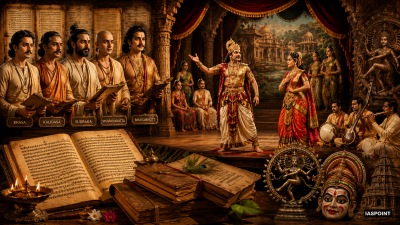
The “Golden Age” of Indian drama was shaped by several legendary playwrights whose works moved from religious ritualism to sophisticated literary expressions of human emotion, politics, and social ethics. These dramatists established the structural and aesthetic foundations that define the Indian Theatre unit of Art and Culture.
Ashvaghosha: The Pioneer (c. 1st Century CE)
Ashvaghosha is credited with writing the earliest known Sanskrit plays. Though primarily a Buddhist philosopher associated with the court of King Kanishka (Kushan Empire), his contributions to drama are seminal.
- Sariputraprakarana: Found as fragments in Turfan (Central Asia), this is the oldest extant Sanskrit drama. It depicts the conversion of Sariputra and Maudgalyayana to Buddhism.
- Significance: His work proves that Sanskrit drama was already a developed art form by the 1st Century CE and was used as a tool for religious propagation.
Bhasa: The Father of Indian Drama (c. 2nd – 3rd Century CE)
Until 1912, Bhasa was known only through references in Kalidasa’s works. T. Ganapati Sastri discovered thirteen of his plays in Kerala, known as the Svapnavasavadatta cycle.
- Svapnavasavadatta (The Vision of Vasavadatta): His masterpiece, detailing King Udayana’s political struggle and his love for Queen Vasavadatta.
- Urubhanga (The Shattered Thigh): A revolutionary play for Indian aesthetics as it portrays the tragic death of Duryodhana, deviating from the traditional “happy ending” rule.
- Madhyamavyayoga: Based on the Mahabharata, focusing on the character of Bhima and his son Ghatotkacha.
Kalidasa: The “Prince of Poets” (c. 4th – 5th Century CE)
Associated with the court of Chandragupta II (Vikramaditya) of the Gupta Dynasty, Kalidasa is the most celebrated figure in Indian literature.
- Abhigyanashakuntalam: The pinnacle of Sanskrit drama. It revolves around the recognition of Shakuntala by King Dushyanta. It is famous for its depiction of Shringara Rasa (Erotic/Love Sentiment) and nature.
- Malavikagnimitram: A court comedy depicting the love between King Agnimitra (Shunga Dynasty) and the maid Malavika. It provides historical insights into the Shunga period.
- Vikramorvasiyam: A mythological drama exploring the love between a mortal (Pururavas) and a celestial nymph (Urvashi).
Shudraka: The Realist Dramatist (c. 5th Century CE)
Shudraka is best known for shifting the focus from royal courts and gods to the lives of common citizens.
- Mrichchhakatika (The Little Clay Cart): A ten-act Prakarana play. It follows the love story of Charudatta, a poor but noble Brahmin merchant, and Vasantasena, a wealthy and virtuous courtesan.
- Unique Features: It is valued for its vivid social realism, featuring a diverse cast of thieves, gamblers, political rebels, and corrupt officials.
Vishakhadatta: The Political Mastermind (c. 6th Century CE)
Unlike his contemporaries who focused on romance or mythology, Vishakhadatta’s work is characterized by political intrigue and espionage.
- Mudrarakshasa: A historical play describing the ascent of Chandragupta Maurya and the diplomatic brilliance of Chanakya in winning over Rakshasa (the minister of the Nandas).
- Devichandraguptam: A lost play (preserved in fragments) that tells the story of the Gupta King Ramagupta’s surrender to a Shaka invader and his eventual overthrow by his brother Chandragupta II.
King Harshavardhana: The Royal Playwright (7th Century CE)
The ruler of Kannauj, Harshavardhana, was a significant patron of arts and a skilled dramatist himself.
- Ratnavali: A romantic drama about the love between King Udayana and Ratnavali.
- Priyadarsika: Another courtly romance following similar themes as Ratnavali.
- Nagananda: A unique play with Buddhist undertones that focuses on the self-sacrifice of Prince Jimutavahana to save the Nagas (serpents) from the hawk-god Garuda.
Bhavabhuti: The Master of Pathos (8th Century CE)
Often ranked alongside Kalidasa, Bhavabhuti was the court poet of King Yashovarman of Kannauj. He is known for his mastery of Karuna Rasa (the sentiment of pathos).
- Uttararamacharita: Depicts the later life of Lord Rama, specifically the events following the exile of Sita. It is considered one of the most emotional plays in Sanskrit literature.
- Malatimadhava: A romantic drama involving the adventures of two young lovers, featuring elements of the supernatural and dark rituals.
- Mahaviracharita: Depicts the early life and heroic exploits of Rama up to his coronation.
Summary Table of Major Works and Authors
| Playwright | Major Work | Genre/Theme | Historical/Cultural Context |
| Ashvaghosha | Sariputraprakarana | Religious/Buddhist | Earliest fragments; Kushan period. |
| Bhasa | Urubhanga | Tragedy/Epic | Rare tragic ending in Sanskrit. |
| Bhasa | Svapnavasavadatta | Romance/Political | Rediscovered in 1912. |
| Kalidasa | Abhigyanashakuntalam | Romantic/Mythological | First Indian play translated to English. |
| Shudraka | Mrichchhakatika | Social Realism | Focus on commoners and urban life. |
| Vishakhadatta | Mudrarakshasa | Political Thriller | Absence of female leads; focus on Chanakya. |
| Harsha | Nagananda | Buddhist Sacrifice | Merges Hindu and Buddhist themes. |
| Bhavabhuti | Uttararamacharita | Pathos/Epic | Masterpiece of emotional depth. |
| Mahendravarman I | Mattavilasa Prahasana | Satire/Farce | Pallava King; satirizes religious sects. |
Key Trivia for Prelims
- Mahendravarman I: The Pallava King who wrote Mattavilasa Prahasana, a farce that provides a humorous look at the Kapalika and Buddhist sects of the 7th Century.
- The “Shakespeare of India”: A title given to Kalidasa by Western scholars, primarily after the translation of Shakuntala.
- Diglossia: Most of these dramatists used a linguistic mix where noble characters spoke Sanskrit and others spoke various Prakrits (Sauraseni, Magadhi, Maharashtri).
- Bharat-Vakya: The concluding prayer in most of these classical plays, seeking the welfare of the kingdom and the people.