
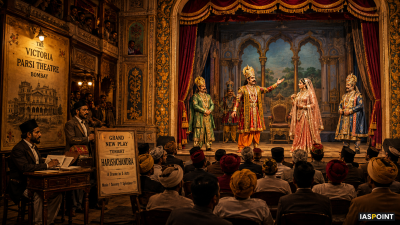
Parsi Theatre represents the first successful “Commercial Theatre” in India, acting as a bridge between the traditional folk forms and the modern proscenium stage. Emerging in the 19th century in the Bombay Presidency, it was a hybrid genre that synthesized European theatrical techniques with Indian mythological and romantic narratives. It was largely funded and managed by the Parsi community, who were the pioneers of industrial and cultural entrepreneurship in colonial India.
Core Characteristics and Technical Innovations
The Parsi stage was synonymous with grandeur and technical spectacle, setting the template for what would later become the Bollywood film industry.
- Proscenium Stage: Unlike the open-air folk theatre, Parsi theatre utilized a formal stage with a curtain, wings, and a clear separation between the actors and the audience.
- Spectacle and “Magic”: It introduced the “Scenography” concept, using painted backdrops, trapdoors for “miraculous” entries, and elaborate lighting to create a sense of wonder.
- The Melodramatic Style: The acting was characterized by stylized gestures, loud declamation, and high-pitched singing to reach the back of the large commercial halls.
- Music and Ghazals: It popularized the use of Hindustani Classical music, Thumris, and Ghazals as integral parts of the narrative, often paused specifically for “encore” musical performances.
Linguistic and Thematic Diversity
Parsi theatre was remarkably cosmopolitan, catering to a diverse urban audience by using multiple languages and themes.
- Language Evolution: Initial plays were in Gujarati and English, but to reach a Pan-Indian market, the medium shifted to Urdu and Hindustani.
- Religious and Mythological Themes: Plays like Harishchandra and Bilwamangal drew from Hindu epics.
- Persian and Arabic Legends: Themes from the Shahnameh (like Sohrab and Rustum) and Arabian tales (Aladdin, Ali Baba) were highly popular.
- Shakespearean Influence: Parsi companies were famous for Indianizing Shakespeare; for example, Hamlet became Khoon-e-Nahaq and The Merchant of Venice became Zulm-e-Naseeb.
Prominent Parsi Theatre Companies
The movement was sustained by professional touring companies that traveled across the Indian subcontinent and Southeast Asia.
| Company Name | Founder/Key Figure | Notable Contribution |
|---|---|---|
| Parsi Dramatic Mandali | Pestonji Framji Madan | One of the earliest organized groups (1853). |
| Alfred Theatre Company | Cowasji Khatau | Known for high production values and Shakespearean adaptations. |
| Original Theatrical Company | Seth Khurshedji Balliwala | Popularized Parsi theatre in North India and even toured London. |
| Victoria Theatrical Company | Dadabhai Naoroji (Early Associate) | Focused on social reform and educational themes. |
| Madan Theatres (Calcutta) | J.F. Madan | Became a massive empire that eventually transitioned into film production. |
The Great Playwrights of the Era
Three names stand out as the “Trinity” of Parsi theatre writing, known for their mastery over Urdu poetry and dramatic structure.
- Agha Hashar Kashmiri: Known as the “Shakespeare of India,” he wrote iconic plays like Yahudi Ki Ladki and Sita Banwas.
- Radheyshyam Kathavachak: Specialist in converting Hindu mythological stories into the Parsi format (e.g., Abhimanyu).
- Narayan Prasad ‘Betab’: Famous for the play Mahabharat, he was instrumental in bringing chaste Hindi into the commercial Parsi circuit.
Impact on Modern Indian Culture and Cinema
Parsi theatre was the direct predecessor to the Indian film industry (Bollywood).
- Structural Legacy: The “Song-and-Dance” routine, the interval, and the blend of tragedy and comedy (Masala format) were all inherited from Parsi Theatre.
- Transition to Talkies: The first Indian talkie, Alam Ara (1931), was essentially a Parsi theatre play filmed on a set. Many early actors and directors (like Ardeshir Irani and Prithviraj Kapoor) started in Parsi companies.
- The ‘Sutradhar’ Replacement: The role of the classical narrator was replaced by the “Comedians” and “Villains” who provided interludes between scenes.
UPSC Prelims Fact File
- The “Takht-e-Taus”: This refers to the elaborate throne used in Parsi plays depicting the Mughal or Persian courts, symbolizing the era’s obsession with royalty and grandeur.
- Inder Sabha: Written by Amanat Ali in 1852, this play is often cited as a crucial link between the royal court of Wajid Ali Shah and the commercial Parsi stage.
- The “Chakra” Technique: Parsi theatre used rotating stages and painted scrolls to depict moving scenery, a precursor to modern cinematic pans.
- Social Reform: Despite its commercial nature, plays like Kanya Vikraya (Sale of Daughters) addressed pressing social issues of the Victorian era.
- Demise: The advent of Silent Cinema in the 1920s and Talkies in the 1930s led to the decline of Parsi theatre as audiences shifted to the cheaper and more accessible medium of film.