
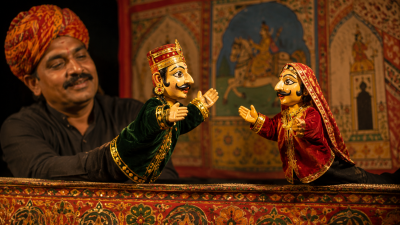
Glove puppetry, known technically as hand or sleeve puppetry, represents the most intimate and direct form of traditional Indian theater. Unlike string or rod puppets, glove puppets lack a rigid internal skeleton. The puppeteer’s hand serves as the “soul” and “frame” of the puppet, with the index finger controlling the head and the thumb and middle finger manipulating the arms. This proximity allows for high manual dexterity, rapid movements, and rhythmic interaction with the audience.
Technical Characteristics of Glove Puppets
- Structure: Typically, the head is made of wood, paper-mache, or terracotta, while the body consists of a long, flowing skirt that hides the puppeteer’s arm.
- Manipulation: The puppeteer remains visible or partially hidden behind a small screen. The movements are highly rhythmic, often synchronized with percussion instruments like the Chenda or Dholak.
- Portability: Due to their compact size and lack of complex external rigging, glove puppetry is traditionally a favorite of nomadic performers and solo artists.
Major Regional Traditions of Glove Puppetry
While glove puppetry is found in sporadic pockets across India, the Indian Puppetry Unit identifies two major traditional forms that have survived with distinct aesthetic identities.
Pavakoothu (Kerala)
Originating in the 18th century, Pavakoothu is a classical-folk hybrid heavily influenced by the Kathakali dance-drama of Kerala.
- Design and Iconography: The puppets are carved from wood and decorated with mirrors, gilded paper, and peacock feathers. The facial painting (Vesham) strictly follows Kathakali standards: Pacha (Green) for noble characters, Katti (Knife) for arrogant villains, and Kari (Black) for demonic figures.
- Musical Accompaniment: The performance uses traditional Kerala instruments including the Chenda, Ilathalam (cymbals), and Chengila.
- Repertoire: The themes are predominantly based on episodes from the Ramayana and Mahabharata.
Sakhi Kundhei (Odisha)
Prevalent in the Puri and Cuttack districts, this form is deeply rooted in the Bhakti movement and Vaishnava philosophy.
- Performance Style: The puppeteer usually performs sitting on the ground, often without a screen. They frequently play the Khol (drum) or Gini (cymbals) with one hand while manipulating the puppet with the other.
- Thematic Focus: Unlike the epic-centric Pavakoothu, Sakhi Kundhei focuses on the Radha-Krishna Leela and the romantic-devotional lyrics of the Gitagovinda.
- Costume: The puppets are dressed in traditional Odia attire, reflecting the local Gotipua and Odissi dance costumes.
Comparative Summary of Glove Puppetry Styles
| Feature | Pavakoothu (Kerala) | Sakhi Kundhei (Odisha) |
| Primary Influence | Kathakali Dance-Drama | Vaishnava Bhakti Movement |
| Material | Wood, Mirror, Peacock Feathers | Wood, Cloth, Paper-mache |
| Themes | Mahabharata, Ramayana | Krishna Leela, Gitagovinda |
| Musical Instruments | Chenda, Ilathalam, Chengila | Khol, Gini, Harmonium |
| Headgear | Elaborate Kathakali Crowns | Traditional Odia Headgear |
Socio-Cultural Significance and Modern Evolution
Glove puppetry has historically served as a versatile medium for community engagement and education.
- The Vidushaka (The Jester): Most glove puppet plays introduce a comic character who speaks in the local dialect. This character acts as a bridge between the mythological story and contemporary social issues.
- Educational Utility: Because of the low cost of production and ease of transport, the Sangeet Natak Akademi utilizes glove puppets for “Developmental Puppetry,” focusing on health, sanitation, and literacy campaigns in rural India.
- Institutional Preservation: The Pavakoothu tradition saw a significant revival through the efforts of the G. Venu and the Natana Kairali research center, supported by the Union Ministry of Culture.
Trivia and Key Facts for UPSC Aspirants
- Earliest Reference: While string puppetry is mentioned in the Silappadikaram, glove puppetry is often associated with the medieval Bhakti era, where it was used as a tool for proselytization.
- The Term “Pava”: In Malayalam, Pava means doll or puppet. The term Pavakoothu literally translates to “the dance of the dolls.”
- Beni Putul: A lesser-known glove puppetry tradition in West Bengal where the puppets often have bells attached to their wrists to provide their own rhythmic accompaniment.
- Technical Terminology: The puppeteer’s manipulation technique is sometimes referred to as Hasta-Sutra (Hand-String) in vernacular technical treatises, emphasizing the hand as the primary controller.
- Preservation Status: Sakhi Kundhei is currently considered an endangered art form, receiving special “Revival Grants” from the Sangeet Natak Akademi.