
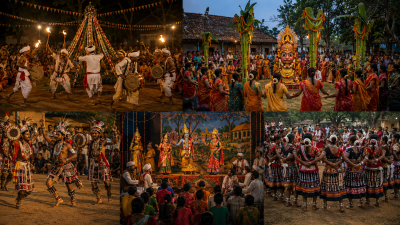
Community-based performances in India represent the intersection of social cohesion, religious devotion, and artistic expression. Unlike individualized art forms, these are characterized by collective participation, where the line between the performer and the spectator often blurs. These forms are typically tied to the agricultural calendar, seasonal festivals, or life-cycle rituals of specific tribes and communities.
Ritualistic Community Theatre and Dance
Ritualistic performances are often believed to invoke the divine or ensure the well-being of the village. These forms are frequently hereditary and involve complex preparatory rituals.
- Mudiyettu (Kerala): A ritual dance-drama based on the mythological battle between the goddess Bhadrakali and the demon Darika. It is performed in the “Kali Kavu” (temple groves) and is inscribed on the UNESCO Representative List of Intangible Cultural Heritage.
- Theyyam (Kerala): A spectacular ritual dance of North Malabar where performers represent deities, ancestral spirits, or legendary heroes. The “Mudi” (headgear) and facial painting are distinctive features. It is considered a “living cult” rather than mere entertainment.
- Bhaona (Assam): Created by the saint-reformer Srimanta Sankardeva, this is a traditional form of entertainment used to propagate Vaishnavism. It is performed in “Namghars” (prayer halls) and uses the Brajavali language.
- Dashavatar (Konkan/Goa): Popular among the farming communities of the Konkan coast, it depicts the ten incarnations of Lord Vishnu. The performers belong to the Gopalak community.
Martial and Physical Community Arts
Many community performances originated as training exercises for warriors or as displays of physical strength within specific social groups.
- Kalaripayattu (Kerala): One of the oldest martial arts in the world, it includes strikes, kicks, and weaponry. Public demonstrations function as community festivals, symbolizing the physical culture of the Nair and Chekavar communities.
- Gatka (Punjab): A traditional martial art associated with the Sikhs, particularly the Nihang warriors. It is performed during religious processions like Nagar Kirtan and festivals like Hola Mohalla.
- Paika Akhada (Odisha): A martial folk dance performed by the Paikas (peasant-militia). It combines acrobatic maneuvers with the use of swords and shields, reflecting the military history of Odisha.
- Silambam (Tamil Nadu): A weapon-based martial art involving bamboo staff fencing. It is often showcased during temple festivals and the harvest festival of Pongal.
Narrative and Storytelling Traditions
These forms focus on preserving the oral history and epics of a community through song and narration.
- Pandavani (Chhattisgarh): A narrative of the Mahabharata performed primarily by the Pardhi and Gond tribes. It uses a Tambura as a prop to represent various weapons or characters.
- Villu Paatu (Tamil Nadu): The “Bow Song” community performance where a large bow serves as the primary musical instrument. It is common in the southern districts of Tamil Nadu and narrates stories of local deities and heroes like Muthuramalinga Thevar.
- Pabuji Ki Phad (Rajasthan): A scroll-painting narrative where the Bhopa community singers recite the exploits of the folk-deity Pabuji while pointing to scenes on a long cloth painting (Phad).
Comparative Analysis of Major Community Forms
| Performance Form | Region | Primary Community | Themes/Focus |
| Kaniyan Koothu | Tamil Nadu | Kaniyan Community | Invoking spirits and village deities; ritualistic drumming. |
| Bhavai | Gujarat | Tarkala/Bhavaiya | Social satire, maternal deity worship (Amba Mata). |
| Dhangari Gaja | Maharashtra | Dhangar (Shepherds) | Gratitude to God Biruba; involves rhythmic drum beats. |
| Lai Haraoba | Manipur | Meitei Community | Ritual of the “Merrymaking of the Gods”; focuses on creation myths. |
| Kaksar Dance | Chhattisgarh | Abhujmaria Tribe | Seasonal dance during the harvest; used for selecting life partners. |
Community-Based Puppetry and Satire
Puppetry serves as a non-confrontational medium for communities to address social issues or celebrate local legends.
- Kathputli (Rajasthan): Managed by the Bhatt community, these string puppets often narrate the life of Amar Singh Rathore. The puppeteer uses a “Boli” (whistle) to create a unique vocal texture.
- Tholu Bommalata (Andhra Pradesh): Large shadow puppets made of translucent leather. This performance involves the entire family of the Chitraka community, who handle the manipulation, music, and lighting.
Significant Facts and UPSC Trivia
- Sutradhar: In almost all community-based theatre, the Sutradhar (holder of the strings) acts as the narrator and director, ensuring the flow of the performance.
- Vidushaka/Jester: A vital component in community arts (e.g., Komali in Therukoothu, Hanuman in Yakshagana) who provides comic relief and bridges the gap between the ancient epic and contemporary local issues.
- UNESCO Inscriptions: Aspiring candidates should note that Mudiyettu, Chhau, and Kalbelia are specific community performances listed under UNESCO’s Intangible Cultural Heritage.
- Ritualistic Purity: Many community forms, like Theyyam, require the performer to observe strict dietary and lifestyle penance weeks before the performance, as they are viewed as temporary vessels for the divine.
Current Status and Preservation
Community-based performances face threats from globalization and the migration of rural youth to urban centers. The Government of India, through the Sangeet Natak Akademi and the Zonal Cultural Centres (ZCCs), provides financial assistance under the “Scheme for Safeguarding the Intangible Cultural Heritage and Diverse Cultural Traditions of India.” Documentation of these performances is also a key mandate of the Indira Gandhi National Centre for the Arts (IGNCA).
Last Modified: May 7, 2026