
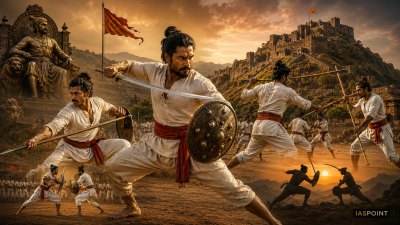
Mardani Khel is a traditional weapon-based martial art originating from the state of Maharashtra. While its roots can be traced to the early medieval period, it saw its greatest refinement and institutionalization during the 17th century under the reign of Chhatrapati Shivaji Maharaj. The art was specifically designed to suit the unique topography of the Sahyadri mountain ranges, emphasizing high mobility, rapid strikes, and the use of the landscape to neutralize numerically superior forces.
- Etymology: The term is derived from the Marathi words Mardan (masculine/brave) and Khel (sport/play), signifying a discipline intended to build physical and mental fortitude.
- Guerrilla Warfare (Ganimi Kava): Mardani Khel was the tactical backbone of the Maratha “Ganimi Kava” (Guerrilla tactics), focusing on “hit-and-run” maneuvers rather than static, conventional battlefield formations.
- The Akhada Tradition: Historically, training took place in Talims or Akhadas, which served as both physical gymnasiums and centers for strategic military education.
Core Weapons and Equipment of Mardani Khel
The weaponry of Mardani Khel is distinctive for its ergonomic design, often allowing for maximum reach and speed during close-quarter mountain combat.
| Weapon Name | Description | Strategic Utility |
| Pata | Gauntlet Sword | A long, double-edged blade attached to a steel gauntlet. It protects the forearm and allows for circular, sweeping strikes. |
| Vita | Corded Spear | A short spear with a long cord attached to the butt-end, allowing the warrior to throw it and pull it back instantly. |
| Talwar | Curved Saber | The standard Maratha sidearm, specifically the Bhavani style (named after the deity), optimized for slashing from horseback. |
| Dhal | Circular Shield | Typically made of rhinoceros or buffalo hide, used for parrying and striking with the rim. |
| Barchhi | Short Spear | Used for thrusting in dense forest skirmishes where a long pike would be cumbersome. |
| Lathi | Bamboo Staff | The foundational weapon for beginners to master footwork and rhythmic movement. |
Technical Phases and Training Pedagogy
The training in Mardani Khel is structured around the transition from rhythmic movement to lethal precision.
Footwork and Agility (Chal)
The foundation of the art lies in Chal (movements). Practitioners learn to move in circular and zig-zag patterns to avoid being cornered in narrow mountain passes. This involves:
- Vartul-Chal: Circular movements used when surrounded by multiple attackers.
- Tri-kon Chal: Triangular footwork used for deceptive lunges and retreats.
Weapon Handling and Drills
Once the footwork is mastered, the practitioner moves to weapon-specific drills.
- Jori-Pata: Dual-sword play which requires exceptional coordination and peripheral awareness.
- Soti-Fari: A practice version using wooden sticks and leather shields to simulate real combat without high risk of injury.
Cultural Significance and Ritualistic Elements
Mardani Khel is deeply integrated into the socio-religious fabric of Maharashtra, particularly during the festivals of Dasara and Shiv Jayanti.
- Shastra Puja: On Dasara, weapons are ritually cleaned, worshipped with marigolds and vermillion, and the “Simolanghan” (crossing the boundary) ceremony is performed to symbolize the start of military campaigns.
- Totem and Deities: Practitioners often invoke Lord Hanuman (for strength) and Goddess Bhavani (for victory and tactical wisdom) before beginning a session.
- The Role of Kolhapur: Post the Maratha-Mughal wars, the princely state of Kolhapur, under the patronage of Chhatrapati Shahu Maharaj, became the primary hub for preserving Mardani Khel and traditional wrestling (Kushti).
Modern Status and State Recognition
Like many indigenous arts, Mardani Khel faced a decline during British rule due to the “Disarming Act,” but it has seen a modern revival through state-sponsored initiatives.
- Public Demonstrations: It is a major attraction during the Republic Day parade in Maharashtra and at the annual Shiv Jayanti celebrations at Shivneri Fort.
- Sports Integration: Efforts are ongoing by the Maharashtra government to include Mardani Khel in state-level school sports competitions to ensure its survival among the youth.
- Community Preservation: Many families in rural Maharashtra, particularly among the Maratha and Dhangar communities, continue to pass down these techniques as a form of cultural heritage rather than active combat.
UPSC Fact File for Quick Revision
- The Pata Expert: Historical accounts suggest that Maratha infantrymen could use the Pata to decapitate multiple opponents in a single 360-degree rotation.
- Bhavani Talwar: Chhatrapati Shivaji’s personal sword, the Bhavani, is a legendary symbol of the art; historical debates continue regarding its current location (London vs. Satara).
- Link to Other Arts: Mardani Khel shares technical similarities with Gatka (Punjab) and Silambam (Tamil Nadu), particularly in the rhythmic use of the staff, reflecting the cross-pollination of Indian martial cultures.
- Geographic Center: While practiced across Maharashtra, the most authentic forms are preserved in Kolhapur, Pune, and Satara.
- Inclusion in Heritage Lists: It is often studied under the “Intangible Cultural Heritage” category of Indian Art and Culture for its unique combination of physical discipline and historical narrative.