

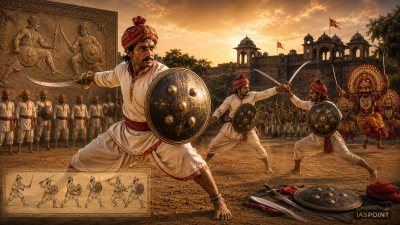
Pari-Khanda is a traditional martial art originating from the state of Bihar, specifically nurtured by the Rajputs. It is considered the foundational precursor to the world-renowned Chhau dance of Eastern India. The term is derived from two distinct elements: Pari, meaning “shield,” and Khanda, meaning “sword.” Historically, this art form was practiced by warriors to refine their reflexes, balance, and coordination for battlefield engagement.
- Geographic Hub: The Saran and Bhojpur regions of Bihar are historically recognized as the heartland of Pari-Khanda.
- Warrior Ethos: Unlike purely performance-based arts, Pari-Khanda was a rigorous military exercise used to train infantry in the use of the heavy double-edged sword and leather shield.
Technical Components and Training Methodology
The practice of Pari-Khanda is characterized by its heavy reliance on leg movements and core stability, which translates directly into the “Chhau” performance vocabulary.
Core Stances and Movements
- Chauk: A basic square stance where the practitioner maintains a low center of gravity, essential for stability during sword swings.
- Chali: Rhythmic walking patterns that simulate advancing or retreating on a battlefield.
- Upalayas: Specific sub-movements or “jumps” that are used to dodge strikes or bridge the distance between opponents.
Weaponry Profile
- The Khanda: A heavy, straight, double-edged sword. Unlike the curved Talwar, the Khanda is designed for hacking and blunt-force thrusting.
- The Pari: A circular shield typically made of buffalo hide or wood, reinforced with metal studs.
The Structural Link: Pari-Khanda to Chhau Dance
The evolution of Pari-Khanda into Chhau (Seraikella, Purulia, and Mayurbhanj styles) is a significant case study in Indian cultural history, where martial drills transitioned into a sophisticated performing art.
| Feature | Pari-Khanda (Martial Art) | Chhau (Dance Form) |
| Primary Intent | Combat readiness and self-defense. | Storytelling and ritualistic performance. |
| Movement Base | Chauk and Chali (Military). | Chauk and Chali (Stylized/Artistic). |
| Prop Usage | Functional steel sword and hide shield. | Wooden or bamboo replicas, or symbolic gestures. |
| Accompaniment | Rhythmic drum beats for timing. | Elaborate music (Dhol, Shehnai, Nagada). |
Chhau Foundations: Regional Variations and Martial Roots
Chhau is a semi-classical Indian dance with deep martial, tribal, and folk origins. The three main styles of Chhau are fundamentally rooted in the martial drills of local militias.
1. Seraikella Chhau (Jharkhand)
- Origin: Developed in the erstwhile Seraikella State.
- Martial Element: Closely mirrors Pari-Khanda techniques; it is known for its sophisticated mask-work and subtle movements.
- Patronage: Historically supported by the local royalty who were often performers themselves.
2. Mayurbhanj Chhau (Odisha)
- Distinction: This style does not use masks.
- Martial Influence: It retains the most aggressive martial elements. The dancers perform “Hatiyar Dhara” (holding weapons), which is a direct adaptation of Pari-Khanda’s weapon drills.
- Technique: Focuses on Topkas (pelvic movements) and Uflis (leaps mimicking daily chores or animal movements).
3. Purulia Chhau (West Bengal)
- Thematic Focus: Emphasizes the triumph of good over evil (e.g., Durga slaying Mahishasura).
- Martial Character: Characterized by high-energy acrobatics, somersaults, and vigorous weapon play that reflects the “Khandayat” (swordsmen) tradition of the region.
Fact File for UPSC Prelims
- UNESCO Recognition: Chhau dance was inscribed on the UNESCO Representative List of the Intangible Cultural Heritage of Humanity in 2010.
- The Munda-Bhumij Connection: Tribal communities such as the Mundas and Bhumijs are credited with preserving the early martial structures that eventually merged with Hindu epic narratives.
- Instrumental Profile: The Nagada (kettle drum) and Dhol provide the high-decibel rhythmic cues that originate from battlefield signaling.
- Sangeet Natak Akademi: Chhau is one of the forms recognized as a classical dance by the Sangeet Natak Akademi (though the Ministry of Culture lists nine classical dances including Chhau, the Akademi traditionally lists eight).
- Seasonal Significance: Both Pari-Khanda demonstrations and Chhau festivals are peak during the Chaitra Parva (Spring Festival), marking the beginning of the agricultural cycle.
Socio-Cultural Legacy
The transition from Pari-Khanda to Chhau signifies the “civilizing” of martial energy into an aesthetic form. While the sword and shield are no longer used for warfare, the physical rigor required for Chhau ensures that the ancient Rajput and tribal martial techniques are preserved within the cultural memory of Eastern India. Training still begins with the Upalayas and Chalis, ensuring that every Chhau performer is, in essence, trained in the foundations of Pari-Khanda.
Last Modified: May 7, 2026