
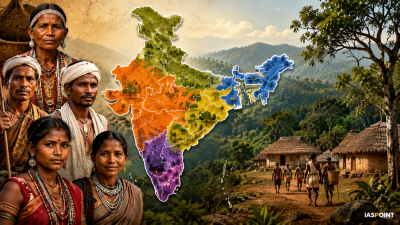
The tribal population in India, comprising approximately 8.6% of the total population according to the 2011 Census, is not uniformly distributed. Geographically, these communities are categorized into five distinct clusters based on their ecological, social, and linguistic traits.
The Himalayan Belt: Northern and North-Eastern Regions
This cluster spans the sub-Himalayan region and the North-Eastern states, characterized by a high concentration of Scheduled Tribes (STs).
- Geographic Spread: Jammu & Kashmir, Ladakh, Himachal Pradesh, Uttarakhand, Sikkim, Arunachal Pradesh, Assam, Meghalaya, Mizoram, Manipur, Nagaland, and Tripura.
- Key Tribal Groups: Gujjars, Bakarwals (J&K); Gaddi, Kinnaura (HP); Tharu, Jaunsari (UK); Lepcha, Bhutia (Sikkim); Adi, Nyishi, Mishmi (Arunachal); Naga, Kuki, Mizo, Khasi, Jaintia, and Garo (North-East).
- Linguistic Features: Primarily Tibeto-Burman and Austro-Asiatic (Khasi and Jaintia) language families.
- Socio-Cultural Fact: Many North-Eastern tribes follow matrilineal systems (e.g., Khasi and Garo) and practice Shifting Cultivation, known locally as Jhum.
The Central India Cluster: The Heart of Tribal India
This is the largest cluster in terms of population and geographical spread, spanning the plateau regions and hilly tracts of central India.
- Geographic Spread: Madhya Pradesh, Chhattisgarh, Jharkhand, Odisha, and parts of Maharashtra, Rajasthan, and Gujarat.
- Key Tribal Groups: Gond (the largest tribal group), Bhil, Santhal, Munda, Oraon, Ho, Birhor, and Kondh.
- Linguistic Features: Predominantly Austro-Asiatic (Munda branch) and Dravidian (Gondi, Kurukh).
- Economic Profile: Primarily settled agriculture, though groups like the Birhor are traditionally nomadic hunter-gatherers.
- Mining and Industry: This region overlaps with India’s major mineral belt, leading to significant tribal displacement and the rise of forest rights movements.
The Western India Cluster
This region bridges the gap between the Central and Southern clusters, focusing on the Aravalli and Western Ghats.
- Geographic Spread: Rajasthan, Gujarat, Maharashtra, Goa, and Dadra & Nagar Haveli.
- Key Tribal Groups: Bhil (widely distributed), Sahariya, Meena (Rajasthan); Warli, Katkari, Rathwa (Maharashtra/Gujarat).
- Artistic Heritage: The Warli tribe is globally renowned for its ritualistic wall paintings (Warli Art), which use geometric patterns to depict daily life and nature.
- Demographic Detail: Rajasthan’s Meena community is among the most educationally and economically advanced tribal groups in India.
The Southern India Cluster
Tribal communities in South India are largely concentrated in the forest-clad hills of the Western and Eastern Ghats.
- Geographic Spread: Karnataka, Kerala, Tamil Nadu, Andhra Pradesh, and Telangana.
- Key Tribal Groups: Toda, Kota, Badaga (Nilgiris); Chenchu (Nallamala Hills); Kadar, Kanikkar, Kurumba (Western Ghats).
- Linguistic Features: Entirely Dravidian language family.
- Unique Cultural Facts:
- Toda: Known for their distinct barrel-shaped huts and buffalo-centered economy/religion.
- Chenchu: One of the oldest hunter-gatherer tribes, largely resisting settled agriculture.
The Island Cluster: Bay of Bengal and Arabian Sea
This cluster consists of small, isolated communities, many of which are classified as Particularly Vulnerable Tribal Groups (PVTGs).
- Geographic Spread: Andaman & Nicobar Islands and Lakshadweep.
- Key Tribal Groups: Great Andamanese, Onge, Jarawa, Sentinelese (Andaman); Shompen, Nicobarese (Nicobar).
- Sentinelese: Known as one of the most isolated tribes in the world, maintaining a hunter-gatherer lifestyle with no external contact.
- Linguistic Status: The languages of the Andamanese are considered “language isolates,” unrelated to any major global language families.
Comparative Overview of Tribal Clusters
| Region | Predominant State(s) | Major Tribes | Primary Language Family |
| North/North-East | Assam, Nagaland, Arunachal | Naga, Khasi, Mizo, Bodo | Tibeto-Burman |
| Central India | MP, Jharkhand, Odisha | Gond, Santhal, Munda | Austro-Asiatic / Dravidian |
| Western India | Rajasthan, Gujarat | Bhil, Meena, Warli | Indo-Aryan |
| Southern India | TN, Kerala, Karnataka | Toda, Chenchu, Kadar | Dravidian |
| Islands | Andaman & Nicobar | Jarawa, Sentinelese, Onge | Andamanese / Nicobarese |
Classification of PVTGs (Partially Vulnerable Tribal Groups)
Within these clusters, the Government of India identifies 75 groups as PVTGs based on specific criteria:
- Pre-agricultural level of technology.
- Stagnant or declining population.
- Extremely low literacy.
- Subsistence level of economy.
- Highest Number of PVTGs: Odisha has the highest number (13), followed by Andhra Pradesh.
- Specific Examples: Sahariyas (MP/Rajasthan), Sentinelese (A&N), Dongria Kondh (Odisha).
Important Constitutional and Administrative Facts for Prelims
- Fifth Schedule: Governs the administration of Scheduled Areas and Tribes in states other than Assam, Meghalaya, Tripura, and Mizoram.
- Sixth Schedule: Provides for Autonomous District Councils (ADCs) in the four North-Eastern states mentioned above.
- Article 342: Empowers the President to specify the tribes or tribal communities to be deemed Scheduled Tribes.
- Xaxa Committee (2013): A high-level committee on the socio-economic status of tribal communities in India, emphasizing the “Five Ds”: Displacement, Deprivation, Discrimination, Demography, and Development.