
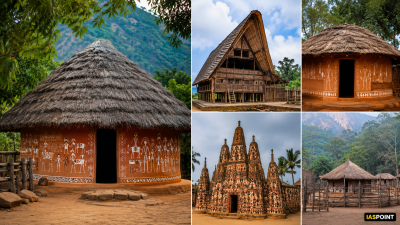
Tribal architecture in India, often referred to as “Ethno-architecture,” is a manifestation of indigenous knowledge, ecological adaptation, and socio-religious beliefs. Unlike monumental architecture, tribal dwellings are characterized by their “vernacular” nature—built using locally available materials and designed to withstand specific climatic conditions while reflecting the social hierarchy and cosmology of the tribe.
Regional Variations and Architectural Styles
The diversity in tribal housing is primarily dictated by the geographical cluster and the availability of raw materials like bamboo, thatch, mud, and timber.
The North-Eastern Stilt Houses (Chang Ghar)
In the heavy rainfall zones of the North-East, tribes have perfected the art of bamboo construction.
- Structure: Houses are typically built on raised platforms (stilts) to protect against floods, dampness, and wild animals.
- Major Tribes: Mising, Naga, and Adi.
- Naga Architecture: The Morung (youth dormitory) is the most prominent structure, featuring massive carved wooden pillars and a “V” shaped horn projection on the roof, symbolizing the status of the village.
- The Khasi House: Traditionally oval-shaped with a thatched roof reaching nearly to the ground to resist high-velocity winds.
The Central Indian Mud and Tile Dwellings
The plateau regions favor thermal mass to combat extreme heat.
- Structure: Thick mud walls with tiled roofs (khaprail). The walls are often treated with a mix of cow dung and clay for insulation and hygiene.
- Santhal Dwellings: Known for their impeccable cleanliness. The walls are meticulously plastered and often painted with colorful floral and geometric patterns using natural pigments.
- Gond Houses: Often include a central courtyard and specific areas dedicated to the family deity (Persa Pen).
The Nilgiri Circular Huts
The Toda tribe of the Nilgiri Hills (Tamil Nadu) constructs one of the most unique architectural forms in India.
- Design: Known as “Dogles,” these are barrel-vaulted structures made of bamboo, cane, and thatch.
- Features: The entrance is exceptionally small, requiring one to crawl, which serves as protection from the cold and wild animals. The front wall is often decorated with Toda embroidery patterns and stone carvings.
Socio-Functional Classification of Tribal Spaces
Tribal dwellings are rarely just residential; they are divided into functional zones based on gender, age, and ritual purity.
| Component | Tribal Name / Example | Significance |
| Youth Dormitory | Ghotul (Muria), Morung (Naga) | Center for socialization, learning, and community defense. |
| Sacred Granary | Deoghar (Various) | Storage for grains, often associated with the Goddess of Wealth. |
| Ancestral Space | Sasandiri (Munda) | A dedicated space or stone slab for honoring the deceased. |
| Menstrual Hut | Kurma (Gond/Muria) | A secluded hut located at the edge of the village for women during menstruation. |
Materials and Sustainable Techniques
Tribal architecture is a benchmark for sustainable development, utilizing “zero-carbon” materials.
- Bamboo: Known as the “timber of the poor,” it is used for flooring, walls (wattle), and roof frameworks.
- Mud and Thatch: Provide excellent thermal insulation, keeping interiors cool in summer and warm in winter.
- Natural Pigments: Colors are derived from red oxide (Geru), charcoal, and lime, which also act as natural preservatives for the walls.
- Joinery: Traditional houses seldom use iron nails; instead, they employ sophisticated lashings made of cane or creepers and wooden dowels.
Art and Aesthetics in Dwellings
The exterior of a tribal house serves as a canvas for the community’s history and spiritual beliefs.
- Warli Wall Paintings: In Maharashtra, the walls of the Sahyadri tribes are decorated with white rice paste on red ochre backgrounds, depicting the “Tree of Life” and the “Circle of Time.”
- Rathwa Pithora: The Bhilala and Rathwa tribes of Gujarat paint “Pithora” murals on their main walls as a ritualistic offering to their gods.
- The Meena ‘Mandana’: Elaborate floor and wall drawings in Rajasthan used to welcome deities and mark festive occasions.
Fact Sheet for UPSC Prelims
- The Apatani Houses: Located in the Ziro Valley of Arunachal Pradesh, these houses are built entirely without nails, using a complex system of bamboo interlocking.
- The Nicobarese Beehive Hut: Circular huts on stilts with a dome-shaped thatched roof, designed to withstand the tropical storms of the Andaman and Nicobar Islands.
- Bhungas of Kutch: While often associated with the nomadic Rabari, these circular mud houses with conical roofs are earthquake-resistant due to their aerodynamic shape—a fact proven during the 2001 Bhuj earthquake.
- Ghotul Symbolism: The Muria Gond Ghotul is often the most aesthetically decorated building in the village, featuring wood carvings of fertility symbols and tortoises.
- Kitchen Location: In many Himalayan tribes, the hearth is kept in the center of the main room to provide constant warmth and to allow smoke to preserve the thatched roof from insects.