
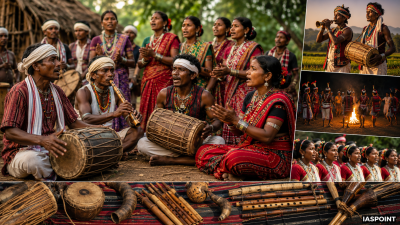
Tribal music, unlike classical Indian music (Margi), is fundamentally communal and functional. It is categorized as Desi or folk tradition, where music is inextricably linked to life-cycle rituals, agricultural cycles, and oral history. It lacks the formal structure of Ragas and Talas, relying instead on repetitive rhythmic patterns and collective participation.
Characteristics of Tribal Music
- Communal Ownership: Songs are rarely attributed to a single composer; they are the heritage of the entire tribe.
- Functional Nature: Music serves a specific purpose—invoking rain, celebrating a harvest, mourning the dead, or narrating the origin of the clan.
- Oral Transmission: Melodies and lyrics are passed down through generations via youth dormitories (like the Ghotul or Morung).
- Relationship with Dance: In tribal contexts, music and dance are rarely separate; the rhythm of the instrument usually dictates the choreography of the community dance.
Classification of Tribal Musical Instruments
Tribal instruments are classified into four categories based on the Natya Shastra classification system (Vadya).
Avanaddha Vadya (Membranophones/Percussion)
These are rhythmic instruments made of animal skin stretched over a frame.
- Dholak/Dhol: A universal tribal drum. The Bhil tribe uses a large dhol during the Gavoeri festival.
- Tamale: A specific drum used by the Irula tribe of the Nilgiris.
- Mandar/Madal: A clay-bodied drum iconic to the Santhal and Oraon tribes of Jharkhand and West Bengal.
- Nagada: Large kettledrums used by the Ho and Munda tribes to signal community gatherings or war.
- Tumdak: A two-faced drum central to Santhali music culture.
Ghana Vadya (Idiophones/Solid Instruments)
These are resonance instruments that do not require tuning and are made of metal or wood.
- Manjira: Small brass cymbals used across Central India to maintain tempo.
- Chimta: A tong-like instrument with small metal discs, common in the tribal music of Himachal Pradesh and Punjab.
- Kartal: Wooden clappers used by the Meena and Bhil communities during devotional singing.
- Ghungroo: Ankle bells worn by dancers in the Bastar region (Chhattisgarh) to add a rhythmic layer to their movements.
Sushira Vadya (Aerophones/Wind Instruments)
Instruments played by blowing air, often made of bamboo, bone, or horns.
- Bansuri/Tiriyo: Bamboo flutes. The Santhals consider the Tiriyo a sacred instrument associated with their creation myths.
- Pungi/Been: Traditionally made from a dried gourd, used by the Kalbelia tribe of Rajasthan.
- Kombu: An ancient C-shaped brass or ivory horn used by tribes in South India (Karnataka and Kerala) during temple festivals.
- Tangmuri: A wooden wind instrument unique to the Khasi tribe of Meghalaya.
- Pepa: An instrument made from buffalo horn, essential to the Bodo and folk-tribal traditions of Assam during Bihu.
Tata Vadya (Chordophones/Stringed Instruments)
Instruments where sound is produced by the vibration of strings.
- Ektara: A single-stringed instrument used by nomadic tribes and the Baul community (semi-tribal).
- Kendra: A primitive stringed instrument used by the Santhals, often referred to as the “tribal violin.”
- Banam: A bowed string instrument used by the Santhal and Munda tribes; the resonator is often carved with intricate human or animal figures.
- Tuila: A rare one-stringed instrument played by the tribes of Odisha and Jharkhand, known for its complex fingering technique.
- Gogona: A jaw harp made of bamboo used by tribes in Assam, though technically an idiophone, it is often categorized by its string-like vibration.
Regional Tribal Music Traditions
| Region | Key Tribes | Famous Music/Instruments | Ritual Context |
| North-East | Naga, Mizo, Garo | Bamboo clappers, Log Drums | Harvest and War victory |
| Central India | Gond, Baiga, Muria | Relo songs, Mandar drum | Ghotul socialization and Weddings |
| Western India | Bhil, Kalbelia | Pungi, Dhol | Shamanic rituals and Fair celebrations |
| Eastern India | Santhal, Juang | Banam, Tiriyo, Madal | Sohrai (Harvest) and Karam festival |
| Southern India | Toda, Kurumba | Buguri (Flute), Kwahl | Funeral dirges and Buffalo rituals |
Significant Tribal Songs and Vocal Styles
- Relo Songs: Practiced by the Muria and Maria Gonds of Bastar; these are sung by the youth in the Ghotul.
- Hajong Geeta: Folk-tribal songs of the Hajong tribe in Meghalaya and Assam, focusing on agricultural life.
- Lujari and Domkach: Traditional songs of the tribes in the Chota Nagpur plateau, typically sung in a call-and-response format.
- Pala: A form of ballad singing among tribes in Odisha that blends tribal lore with local folk deities.
Facts for UPSC Prelims
- The Log Drum: In Nagaland, the Konyak and Ao Nagas carve massive drums from a single tree trunk. These are kept in the Morung and were historically used to alert the village of enemy attacks.
- The Banam Myth: Santhals believe the Banam was created from the remains of a human being, which is why the instrument is often carved to look like a human figure.
- Instrument as Totem: For many tribes, the drum is not just an instrument but a deity. The Gonds offer prayers to their drums before any major festival or hunt.
- Simplicity of Scale: Most tribal music is pentatonic (five notes) or even more restricted, focusing on rhythm rather than melodic complexity.
- UNESCO Recognition: The Kalbelia folk songs and dances of Rajasthan were included in the UNESCO Representative List of the Intangible Cultural Heritage of Humanity in 2010.
- Karam Gaan: Songs dedicated to the Karam tree, performed by the Munda, Oraon, and Santhal tribes to ensure the prosperity of the clan and the fertility of the crops.