
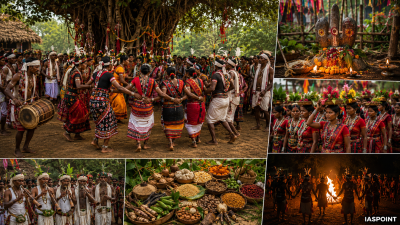
Tribal festivals in India are multifaceted events that integrate religious fervor, ecological wisdom, and social cohesion. Unlike mainstream festivals that often follow a standardized pan-Indian calendar, tribal rituals are governed by the local biological clock—linked to the flowering of trees, the movement of wildlife, and the harvest cycles of specific forest produce. These celebrations serve as a primary mechanism for preserving oral traditions and strengthening the bond between the community and their ancestral lands.
Core Themes of Tribal Rituals
Tribal festivals generally revolve around three functional pillars:
- Propitiation of Nature: Rituals aimed at honoring the spirits of the forest, mountains, and water bodies to ensure ecological balance.
- Ancestor Veneration: Ceremonies to invite the protection of deceased elders, who are believed to reside in a parallel spiritual realm.
- Agricultural Sanctity: Rites performed during the “first fruit” eating, sowing, and harvesting to thank the Earth for its bounty.
Major Tribal Festivals: A Regional Perspective
The following festivals are critical for UPSC aspirants as they often feature in questions regarding cultural geography and intangible heritage.
Central and Eastern India (Jharkhand, Odisha, Chhattisgarh, MP)
- Sarhul (Jharkhand/Odisha): Celebrated by the Munda, Oraon, and Ho tribes, this festival marks the tribal New Year. It coincides with the flowering of the Sal tree (Shorea robusta). The ritual involves the “marriage” of the sun and the earth, represented by the priest (Pahan) and his wife.
- Bastar Dussehra (Chhattisgarh): Spanning 75 days, it is the world’s longest festival. It does not celebrate the victory of Rama over Ravana but focuses on Danteshwari Mai, the presiding deity of Bastar. It involves the participation of multiple tribes like the Maria, Muria, and Bhatra.
- Bali Jatra (Odisha/Bastat): Observed by the Gadaba and Paroja tribes, it marks the end of the harvest. It features the “Bali” (sand) ritual where grains are germinated in sand-filled pots, symbolizing the life cycle.
- Karam Festival: Widely celebrated across the Chota Nagpur plateau, it involves the worship of the Karam tree (Adina cordifolia), the god of power, youth, and youthfulness.
North-Eastern India
- Hornbill Festival (Nagaland): Often called the “Festival of Festivals,” it is a collaborative celebration of all 17 major Naga tribes. It is held annually from December 1st to 10th to promote inter-tribal interaction and preserve Naga heritage.
- Chapchar Kut (Mizoram): A spring festival celebrated after the completion of Jhum (shifting cultivation) clearing. It is characterized by the Cheraw or bamboo dance.
- Wangala Festival (Meghalaya): Also known as the 100 Drums Festival, it is the harvest festival of the Garo tribe, dedicated to Saljong, the Sun God of fertility.
- Apatani Myoko (Arunachal Pradesh): A month-long festival focused on friendship and shamanic rituals to ensure prosperity and community health.
Western and Southern India
- Bhagoria (Madhya Pradesh/Maharashtra): A festival of the Bhil and Bhilala tribes occurring before Holi. Historically, it was a “matchmaking” festival where young men and women chose their life partners.
- Baneshwar Fair (Rajasthan): Known as the “Kumbh of the Tribals,” it is a major gathering of the Bhils at the confluence of the Som, Mahi, and Jakham rivers to worship Lord Shiva.
- Nagoba Jatara (Telangana): The second-largest tribal fair in India, celebrated by the Mesram clan of the Gond tribe. It involves the worship of the serpent god, Nagoba.
- Toda Cone-burning Ritual: The Toda of the Nilgiris perform specific buffalo-centric rituals, including the “Modhweth” (churning of milk) and ritualistic burning of temple cones.
Classification of Tribal Rituals by Type
| Ritual Category | Example | Associated Tribe | Significance |
| Agricultural | Bihu (various types) | Bodo, Mising, Deori | Marking the three stages of the paddy cycle. |
| Martial/Victory | Chang Lo | Chang Naga | Celebrating victory in historical warfare. |
| Shamanic | Pithora Ritual | Rathwa/Bhilala | Healing and vow fulfillment through painting. |
| Ecological | Sarna Puja | Munda, Santhal | Protection of the sacred grove. |
| Life Cycle | Ghotul Rites | Muria Gond | Transition from childhood to adulthood. |
Key Tribal Ritualistic Concepts
The Concept of “Sacred Groves” (Sarna/Kavu)
Tribal rituals often take place in Sacred Groves, which are patches of virgin forest untouched by the axe. They act as “natural cathedrals” where the deity resides. In the Chota Nagpur region, this is called Sarna. These groves are critical for biodiversity conservation as they house rare medicinal plants.
Shamanism and Divination
The Shaman (variously called Pahan, Baiga, Bhagat, or Deori) is the intermediary who performs the rituals.
- Techniques: Rituals often involve animal sacrifice (chicken or goat), the use of local rice beer (Handia or Apong), and trance-inducing music.
- Diagnosis: The shaman diagnoses social or physical ailments by reading signs in grains of rice or the patterns of broken eggs.
Totemic Taboos
Rituals often reinforce totemic beliefs. A tribe or clan will have a specific animal or plant as its totem. During festivals, rituals are performed to honor the totem, and there are strict prohibitions against harming that specific species.
Essential Facts for UPSC Prelims
- Article 244(1): Tribal festivals in “Scheduled Areas” are often protected under the Fifth Schedule to maintain the cultural autonomy of the tribes.
- UNESCO Intangible Heritage: The Kalbelia songs/dances of Rajasthan and Chhau dance (rooted in tribal rituals of Odisha/JH/WB) are part of the UNESCO list.
- PVTGs and Rituals: Particularly Vulnerable Tribal Groups like the Sentinelese or Jarawa have rituals that remain largely unstudied due to their isolation, centered mostly around the sea and forest spirits.
- Role of Women: While many tribal societies are egalitarian, certain rituals (like the Pithora painting or the Naga head-taking ceremonies) were historically gender-segregated, whereas harvest dances like Karma are inclusive.
- Ethno-medicine: Most tribal rituals are accompanied by the administration of forest-based medicines, blending the spiritual with the medicinal.
Trivia and Factoids
- The Log Drum Ritual: In Nagaland, the beating of the massive log drum during festivals serves as a community “telegraph,” with different rhythms signifying fire, war, or celebration.
- The ‘Bithlaha’ Ritual: Among the Santhals, this is a ritual of social boycott—the highest form of punishment for breaking social taboos, performed with the beating of drums throughout the village.
- Donyi-Polo: In Arunachal Pradesh, rituals focus on the Sun (Donyi) and Moon (Polo), representing the feminine and masculine principles of the universe.
- Baha Festival: The Santhal spring festival where men and women offer Sal flowers to the deities, and no one is allowed to use Sal flowers or fruits until the ritual is completed.