
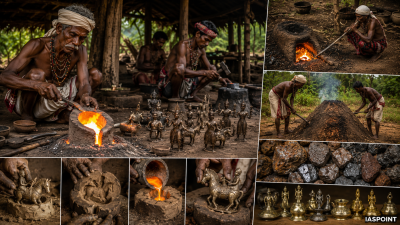
Tribal metallurgy and craft in India represent an unbroken chain of indigenous technology dating back to the Chalcolithic period and the Indus Valley Civilization. These crafts are not merely commercial enterprises but are deeply embedded in the “ethno-technological” heritage of India, where material science meets spiritual belief. The use of the “Lost Wax” process (Cire Perdue) and the extraction of iron from local ores are the hallmarks of this tradition.
Tribal Metallurgy: The Ancient Science of Metal Casting
Indian tribes have mastered the art of non-ferrous and ferrous metallurgy, utilizing locally sourced ores and traditional furnaces.
Dokra Art (Lost Wax Casting)
Dokra is perhaps the most famous tribal metallurgical craft, practiced for over 4,000 years.
- Technique: It utilizes the “Lost Wax” casting method. A clay core is covered with wax threads, which is then encased in another layer of clay. Molten metal (usually a brass/bronze alloy) is poured into the mold, melting the wax and taking its place.
- Primary Tribes: The Gonds of Chhattisgarh and Madhya Pradesh, the Santhals of West Bengal and Jharkhand, and the Kondhs of Odisha.
- Themes: Motifs include tribal deities, elephants, horses, measuring bowls (Paila), and scenes from daily life.
- Geographical Indications (GI): Bastar Dokra (Chhattisgarh), Adilabad Dokra (Telangana), and West Bengal Dokra have received GI tags.
Iron Smelting and the Agaria Tribe
The Agaria tribe of Central India (MP and Chhattisgarh) are traditional iron-smelters who consider iron to be a sacred element.
- Indigenous Technology: They use traditional small-scale clay furnaces (Kothis) and bellows (Bhati) made of skin to smelt iron from local ores.
- Symbolism: They believe that the “Loha-Asur” (Iron Demon) resides in the furnace, and rituals are performed before smelting to ensure the quality of the metal.
- Utility: They primarily produce agricultural tools, arrowheads, and ritualistic objects like the Trishul.
Bamboo and Cane Craft: The “Green Gold” of the North-East
The North-Eastern tribes have achieved unparalleled sophistication in utilizing bamboo and cane, influenced by the region’s dense tropical forests.
- Apatani and Nyishi (Arunachal Pradesh): Known for specialized bamboo baskets and headgear. The Bopa is a unique woven hat used by Nyishi men.
- Mizo Bamboo Work: Famous for the Khowpui (large storage baskets) and the intricate weaving of bamboo mats used in traditional flooring.
- Assamese Tribal Crafts: The Bodo and Mising tribes create the Japi (traditional sunshade hat), which has become a cultural symbol of the state.
- Structural Use: The use of bamboo in constructing “Chang Ghars” (stilt houses) and suspension bridges demonstrates advanced tribal civil engineering.
Tribal Wood Carving and Sculpture
Wood carving serves as a medium for recording history and decorating communal spaces, particularly in the North-East and Central India.
- Naga Wood Carvings: Traditional Naga houses and Morungs (youth dormitories) feature massive carved pillars. Motifs often include tigers, elephants, and human heads (reflecting historical warrior status).
- Ghotul Carvings (Muria Gonds): The pillars of the Ghotul are often carved with intricate fertility symbols, tortoises, and dancers.
- Kondh Woodwork (Odisha): The Kuttia Kondhs carve elaborate designs on the doors of their houses and on the wooden pillars used for ritualistic sacrifices.
Tribal Pottery and Terracotta
While pottery is a pan-Indian craft, tribal terracotta is distinguished by its ritualistic purpose and unglazed, raw finish.
- Bastar Terracotta: The tribes of Bastar create large terracotta elephants and horses as offerings to the village deity, Rao Dev.
- Molela Terracotta (Rajasthan): Though categorized as folk art, it is heavily used by the Bhil and Meena tribes. These are hollow relief plaques of deities like Devnarayan.
- Longpi Pottery (Manipur): Practiced by the Tangkhul Naga tribe. It is unique because it is made without a potter’s wheel. A mixture of black serpentinite stone and weathered rock is used to create heat-resistant, black earthenware.
Comparative Table: Major Tribal Crafts and Regions
| Craft Type | Notable Tribe | Region/State | Key Features |
| Dokra | Gond, Kondh, Santhal | Chhattisgarh, Odisha, WB | Lost wax metal casting; brass/bronze. |
| Longpi Pottery | Tangkhul Naga | Manipur | Black stone pottery; no potter’s wheel. |
| Pithora | Rathwa, Bhilala | Gujarat, MP | Ritualistic wall painting/craft. |
| Toda Embroidery | Toda | Tamil Nadu | Geometric “Pukhoor” embroidery. |
| Applique Work | Pipli (Tribal roots) | Odisha | “Chandua” cloth-stacking craft. |
| Mask Making | Sherdukpen, Monpa | Arunachal Pradesh | Painted wooden masks for Cham dances. |
Tribal Jewelry and Personal Adornment
Tribal jewelry is often a mix of metallurgy and found objects, representing the wearer’s social status and protective amulets.
- Beadwork: The Wancho and Nocte tribes of Nagaland/Arunachal are masters of seed and glass beadwork.
- Bell Metal Jewelry: Worn by the Lambani and Banjara tribes, featuring heavy anklets and Hanslis (neck collars).
- Dokra Ornaments: Intricate hairpins, rings, and pendants featuring geometric coils and spirals.
360° Fact Sheet for UPSC Prelims
- The Agaria Furnace: The Agaria furnace is designed to produce “Wootz-like” steel through a solid-state reduction process, avoiding the complete melting of the iron.
- Sikkim’s Choktse: Elaborately carved wooden folding tables made by the Bhutia tribe, often featuring Buddhist motifs.
- Kumbhar (Potter) vs. Tribal Potter: Unlike caste-based potters who use the wheel, many interior tribes (like the Juangs or Nagas) traditionally used the “Hand-and-Beater” method or coil method.
- GI Protection: Many tribal crafts like Bastar Iron Craft and Bastar Wooden Craft are protected under the Geographical Indications of Goods Act, 1999.
- TRIFED’s Role: The Tribal Co-operative Marketing Development Federation of India (TRIFED) acts as the primary agency for the “Minimum Support Price” (MSP) for Non-Timber Forest Produce (NTFP) and the marketing of tribal artifacts through “Tribes India” outlets.
- Vishwa Karma: In many tribal cosmologies, the first blacksmith is seen as a divine figure, often equated with the creator of the world.
Trivia and “Did You Know?” for Aspirants
- Zinc Smelting: Ancient tribal sites in Zawar (Rajasthan) show that India was the first to smelt zinc by distillation, a technology that was likely shared between tribal miners and local artisans.
- The “Flying” Birds: Many Dokra artifacts feature birds with elongated necks; these are often interpreted as messengers between the human world and the spirit world.
- Black Pottery Health Benefits: Longpi pottery from Manipur is highly sought after because it is believed that cooking in stone-based earthenware adds minerals to the food and retains heat for longer durations without reacting with acidic ingredients.