
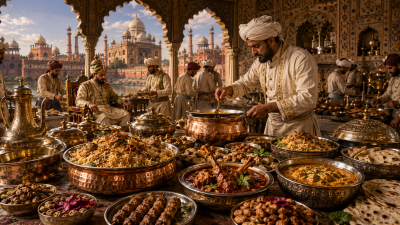
The Mughal culinary tradition represents the pinnacle of Indo-Islamic fusion, blending the hearty nomadic diet of Central Asia with the refined aesthetics of Persian cuisine and the vibrant spices of the Indian subcontinent. Under the patronage of emperors from Babur to Shah Jahan, the royal kitchen (the Nimat-Khana) evolved into a sophisticated department of state, governed by strict protocols and a specialized workforce.
Administrative Framework of the Nimat-Khana
The Mughal kitchen was a highly organized institution, as detailed in the Ain-i-Akbari by Abu’l-Fazl.
- Mir Bakawal: The Master of the Kitchen/Prime Minister of the Palate, responsible for overseeing all culinary operations and ensuring food safety.
- Bakawals: Subordinate officers who tasted every dish before it was served to the Emperor to guard against poisoning.
- Hakims: Royal physicians who collaborated with chefs to ensure that meals were balanced according to the temperament (Mizaj) of the season and the ruler.
- The Toshakhana: The imperial storehouse that managed the procurement of high-quality grains, spices, and rare ingredients from across the empire and beyond.
Categorization of Imperial Dishes
The Mughal court categorized its culinary repertoire into three distinct classes based on the complexity and ingredients used:
- Sufiyana: Meatless dishes consumed on days of abstinence or by the “Sufis” at court. These relied on grains, pulses, and ghee.
- Meat and Grain Blends: Dishes where meat was cooked with rice or wheat, such as Pilaf (Pulao) and Haleem.
- Meat with Spices: Rich gravies and roasts where meat was the primary focus, prepared with varied spice blends and dairy.
Signature Techniques and Innovations
Mughal chefs introduced several sophisticated cooking methods that defined the texture and aroma of their cuisine:
- Dum Pukht: The technique of sealing a heavy-bottomed pot with dough (Atta) and cooking over slow embers. This trapped the steam and essential oils, resulting in highly aromatic dishes.
- Dhungar: A method of cold-smoking where a piece of live charcoal is placed in a small vessel inside the cooking pot, drizzled with ghee, and sealed to infuse a smoky flavor into meats and lentils.
- Grafting and Horticulture: Emperors like Babur and Jahangir were obsessed with fruit. They introduced systematic grafting, leading to superior varieties of Mangoes (like Chausa and Langra), Grapes, and Melons.
- Ice Procurement: To chill beverages and fruit, the Mughals established a supply chain where ice was brought from the Himalayas by boat and horse-runners to the plains of Delhi and Agra.
Major Contributions to the Indian Food Basket
| Category | Contribution | Specific Examples |
| Rice Preparations | Biryani & Pulao | Evolution of Persian Pilaf into the spice-rich Indian Biryani using Basmati rice. |
| Meat Dishes | Kebabs & Koftas | Introduction of minced meat preparations like Seekh, Shami, and Nargisi Kofta. |
| Breads | Tandoori & Leavened | Popularization of Naan, Bakarkhani, and Sheermal (saffron-flavored bread). |
| Desserts | Kuldai & Halwa | Creation of Kulfi (frozen in metal cones) and various fruit-based Halwas. |
| Dairy | Paneer & Malai | Refinement of milk-solids usage in savory gravies to provide a “Shahi” texture. |
Regional Centers of Mughal Culinary Heritage
While originating in the North, the Mughal influence spread, creating distinct regional “Gharanas” of cooking:
- Delhi/Agra: Known for the original “Mughlai” style—rich, heavy gravies using cream and butter.
- Awadh (Lucknow): Focused on the Nazaqat (refinement) of food, specializing in slow-cooked Dum dishes and the famous Galauti Kebab.
- Hyderabad: A unique synthesis of Mughal techniques with local Deccani ingredients like tamarind, peanuts, and curry leaves, resulting in Hyderabadi Haleem and Kachchi Biryani.
- Bengal: The Mughal governors in Dhaka and Murshidabad introduced the use of mustard oil in Islamic meat preparations, creating a distinct Eastern Mughal profile.
Fact Sheet for UPSC Prelims
- Nihari: Derived from the Arabic word ‘Nahar’ (daybreak). It was a slow-cooked beef or lamb stew served to laborers and the army after morning prayers (Fajr) for sustained energy.
- Kulfi: Developed in the 16th century, it is documented as the world’s first “frozen dairy dessert” made by reducing milk and freezing it in sealed lead/metal cones using a mixture of saltpeter and ice.
- Introduction of Saffron: While known earlier, the Mughals institutionalized the use of Kashmiri Saffron as a primary coloring and flavoring agent for royal rice dishes.
- The Chili Factor: It is a common misconception that Mughal food was always “chili hot.” Red chilies were only introduced by the Portuguese in the 16th century. Prior to that, Mughal chefs relied on Black Pepper and Long Pepper (Pippali) for heat.
- Murabba: The Persian art of preserving fruits in sugar syrup was popularized, leading to the diverse range of Indian fruit preserves (Amla, Mango, Apple).
Etiquette and the Dastarkhwan
The Dastarkhwan (the ceremonial dining cloth) was the center of Mughal social life. Meals were served in large communal platters, emphasizing the Islamic value of brotherhood. The meal concluded with the offering of Paan (betel leaf), which was refined into an art form with the addition of silver foil (Varq), lime, and fragrant spices to aid digestion.
Last Modified: May 7, 2026