
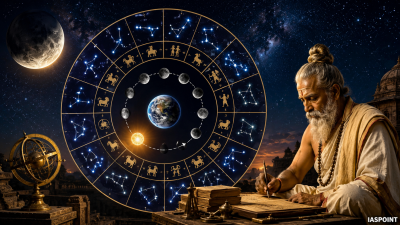
The term Nakshatra refers to the lunar mansions or stellar constellations along the ecliptic (the path of the Sun). While the Sun traverses the 12 signs of the Zodiac (Rashis) in a year, the Moon completes its orbit in approximately 27.3 days. To track this movement, ancient Indian astronomers divided the 360° ecliptic into 27 equal segments, each measuring 13° 20′. Each segment is a Nakshatra, representing the house where the Moon “stays” for approximately one day.
Mathematical Division and Rashi Relationship
The Nakshatra system is more granular than the Rashi (Zodiac) system. There is a precise mathematical correlation between the two:
- Total Ecliptic: 360°.
- 1 Rashi: 30° (Total 12 Rashis).
- 1 Nakshatra: 13° 20′ (Total 27 Nakshatras).
- Padas (Quarters): Each Nakshatra is divided into four Padas of 3° 20′ each.
- Integration: One Rashi contains exactly 2.25 Nakshatras or 9 Padas.
The 27 Nakshatras and their Attributes
Each Nakshatra is associated with a specific deity, a planetary ruler, and a symbolic representation.
| Sequence | Nakshatra Name | Symbol | Governing Deity | Planetary Ruler |
| 1 | Ashwini | Horse’s Head | Ashwini Kumaras | Ketu |
| 2 | Bharani | Yoni (Vessel) | Yama | Venus |
| 3 | Krittika | Knife/Razor | Agni | Sun |
| 4 | Rohini | Cart/Chariot | Brahma/Prajapati | Moon |
| 5 | Mrigashira | Deer’s Head | Soma (Moon) | Mars |
| 6 | Ardra | Teardrop | Rudra | Rahu |
| 7 | Punarvasu | Quiver of Arrows | Aditi | Jupiter |
| 8 | Pushya | Cow’s Udder | Brihaspati | Saturn |
| 9 | Ashlesha | Coiled Serpent | Sarpas | Mercury |
| 10 | Magha | Royal Throne | Pitris | Ketu |
| 11 | Purva Phalguni | Front legs of a bed | Bhaga | Venus |
| 12 | Uttara Phalguni | Back legs of a bed | Aryaman | Sun |
| 13 | Hasta | Hand/Fist | Savitar | Moon |
| 14 | Chitra | Bright Jewel | Vishwakarma | Mars |
| 15 | Swati | Coral/Sword | Vayu | Rahu |
| 16 | Vishakha | Triumphal Arch | Indra-Agni | Jupiter |
| 17 | Anuradha | Lotus/Staff | Mitra | Saturn |
| 18 | Jyeshtha | Umbrella/Earring | Indra | Mercury |
| 19 | Mula | Tied bunch of roots | Nirriti | Ketu |
| 20 | Purva Ashadha | Winnowing basket | Apas (Water) | Venus |
| 21 | Uttara Ashadha | Elephant’s Tusk | Vishvadevas | Sun |
| 22 | Shravana | Three Footprints | Vishnu | Moon |
| 23 | Dhanishta | Drum/Flute | Eight Vasus | Mars |
| 24 | Shatabhisha | Empty Circle/100 Stars | Varuna | Rahu |
| 25 | Purva Bhadrapada | Swords/Funeral Cot | Aja Ekapada | Jupiter |
| 26 | Uttara Bhadrapada | Twins/Back of bed | Ahirbudhnya | Saturn |
| 27 | Revati | Fish/Drum | Pushan | Mercury |
The Abhijit Nakshatra: The “Intercalary” Mansion
In certain Vedic texts and for specific ritualistic purposes (Muhurta), a 28th Nakshatra called Abhijit is recognized.
- Location: It occupies the space between Uttara Ashadha and Shravana.
- Significance: It is considered highly auspicious. In the Mahabharata, it is mentioned that Abhijit slipped out of the sky, leading to the standardization of 27 Nakshatras for calendar purposes.
- Usage: It is generally excluded from the daily lunar calendar but remains vital in Chakra calculations for electional astrology.
Role in Time Reckoning and Cultural Heritage
The Nakshatras are fundamental to the Indian social and religious fabric through the following applications:
- Naming of Months: The lunar months in the Hindu calendar (e.g., Chaitra, Vishakha, Kartika) derive their names from the Nakshatra in which the Moon is full (Purnima) during that month.
- Panchangam: Nakshatra is one of the five “Angas” (limbs) of the Indian almanac. It is used to determine the Muhurta (auspicious time) for marriages, voyages, and religious ceremonies.
- Agricultural Cycles: Specific Nakshatras coincide with monsoon patterns. For instance, the entry of the Sun into Ardra Nakshatra traditionally signals the onset of the rainy season in North India.
- Janma Nakshatra: The Nakshatra in which the Moon is positioned at the time of an individual’s birth is believed to determine their temperament and is used for naming conventions (Naming based on Phonetic padas).
Fact File for UPSC Prelims
- Vedanga Jyotisha: The earliest list of 27 Nakshatras appears in the Vedanga Jyotisha and the Taittiriya Samhita.
- Yogatara: Each Nakshatra has a principal star known as the Yogatara, used for astronomical identification (e.g., Rohini is identified with the star Aldebaran).
- Gana Classification: For matrimonial purposes, Nakshatras are divided into three Ganas: Deva (Divine), Manushya (Human), and Rakshasa (Demonic).
- Geographical Mapping: In ancient texts like the Brihat Samhita of Varahamihira, Nakshatras were mapped to different regions of the Indian subcontinent to predict regional prosperity or calamities.
- Navatara System: A method of calculating the compatibility and auspiciousness of a day by counting from one’s birth Nakshatra to the Nakshatra of the day in groups of nine.