
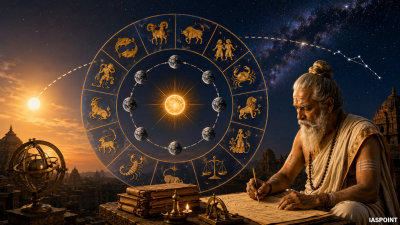
In the Indian astronomical tradition (Jyotisha), the Rashi system represents the division of the ecliptic—the Sun’s apparent path around the Earth—into twelve equal segments. While the lunar-based Nakshatra system is indigenous to the Vedic period, the formal twelve-fold Solar Zodiac (Rashichakra) gained prominence during the Siddhantic era, reflecting a sophisticated synthesis of indigenous observations and Greco-Indian astronomical exchanges.
Mathematical Framework of the Rashichakra
The Indian Solar Zodiac is based on the Sideral (Nirayana) system, which accounts for the precession of the equinoxes, unlike the Tropical (Sayana) system used in Western astrology.
- Total Ecliptic: 360°.
- Single Rashi Span: 30° (360 ÷ 12 = 30).
- Integration with Nakshatras: One Rashi is exactly equal to 2.25 Nakshatras or 9 Padas (quarters).
- Calculation: The Sun stays in each Rashi for approximately one month, completing the full circle in a solar year.
The Twelve Rashis: Attributes and Symbolism
Each Rashi is defined by a specific symbol, a governing planet (Graha), and an elemental nature.
| Sanskrit Name | English Equivalent | Symbol | Governing Planet | Element (Tattva) |
| Mesha | Aries | Ram | Mars (Mangal) | Fire (Agni) |
| Vrishabha | Taurus | Bull | Venus (Shukra) | Earth (Prithvi) |
| Mithuna | Gemini | Twins | Mercury (Budha) | Air (Vayu) |
| Karka | Cancer | Crab | Moon (Chandra) | Water (Jala) |
| Simha | Leo | Lion | Sun (Surya) | Fire (Agni) |
| Kanya | Virgo | Maiden | Mercury (Budha) | Earth (Prithvi) |
| Tula | Libra | Balance/Scale | Venus (Shukra) | Air (Vayu) |
| Vrishchika | Scorpio | Scorpion | Mars (Mangal) | Water (Jala) |
| Dhanu | Sagittarius | Archer/Bow | Jupiter (Guru) | Fire (Agni) |
| Makara | Capricorn | Sea-Goat/Crocodile | Saturn (Shani) | Earth (Prithvi) |
| Kumbha | Aquarius | Water-bearer/Pot | Saturn (Shani) | Air (Vayu) |
| Meena | Pisces | Fish | Jupiter (Guru) | Water (Jala) |
Sankranti: The Temporal Significance of Solar Transit
The moment the Sun moves from one Rashi to another is termed Sankranti. There are twelve Sankrantis in a year, marking the beginning of the solar month in various Indian regional calendars.
- Makar Sankranti: The transit into Makara Rashi. It traditionally marks the beginning of Uttarayana (the northward journey of the Sun), though due to the precession of equinoxes, the astronomical solstice now occurs in late December.
- Mesha Sankranti: The transit into Mesha Rashi. It is celebrated as the Solar New Year in many parts of India, known as Vaisakhi (Punjab), Puthandu (Tamil Nadu), Poila Baisakh (Bengal), and Vishu (Kerala).
- Maha Vishuva Sankranti: Corresponds to the Spring Equinox, historically linked with the month of Chaitra.
Role in Calendars and Time Reckoning
The Rashi system provides the foundational structure for Sauramana (Solar) calendars and influences Luni-Solar calculations.
- Solar Months: In states like Tamil Nadu and Odisha, months are named after the Rashi in which the Sun resides (e.g., Mesha Masa).
- Adhik Masa Calculation: A lunar month is declared an “Adhik Masa” (Extra Month) if no Sankranti (Solar transit) occurs within its duration.
- Kumbh Mela Cycles: The occurrence of the Kumbh Mela is determined by the positions of Jupiter and the Sun in specific Rashis. For example, the Haridwar Kumbh occurs when Jupiter is in Kumbha Rashi and the Sun enters Mesha Rashi.
Fact File for UPSC Aspirants
- Yavanajataka: One of the earliest Indian texts (c. 2nd century CE) to detail the Rashi system, translated from Greek into Sanskrit by Sphujidhvaja.
- Siddhanta Shiromani: Bhaskaracharya’s 12th-century treatise provides precise mathematical formulas for calculating the longitudinal positions of Rashis.
- Nirayana vs. Sayana: Indian calendars primarily use Nirayana (fixed zodiac based on stars), whereas the Rashtriya Panchang (National Calendar) uses a tropical-adjusted system for seasonal accuracy.
- Hora Shastra: A sub-branch of Jyotisha that focuses on the influence of Rashis and Grahas on human time and destiny, famously codified by Varahamihira in the Brihat Jataka.
- Solar Ingress: The entry of the Sun into a Rashi is the basis for the Sauramana month, which typically lasts between 29 to 32 days due to the Earth’s elliptical orbit.