
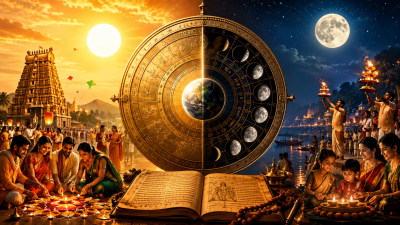
Indian festivals are primarily governed by the Luni-Solar Calendar, a sophisticated system that synchronizes the movements of both the Sun (Solar) and the Moon (Lunar). Unlike the Gregorian calendar, which is purely solar, the Indian system ensures that lunar dates (Tithis) remain aligned with the physical seasons.
Understanding the Luni-Solar Framework
The Indian calendar system, often referred to as the Panchang, relies on five key elements: Tithi (Lunar day), Var (Weekday), Nakshatra (Asterism), Yoga (Luni-solar day), and Karana (Half-luni-solar day).
Solar vs. Lunar Markers
- Solar Cycle (Saurmana): Based on the transit of the Sun through the twelve signs of the Zodiac (Rashis). A Sankranti marks the Sun’s entry into a new Rashi.
- Lunar Cycle (Chandramana): Based on the phases of the Moon. A lunar month typically lasts 29.5 days, spanning from one New Moon (Amavasya) to the next, or one Full Moon (Purnima) to the next.
- The Gap and Adhik Maas: A lunar year is approximately 354 days, while a solar year is 365.25 days. To bridge this 11-day gap, an intercalary month called Adhik Maas (Purushottam Maas) is added roughly every 32.5 months to keep festivals in their respective seasons.
Classification of Festivals Based on Celestial Rhythms
Indian festivals are categorized by whether they follow the Solar transit or the Lunar phase.
Solar-Centric Festivals
These occur on fixed dates relative to the Sun’s position, usually marking the transition of seasons or the harvest.
- Makar Sankranti: Marks the Sun’s entry into Capricorn and the beginning of Uttarayan (the northward journey of the Sun).
- Baisakhi / Vishu / Puthandu: Celebrate the Solar New Year in different regions (Punjab, Kerala, Tamil Nadu) as the Sun enters Aries (Mesha Rashi).
- Pongal: A four-day harvest festival in Tamil Nadu timed with the solar transition.
Lunar-Centric Festivals
The majority of Indian festivals are lunar-based, falling on specific Tithis of the bright fortnight (Shukla Paksha) or dark fortnight (Krishna Paksha).
- Diwali: Observed on the Amavasya (New Moon) of the month of Kartik.
- Holi: Celebrated on the Purnima (Full Moon) of the month of Phalguna.
- Mahashivratri: Observed on the 13th night/14th day of the Krishna Paksha in the month of Maagha or Phalguna.
- Ganesh Chaturthi: Observed on the Chaturthi (4th day) of the Shukla Paksha in Bhadrapada.
Regional Variations in Calendar Reckoning
India employs two primary lunar reckoning systems which determine when a month begins and ends.
| System | Region of Prevalence | Month Definition |
| Amanta | South & West India (Maharashtra, Gujarat, Karnataka, AP, Telangana) | Month ends on Amavasya (New Moon). The new month begins with Shukla Paksha. |
| Purnimanta | North & East India (UP, Bihar, MP, Rajasthan, Haryana) | Month ends on Purnima (Full Moon). The new month begins with Krishna Paksha. |
Key Luni-Solar Festivals and Their Significance
The Spring Equinox and New Years
Most Indian regional New Years coincide with the first waxing moon after the Spring Equinox.
- Chaitra Sukladi: The Vedic New Year.
- Ugadi / Gudi Padwa: Celebrated in the Deccan region on the first day of Chaitra.
- Navreh: The Kashmiri Pandit New Year.
The Monsoon and Post-Monsoon Cycle
- Shravan Festivals: Includes Raksha Bandhan (Purnima) and Janmashtami (Krishna Paksha Ashtami). This period aligns with the height of the monsoon.
- Sharad Navratri: Begins on the first Tithi of Ashvin Shukla Paksha, culminating in Vijayadashami (10th day). It marks the transition from monsoon to autumn.
Important Facts for Prelims
- The National Calendar: India adopted the Saka Era calendar as the National Calendar in 1957. It begins with the month of Chaitra and its first day falls on March 22 (March 21 in leap years).
- Vikram Samvat: An ancient Hindu calendar started in 57 BCE, currently ahead of the Gregorian calendar by 57 years.
- Tithi Calculation: A Tithi is the time taken by the Moon to increase its distance from the Sun by 12 degrees. Because the Moon’s velocity varies, Tithis vary in duration (19 to 26 hours).
- Kumbh Mela: The timing is determined by a complex Luni-Solar alignment involving the positions of Jupiter (Guru), the Sun, and the Moon. For example, the Haridwar Kumbh occurs when Jupiter is in Aquarius and the Sun is in Aries.
Seasonal Transitions (Ritus)
The Luni-Solar system divides the year into six seasons (Ritus), each lasting approximately two lunar months:
- Vasanta (Spring): Chaitra–Vaisakha
- Grishma (Summer): Jyeshtha–Ashadha
- Varsha (Monsoon): Shravana–Bhadrapada
- Sharad (Autumn): Ashvina–Kartika
- Hemanta (Pre-winter): Margashirsha–Pausha
- Shishira (Winter): Magha–Phalguna