
Diwali, or Deepavali (literally “row of lamps”), is the most widely celebrated festival in India. It is a quintessential example of the Indian Luni-Solar calendar’s precision, falling on the Amavasya (New Moon) of the Hindu month of Kartik. While popularly understood as a single day, it is a five-day liturgical cycle that integrates agrarian transitions, mercantile traditions, and diverse mythological narratives.
Astronomical and Calendar Placement
Diwali occurs during the transition from the Sharad Ritu (Autumn) to Hemanta Ritu (Pre-winter).
- The Tithi: It is observed on the 15th day of the dark fortnight (Krishna Paksha) of Kartik.
- The Transition: It marks the end of the monsoon harvest and the beginning of the new winter cropping season.
- The Darkest Night: The lighting of lamps is a symbolic countermeasure to the darkest night of the year, representing the victory of Chit (Consciousness) over Ajnan (Ignorance).
The Five-Day Festive Cycle
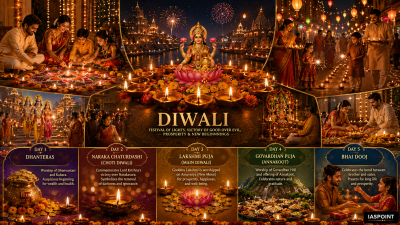
The festival is a composite of five distinct days, each governed by specific rituals and socio-economic significance:
| Day | Name | Significance and Rituals |
| Day 1 | Dhanteras | Marks the birth of Lord Dhanvantari (God of Ayurveda) and the emergence of Lakshmi from the Samudra Manthan. It is an auspicious day for purchasing metal and jewelry. |
| Day 2 | Narak Chaturdashi | Also known as Chhoti Diwali. Commemorates the victory of Krishna and Satyabhama over the demon Narakasura. In South India, the ritual oil bath (Abhyanga Snan) is central. |
| Day 3 | Lakshmi Pujan | The main day of Diwali. Dedicated to Goddess Lakshmi (Wealth) and Lord Ganesha (Wisdom). Business houses perform Chopda Pujan to inaugurate new account books. |
| Day 4 | Govardhan Puja / Balipratipada | Commemorates Krishna lifting the Govardhan hill. In Maharashtra and South India, it celebrates the return of King Bali (Bali Padyami). It also marks the start of the Vikram Samvat New Year in Gujarat. |
| Day 5 | Bhai Dooj | Known as Yama Dwitiya. Celebrates the bond between brothers and sisters, based on the legend of the god of death, Yama, visiting his sister Yamuna. |
Regional Variations and Diverse Mythologies
Diwali is a pan-Indian festival, but its “raison d’être” varies significantly across different cultural zones:
- North India: Celebrates the Return of Lord Rama to Ayodhya after 14 years of exile and his victory over Ravana.
- South India: Focuses on the Slaying of Narakasura by Lord Krishna. It is celebrated a day earlier than in the North (on Chaturdashi).
- Eastern India (Bengal/Odisha): The day is celebrated as Kali Puja. Goddess Kali is worshipped for her strength to destroy ego and evil.
- Jainism: Marks the Nirvana of Lord Mahavira (the 24th Tirthankara) in 527 BCE at Pawapuri.
- Sikhism: Celebrated as Bandi Chhor Divas. It commemorates the release of Guru Hargobind Ji (the 6th Guru) from Gwalior Fort by Emperor Jahangir.
- Buddhism: Some Newar Buddhists (Nepal/India) celebrate it as Ashoka Vijayadashami, the day Emperor Ashoka converted to Buddhism.
Art and Material Culture Associated with Diwali
The festival has historically fostered specific art forms and traditional crafts:
- Sanjhi Art: In Braj (Mathura/Vrindavan), intricate stencils are used to create floral designs on floors or water surfaces during the period leading up to Diwali.
- Rangoli and Alpana: The use of rice flour, limestone powder, and flower petals to create geometric patterns at entrances to welcome Goddess Lakshmi.
- Terracotta Industry: The festival provides a massive economic boost to traditional potters (Kumhars) who craft the Diyas (oil lamps).
- Pattachitra and Miniature Paintings: Several schools of Indian painting (Basohli, Kangra, and Kishangarh) have historically depicted Diwali celebrations within royal courts and rural households.
Socio-Economic and Legal Dimensions for Aspirants
- The National Calendar vs. Religious Dates: While the Indian National Calendar (Saka) is official, Diwali is calculated using the Vikram Samvat or local Luni-solar calendars, leading to occasional date variations between regions.
- Economic Impact: Diwali serves as the “Quarter of Consumption,” where the Indian retail, gold, and textile sectors witness their highest annual turnovers.
- Environment and Judiciary: In recent years, the Supreme Court of India has intervened regarding firecracker bans to balance the “Right to Environment” (Article 21) with religious practices, leading to the development of Green Crackers by CSIR-NEERI.
Historical Trivia
- Mughal Participation: Historical records like the Ain-i-Akbari mention that Emperor Akbar celebrated Diwali as Jashn-e-Chiraghan (Festival of Lights) and used it as a platform to interact with the Rajput nobility.
- The Golden Temple: The foundation stone of the Golden Temple (Harmandir Sahib) was laid on a Diwali day in 1577.
- The Legend of King Bali: In some traditions, Diwali is the time when the “Vamana” avatar of Vishnu pushed King Bali into the netherworld, granting him a boon to return to Earth once a year.