
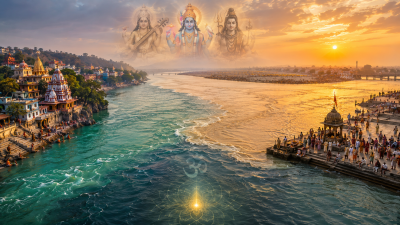
In Indian sacred geography, the term Sangam (derived from the Sanskrit Sam-gam, meaning “to flow together”) refers to the confluence of two or more rivers. These junctions are considered highly auspicious zones where the combined spiritual energy of the water bodies creates a “Tirtha” or a crossing point between the physical and divine realms. Metaphorically, a Sangam represents the union of diverse paths—wisdom, devotion, and action—leading to spiritual liberation (Moksha).
The Prayag Raj: King of Confluences
The most significant Sangam in India is located at Prayagraj (formerly Allahabad), Uttar Pradesh. It is known as Triveni Sangam because it marks the confluence of three rivers:
- The Ganga: Symbolizing the path of Karma (action) and purity.
- The Yamuna: Symbolizing the path of Bhakti (devotion) and the daughter of the Sun.
- The Saraswati: A mythical/subterranean river symbolizing the path of Jnana (knowledge).
Significance of the Triveni Sangam
- Kumbh Mela: Prayagraj is the primary site for the Maha Kumbh Mela, held every 12 years when Jupiter is in Taurus and the Sun/Moon are in Capricorn.
- Akshaya Vat: The “Indestructible Banyan Tree” located within the Allahabad Fort near the Sangam, mentioned by the Chinese traveler Xuanzang (Hiuen Tsang).
- Ritual Merit: Taking a dip at the Sangam during Magh Mela is believed to cleanse the soul of lifetimes of transgressions.
The Panch Prayag of Uttarakhand
The Himalayan landscape features a unique system of five sacred confluences along the Alaknanda river, known as the Panch Prayag. These sites are essential for pilgrims on the Badrinath circuit.
| Name of Prayag | Rivers Meeting | Notable Fact |
|---|---|---|
| Vishnuprayag | Alaknanda + Dhauliganga | Associated with Sage Narada’s penance to Lord Vishnu. |
| Nandaprayag | Alaknanda + Nandakini | Named after the Yadava King Nanda; site of ancient stone temples. |
| Karnaprayag | Alaknanda + Pindar | Where the tragic hero Karna of Mahabharata meditated on the Sun God. |
| Rudraprayag | Alaknanda + Mandakini | Named after Shiva’s ‘Rudra’ form; the junction leading to Kedarnath. |
| Devprayag | Alaknanda + Bhagirathi | The final confluence where the river officially takes the name Ganga. |
Major Sangams in Central and Southern India
The concept of Sangam extends beyond the Indo-Gangetic plains, anchoring the sacred geography of the Deccan and the Peninsula.
The Koodli Sangam (Karnataka)
Located near Shimoga, this is the confluence of the Tunga and Bhadra rivers. It is the site where the rivers merge to form the Tungabhadra. It houses a historical matha established by the disciples of Adi Shankara.
The Bhavani Sangam (Tamil Nadu)
Known as the Kooduthurai, it is the confluence of the Kaveri, Bhavani, and the mythical Amudha rivers. It is home to the Sangameswarar Temple, representing the integration of Shaiva and Vaishnava traditions in the Chola-Chera frontier.
The Sangam at Paithan (Maharashtra)
The Godavari river system features several sacred junctions, most notably at Paithan (ancient Pratishthana), where the river’s flow is considered particularly holy for Pitru-tarpana (ancestral rites).
Socio-Cultural and Economic Dimensions of Sangams
Sangams have historically functioned as more than just religious sites; they are nodes of cultural and economic exchange.
- Trade Hubs: Because confluences were natural transit points, cities built near Sangams (like Patna at the Son-Ganga confluence or Prayagraj) became major commercial centers.
- Centers of Learning: Many Sangams hosted Pathshalas and Ghats where philosophical debates and Sanskrit education flourished.
- Cultural Symbiosis: Sangams often bridge regional identities. For instance, the Indo-Islamic architecture of the Allahabad Fort at the Triveni Sangam represents a layer of political history over sacred geography.
Ritual Practices and Hydrological Sanctity
The rituals performed at a Sangam are distinct from those at single-river banks:
- Sangam Snana: Bathing at the exact point where the currents meet is considered the most meritorious act.
- Asthi Visarjan: Immersion of ashes at a Sangam is believed to grant the departed soul safe passage to the ancestral realm.
- Deep Daan: Offering lamps to the combined waters during dusk is a major visual and spiritual feature of Sangam landscapes.
Fact File for UPSC Prelims
- The ‘Invisible’ Saraswati: While modern geologists debate the Paleochannel of the Saraswati in Haryana and Rajasthan, in sacred geography, it is considered “Gupt” (hidden) at Prayagraj.
- Teerthraj: Prayagraj is titled the “King of all Tirthas” because it contains the merits of all other sacred sites combined.
- River Colors: At many Sangams, the difference in the color of the silt allows the eye to distinguish the two rivers even after they merge (e.g., the muddy Alaknanda vs. the clear Bhagirathi at Devprayag).
- Purna Kumbh Rotation: Apart from Prayagraj, Haridwar (Ganga), Nashik (Godavari), and Ujjain (Kshipra) host Kumbh Melas, though they are not all “confluences” in the strict geological sense like Prayagraj.
Trivia: The Smallest Sangam?
In some traditions, the meeting of a small village stream with a major river is treated with the same ritualistic reverence as a major Sangam, provided the local deity has sanctioned the spot. This highlights the Scalability of Indian sacred geography, where the “Universal” (Triveni) is reflected in the “Local.”
Last Modified: May 7, 2026