

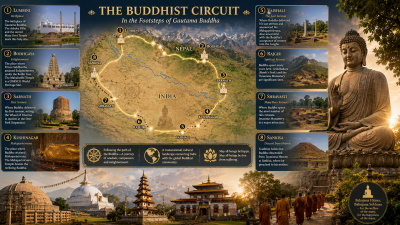
The Buddhist Circuit refers to the sacred geography tracing the life and spiritual journey of Gautama Buddha. In the context of Indian art, culture, and heritage, this circuit is not merely a collection of archaeological sites but a “transnational cultural landscape” that connects India with the global Buddhist community. It follows the traditional “Mahaparinirvana Sutra” which identifies four primary sites of pilgrimage, later expanded into the Ashta-maha-sthanas (Eight Great Places).
The Core Quadrant: The Four Primary Holy Sites
These sites represent the four major milestones in the life of the Buddha: Birth, Enlightenment, First Sermon, and Death.
| Site | Location | Significance | Major Landmark |
| Lumbini | Nepal (near Indo-Nepal border) | Birthplace of Prince Siddhartha (563 BCE). | Ashokan Pillar, Maya Devi Temple. |
| Bodh Gaya | Bihar | Site of Enlightenment (Nirvana) under the Bodhi Tree. | Mahabodhi Temple (UNESCO World Heritage). |
| Sarnath | Uttar Pradesh | First Sermon (Dhammacakkappavattana Sutta). | Dhamekh Stupa, Ashokan Lion Capital. |
| Kushinagar | Uttar Pradesh | Site of Death and Final Liberation (Mahaparinirvana). | Parinirvana Stupa and reclining Buddha statue. |
The Ashta-maha-sthanas: The Eight Great Places
Beyond the primary four, the Buddhist sacred geography includes four additional sites where the Buddha performed significant miracles (Pratiharyas).
- Sravasti (Uttar Pradesh): The capital of Kosala where Buddha spent 24 rainy seasons (Vassavasa). Famous for the “Great Miracle” where he multiplied his form.
- Sankissa (Uttar Pradesh): Believed to be the place where Buddha descended from the Tushita Heaven after preaching to his mother.
- Rajgir (Bihar): The capital of Magadha; site of the Gridhrakuta (Vulture Peak) where the Heart Sutra was preached and the First Buddhist Council was held.
- Vaishali (Bihar): Site of the Buddha’s last sermon; notable for the Ashokan pillar topped by a single lion and the site of the Second Buddhist Council.
Architectural and Artistic Evolution of the Circuit
The Buddhist circuit was the cradle for the development of Indian monumental architecture and sculpture.
Stupa Architecture
The Stupa evolved from a simple burial mound into a complex symbol of the Buddhist cosmos. Key elements include the Harmika (square railing), Yashti (spire), and Chattras (umbrellas).
- Example: The Dhamekh Stupa at Sarnath exhibits intricate Gupta-period floral carvings and geometric patterns.
Chaityas and Viharas
The landscape is dotted with rock-cut and structural architecture:
- Chaityas: Prayer halls (e.g., Karle, Ajanta).
- Viharas: Monastic residences (e.g., Nalanda, Vikramshila).
Iconography and Schools of Art
- Gandhara School: Grecco-Buddhist influence, seen in the realistic drapery of Buddha statues.
- Mathura School: Indigenous style, producing the first human representations of Buddha with robust, fleshy forms.
- Sarnath School: Known for the “chauras” (sublime) expressions and the “Wet Drapery” style of the Gupta era.
Transnational Sacred Geography: The Extended Circuits
The Buddhist cultural landscape extends beyond the heartland of the Gangetic plains into specialized regional circuits.
- The Kapilavastu Circuit: Exploring the ruins of the Shakya capital at Piprahwa (Uttar Pradesh).
- The Andhra (Dhanyakataka) Circuit: Home to the great Stupas of Amaravati and Nagarjunakonda, representing the Mahayana and Vajrayana transition.
- The Odisha (Diamond) Triangle: Comprising Ratnagiri, Udayagiri, and Lalitgiri, which were centers of Tantric Buddhism (Vajrayana).
- The Himalayan (Vajrayana) Circuit: Including monasteries in Ladakh (Hemis, Thiksey), Himachal Pradesh (Tabo), and Sikkim (Rumtek).
Socio-Cultural and Economic Integration
- Monastic Universities: The circuit gave rise to global educational hubs like Nalanda, Vikramshila, Odantapuri, and Somapura, attracting scholars from China, Tibet, and Korea.
- Trade Routes: Sacred sites were often located along the Uttarapatha (Northern trade route), ensuring that religious ideas traveled with merchants and caravans.
- SWADESH Darshan Scheme: The Government of India has identified the Buddhist Circuit as one of the thematic circuits for world-class infrastructure development to promote “spiritual tourism.”
Fact File for UPSC Prelims
- The Mahabodhi Temple: A unique brick structure from the late Gupta period; it is one of the oldest brick temples surviving in India.
- Relic Caskets: The discovery of bone fragments in a casket at Piprahwa is often cited as archaeological evidence of the historical Buddha.
- The Lion Capital: Found at Sarnath, it is the National Emblem of India, symbolizing the “Lion’s Roar” of the Buddha’s teachings spreading in four directions.
- Bodh Gaya’s Bodhi Tree: The current tree is believed to be the fifth generation of the original tree under which Siddhartha meditated.
- International Presence: Many Buddhist nations (Thailand, Japan, Myanmar, Tibet) have built temples in their national architectural styles at Bodh Gaya and Sarnath, making the circuit a “Global Village of Buddhism.”
Trivia: The ‘Invisible’ Footprints
In early Buddhist art (Aniconic phase), the Buddha was never represented in human form. Instead, the sacred geography was marked by symbols like the Bodhi Tree (Enlightenment), the Dharmachakra (First Sermon), the Stupa (Nirvana), and the Buddhadas (Footprints), which are still found carved at various sites across the circuit.
Last Modified: May 7, 2026