

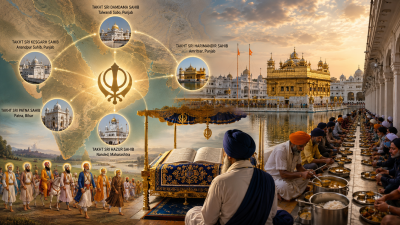
The sacred geography of Sikhism is defined by the life journeys of the ten Gurus and the establishment of centers for Sangat (congregation) and Pangat (communal kitchen). Unlike traditional “static” pilgrimage, Sikh sacred space is functional and egalitarian, centered around the presence of the Guru Granth Sahib. The landscape is anchored by the Five Takhts (Thrones of Authority), which serve as the temporal and spiritual headquarters for the global Sikh community.
The Five Takhts: Seats of Temporal Authority
The Takhts are the highest seats of religious authority where the Hukamnamas (edicts) are issued. While four are associated with Guru Gobind Singh, the first was established by Guru Hargobind.
| Takht Name | Location | Associated Guru | Significance |
| Akal Takht Sahib | Amritsar, Punjab | Guru Hargobind | The “Throne of the Timeless One”; oldest Takht, located opposite the Golden Temple. |
| Takht Sri Damdama Sahib | Talwandi Sabo, Punjab | Guru Gobind Singh | Known as the “Guru’s Kashi”; where the full version of Guru Granth Sahib was prepared. |
| Takht Sri Keshgarh Sahib | Anandpur Sahib, Punjab | Guru Gobind Singh | The birthplace of the Khalsa (1699) during the Baisakhi festival. |
| Takht Sri Patna Sahib | Patna, Bihar | Guru Gobind Singh | The birthplace of the tenth Guru; significant for the spread of Sikhism in eastern India. |
| Takht Sri Hazur Sahib | Nanded, Maharashtra | Guru Gobind Singh | The site of the Guru’s Abchal Nagar (final rest) and where Guruship was passed to the Granth Sahib. |
Evolution of the Gurdwara Landscape
Gurdwaras (Gateways to the Guru) form the primary cultural landscape of Sikhism. Their distribution follows the “Udasian” (travels) of Guru Nanak and the defensive fortifications of the later Gurus.
Major Historical Gurdwaras
- Sri Harmandir Sahib (Golden Temple): Designed by Guru Arjan Dev to be open from all four sides, symbolizing welcome to all castes and religions. The foundation stone was laid by the Sufi saint Mian Mir.
- Gurdwara Janam Asthan (Nankana Sahib): Located in Pakistan, it marks the birthplace of Guru Nanak Dev.
- Gurdwara Darbar Sahib (Kartarpur): Located in Pakistan, where Guru Nanak spent the final 18 years of his life and established the first Sikh commune.
- Gurdwara Bangla Sahib: Located in Delhi, associated with Guru Harkrishan; famous for the “healing” waters of its Sarovar.
Architectural Characteristics of Sikh Shrines
Sikh architecture is a unique synthesis of Mughal and Rajput styles, often referred to as the “Sikh School of Architecture.”
- Domes and Fluted Cupolas: Use of the Gumbad (dome) topped with an inverted lotus and a Kalash.
- Jharokhas and Chhatris: Integration of balconies and kiosks to provide a sense of lightness and ventilation.
- Frescoes and Inlay: Intricate floral designs and Mohrakaashi (fresco painting) often depicting themes from the life of the Gurus.
- The Sarovar: Large holy tanks for ablution, which are central to the spatial planning of major Gurdwaras like Amritsar and Tarn Taran.
Socio-Cultural Landscape: Langar and Sewa
The Sikh cultural landscape is defined by its social practices as much as its physical structures.
- Langar (Communal Kitchen): An institutionalized practice to abolish caste distinctions through communal dining. It is a mandatory feature of every Gurdwara.
- Sewa (Voluntary Service): The maintenance of the sacred landscape—cleaning, cooking, and shoe-keeping—is performed by the devotees, making the site a “Living Heritage.”
- Sarai: Guest houses that provide free lodging, reflecting the Sikh ethos of hospitality and the “Sikh Caravan” heritage.
Panj Pyare and the Khalsa Landscape
The geography of the Khalsa is linked to the Panj Pyare (Five Beloved Ones), who came from different corners of the Indian subcontinent to Anandpur Sahib:
- Bhai Daya Ram (Lahore, Punjab)
- Bhai Dharam Das (Hastinapur, Uttar Pradesh)
- Bhai Himmat Rai (Puri, Odisha)
- Bhai Mohkam Chand (Dwarka, Gujarat)
- Bhai Sahib Chand (Bidar, Karnataka)
This geographic diversity in the first Khalsa initiation highlights the pan-Indian reach of the Sikh movement in the 17th century.
Fact File for UPSC Prelims
- SGPC (Shiromani Gurdwara Parbandhak Committee): An apex body created under the Sikh Gurdwaras Act, 1925, to manage historical shrines in Punjab, Haryana, and Himachal Pradesh.
- The Kartarpur Corridor: A visa-free border crossing connecting Dera Baba Nanak (India) to Kartarpur Sahib (Pakistan), representing a “transnational” sacred geography.
- Hemkund Sahib: Located in the Himalayas at an altitude of 15,000 ft; it is the highest Gurdwara, associated with the meditation of Guru Gobind Singh in his previous life (as mentioned in Bachittar Natak).
- Nishan Sahib: The triangular saffron flag seen at every Gurdwara, signifying a place of refuge and the presence of the Guru.
- Hola Mohalla: A military-style festival celebrated at Anandpur Sahib, showcasing the martial heritage (Gatka) of the Khalsa.
Trivia: The “Kashi” of Sikhism
Takht Sri Damdama Sahib is called the “Guru’s Kashi” (center of learning) because Guru Gobind Singh stayed here for nine months, making it a hub for literary activity and the preparation of the definitive version of the Guru Granth Sahib. It remains a primary center for Sikh theology and education today.
Last Modified: May 7, 2026