
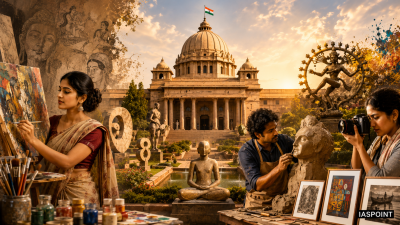
The Lalit Kala Akademi (National Academy of Art) is India’s apex body for the promotion and propagation of visual arts. Established as an autonomous organization under the Ministry of Culture, it focuses on the study and research of creative arts such as painting, sculpture, graphics, and photography. It serves as a bridge between Indian artists and the global art community, fostering a deeper understanding of aesthetic sensibilities.
Historical Genesis and Institutional Framework
- Establishment: Inagurated on August 5, 1954, by Maulana Abul Kalam Azad, the then Minister for Education.
- Legal Status: Registered under the Societies Registration Act, 1860, in the year 1957.
- Headquarters: Housed in Rabindra Bhavan, New Delhi, a landmark cultural hub designed by architect Habib Rahman.
- First Chairman: The renowned sculptor Devi Prasad Roy Chowdhury.
Key Objectives and Functions
The Akademi operates with the mandate to promote the “fine arts” (Lalit Kala) through structured patronage and public engagement.
- Promotion of Contemporary Art: Encouraging new movements and individual expressions in modern Indian art.
- Art Education: Organizing workshops, seminars, and lectures to disseminate knowledge on art history and techniques.
- Preservation: Documenting traditional and folk art forms that are at risk of fading away.
- International Exchange: Organizing the participation of Indian artists in international biennials and triennials and hosting foreign art exhibitions in India.
Major Awards and Honours
The Lalit Kala Akademi recognizes excellence through several tiers of awards that carry significant prestige in the Indian art world.
| Award / Honour | Details and Significance |
| Lalit Kala Akademi Ratna (Fellowship) | The highest honor conferred by the Akademi. It is limited to 40 living eminent artists at any given time. |
| National Art Award | Conferred annually to outstanding artists in various categories during the National Exhibition of Art. |
| Kala Vibhushan | A special category of recognition for veteran artists who have made lifelong contributions to the field. |
Regional Centers and Specialized Facilities
To ensure a decentralized approach to art promotion, the Akademi operates several regional centers and workshops known as Rashtriya Lalit Kala Kendras.
- Regional Centers: Located in Lucknow, Kolkata, Chennai, Garhi (New Delhi), Bhubaneswar, and Shimla.
- Garhi Artist Studios (New Delhi): A unique facility providing subsidized studio spaces for painters, sculptors, and graphic artists to work in a communal environment.
- Workshops: The centers are equipped with facilities for lithography, etching, ceramics, and wood-carving, providing technical support to budding artists.
Key Events and Publications
- National Exhibition of Art: An annual event that provides a platform for both established and emerging artists to showcase their works.
- Triennale-India: An international exhibition of contemporary art organized once every three years, inviting artists from across the globe to India.
- Lalit Kala Contemporary: A high-quality journal focusing on contemporary art trends and criticism.
- Lalit Kala Ancient: A journal dedicated to research on traditional and ancient Indian art and aesthetics.
Cultural Schemes and Digital Initiatives
- Financial Assistance: The Akademi provides grants to state academies and recognized art institutions to organize local exhibitions and seminars.
- Scholarships: Annual scholarships are awarded to young artists (between 20-35 years) to pursue their creative work in the Akademi’s regional workshops.
- Digital Archive: A massive project to digitize the Akademi’s collection of contemporary Indian art, making it accessible to researchers and students worldwide.
Facts and Trivia for UPSC Prelims
- The Symbol: The emblem of the Lalit Kala Akademi is a stylized representation of a peacock, symbolizing beauty and the aesthetic tradition of India.
- Pioneer Leadership: Notable chairmen have included art historian Ananda Coomaraswamy (posthumously influential) and Mulk Raj Anand.
- Scope of Recognition: Unlike Sangeet Natak (Performing Arts) or Sahitya (Literature), Lalit Kala specifically focuses on Plastic Arts (visual arts that involve molding or modeling, such as sculpture or ceramics).
- UNESCO Collaboration: The Akademi frequently collaborates with UNESCO to promote Indian visual heritage on international platforms.
- Rashtriya Kala Mela: A massive art fair organized by the Akademi to allow direct interaction between artists and the public, facilitating the sale of art without intermediaries.