
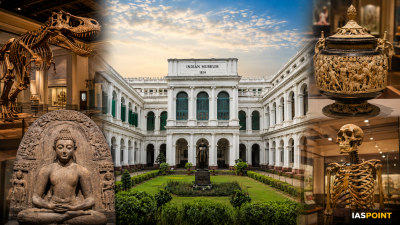
The Indian Museum in Kolkata, popularly known as Jadu Ghar (House of Magic), is the oldest and largest multi-purpose museum not only in India but in the Asia-Pacific region. Founded in 1814, it functions as an autonomous organization under the Ministry of Culture, Government of India. It is recognized as an “Institution of National Importance” under the Seventh Schedule of the Constitution of India.
Historical Genesis and Evolution
The museum’s history is inextricably linked to the beginnings of modern scientific research in India.
- Establishment: It was founded by the Asiatic Society of Bengal in 1814.
- The Founder: Dr. Nathaniel Wallich, a Danish botanist, was the guiding spirit and the first curator of the museum.
- Original Name: It was initially known as the “Asiatic Society Museum” and later as the “Imperial Museum at Calcutta.”
- Current Structure: The present magnificent Italianate building, designed by architect Walter R. Granville, was completed in 1875 and opened to the public in 1878.
Administrative and Functional Sections
The Indian Museum is uniquely diverse, containing six multidisciplinary sections which are further divided into over 35 galleries.
| Section | Scope of Collection |
| Archaeology | Sculptures from Bharhut, Gandhara, and Mathura; coins; and inscriptions. |
| Art | Textiles, paintings, ivory, glass, and silver objects from India and neighboring countries. |
| Anthropology | Tribal artifacts, masks, and physical anthropology (human evolution). |
| Zoology | Managed by the Zoological Survey of India (ZSI); features skeletal remains and taxidermy. |
| Geology | Managed by the Geological Survey of India (GSI); features meteorites and fossils. |
| Botany | Managed by the Botanical Survey of India (BSI); focuses on economic botany and plant life. |
Major Archaeological and Artistic Highlights
The museum houses some of the most significant artifacts in the history of the Indian subcontinent.
- The Bharhut Gallery: This is the most famous section of the museum, containing the railings and the gateway of the Bharhut Stupa (2nd Century BCE). It is critical for studying Sunga period art and Jataka tales.
- The Egyptian Mummy: One of the few authentic mummies in India, belonging to the Ptolemaic era (c. 4000 years old).
- The Gandhara Gallery: Features a vast collection of Greco-Buddhist sculptures, including the life-sized “Fastings Siddhartha.”
- Coin Collection: One of the richest numismatic collections in the world, including gold coins of the Kushanas, Guptas, and various Mughal emperors.
- The Ashokan Pillar: Houses the sandstone Bull Capital from Rampurva (Bihar), a masterpiece of Mauryan polish and animal sculpture.
Scientific Sections: Zoology and Geology
Unlike the National Museum in Delhi, the Indian Museum maintains extensive scientific galleries.
- Siwalik Fossils: A massive collection of prehistoric animal fossils from the Siwalik Hills, including extinct varieties of elephants and giraffes.
- Meteorite Collection: One of the largest collections of meteorites in Asia, including rare stony and iron meteorites that fell across the subcontinent.
- Zoological Specimens: Includes the skeleton of a massive blue whale and rare specimens of the Royal Bengal Tiger.
Key Functions and Cultural Impact
- Conservation Unit: The museum maintains a sophisticated laboratory for the preservation of organic (textiles, manuscripts) and inorganic (stone, metal) artifacts.
- Library: It houses a rare collection of over 50,000 books and journals, many dating back to the 19th century, focusing on Museology, Archaeology, and Anthropology.
- Educational Outreach: The museum conducts mobile exhibitions through “Museo-Buses” to reach rural students and organizes the “Object of the Month” display.
- Publication: It publishes the Indian Museum Bulletin, a prestigious annual journal featuring peer-reviewed research on art and heritage.
Facts and Trivia for UPSC Prelims
- Oldest in Asia: It preceded the establishment of other major Asian museums, earning it the title “The Mother of Museums.”
- The Kalpavruksha: The museum houses the famous Besnagar Yakshi and the Kalpavruksha (Wish-fulfilling tree) capital, which is a rare 2nd-century BCE stone sculpture.
- UNESCO Connection: The museum has been part of various international heritage conservation projects and serves as a primary site for the study of South Asian iconography.
- Legal Framework: It is governed by the Indian Museum Act of 1910, which has been amended over time to modernize its administration.
- Location: Situated on Jawaharlal Nehru Road (formerly Chowringhee Road) in Kolkata, it remains a central landmark of the city’s “White Town” colonial architecture.