
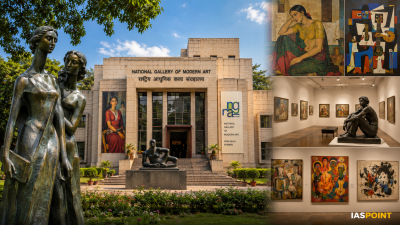
The National Gallery of Modern Art (NGMA) is the premier institution in India for the promotion, preservation, and display of modern and contemporary visual arts. Functioning as a subordinate office under the Ministry of Culture, it serves as the custodian of India’s artistic evolution from the mid-19th century to the present. The gallery provides a comprehensive view of the changing aesthetic sensibilities of the Indian subcontinent as it transitioned from traditional styles to modernism.
Historical Genesis and Locations
The NGMA was established to fill a void in the national cultural landscape specifically dedicated to modern art, distinguishing itself from the National Museum which focuses on ancient and medieval periods.
- Inauguration: The first NGMA was opened on March 29, 1954, at Jaipur House, New Delhi, by Dr. S. Radhakrishnan, the then Vice-President of India.
- Architecture (New Delhi): The gallery is housed in Jaipur House, the former butterfly-shaped winter residence of the Maharaja of Jaipur, designed by architect Blomfield in the early 20th century.
- Expansion: To ensure a pan-India presence, regional centers were later established:
- NGMA Mumbai (1996): Housed in the historic Sir Cowasji Jehangir Public Hall.
- NGMA Bengaluru (2009): Located in the heritage Manikyavelu Mansion.
The Core Collection and Artistic Movements
The NGMA houses over 17,000 works of art, including paintings, sculptures, graphics, and photographs. The collection is categorized to reflect the major milestones of Indian modernism.
| Movement/Category | Key Artists | Characteristics |
| Early Modernism & Company School | Thomas Daniell, William Daniell | European techniques applied to Indian subjects; transition from traditional patronage. |
| Raja Ravi Varma | Raja Ravi Varma | Synthesis of Indian mythological themes with European academic realism and oil painting. |
| Bengal School | Abanindranath Tagore, Nandalal Bose | A nationalist movement rejecting Western oil painting in favor of Japanese wash techniques and indigenous themes. |
| Amrita Sher-Gil | Amrita Sher-Gil | Bridging Western avant-garde styles with rural Indian subjects; known as the “Frida Kahlo of India.” |
| Progressive Artists’ Group (PAG) | F.N. Souza, S.H. Raza, M.F. Husain | Post-independence movement seeking a bold, international language for Indian art. |
| Modern Sculptors | Ramkinkar Baij, Devi Prasad Roy Chowdhury | Introduction of monumental public sculptures and use of non-traditional materials like cement and laterite. |
Major Functions and Specialized Units
The NGMA is not merely a gallery but a center for academic research and technical preservation in the field of visual arts.
- Restoration and Conservation Laboratory: A specialized wing dedicated to the scientific preservation of modern artworks, which often use experimental materials prone to rapid decay.
- Art Reference Library: Houses an extensive collection of rare art books, journals, and periodicals, serving as a primary resource for art historians and research scholars.
- Educational Outreach: Conducts regular “Sketching Clubs,” “Film Screenings” on artists’ lives, and guided tours to bridge the gap between the public and modern art.
- Specialized Publications: The gallery publishes high-quality catalogs of its permanent collection and retrospective volumes on eminent Indian artists.
Key Artworks and Masterpieces for UPSC
Aspirants should be familiar with specific iconic works housed in the NGMA that represent turning points in Indian history:
- “Sati” by Nandalal Bose: A defining work of the Bengal School.
- “Self Portrait” by Amrita Sher-Gil: Highlighting her unique blend of Hungarian and Indian influences.
- “Bapuji” (Linocut) by Nandalal Bose: The famous silhouette of Mahatma Gandhi during the Dandi March.
- “Zamin” by M.F. Husain: A massive mural-like painting reflecting the agrarian soul of India.
- “Triumph of Labour” by D.P. Roy Chowdhury: An iconic bronze sculpture located outside the gallery (and at Marina Beach) depicting human struggle and dignity.
Virtual Museums and Digital Initiatives
In alignment with the Digital India mission, the NGMA has expanded its reach through technological interventions:
- Virtual Gallery Tours: High-resolution digital walkthroughs of the New Delhi, Mumbai, and Bengaluru branches.
- Audio-Visual Archives: Interviews with veteran artists and documentation of significant art movements.
- Social Media Campaigns: Initiatives like “NGMA Ke Sangrah Se” (From the Collections of NGMA) to share art history daily with the public.
Facts and Trivia for UPSC Prelims
- International Participation: The NGMA is the nodal agency for organizing “Exhibitions of Indian Art” in major international festivals and biennials, such as the Venice Biennale.
- The “Nine Masters”: The NGMA collection includes works by the nine artists whose works are considered “Art Treasures” under the Antiquities and Art Treasures Act, 1972: Raja Ravi Varma, Amrita Sher-Gil, Rabindranath Tagore, Abanindranath Tagore, Gaganendranath Tagore, Nandalal Bose, Jamini Roy, Sailoz Mookherjea, and Nicholas Roerich.
- Acquisition Committee: Artworks are inducted into the NGMA only after approval by an expert Art Purchase Committee (APC), ensuring the highest standards of artistic merit.
- Herman Goetz: The first director of the NGMA, a renowned German art historian who played a pivotal role in organizing the initial collection.