
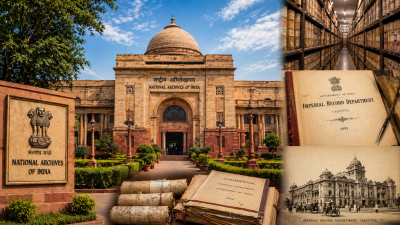
The National Archives of India (NAI) is the primary repository of the non-current records of the Government of India. It was originally established as the Imperial Record Department (IRD) on March 11, 1891, at Calcutta (now Kolkata). Following the transfer of the capital from Calcutta to Delhi in 1911, the IRD was shifted to its present building in 1926. The iconic building was designed by Sir Edwin Lutyens. Post-Independence, the IRD was renamed the National Archives of India, and the Head of the Department was redesignated from Keeper of Records to the Director of Archives.
Administrative Framework and Mandate
The NAI functions as an Attached Office under the Ministry of Culture. It serves as the central nodal agency for the implementation of the Public Records Act, 1993, and the Public Records Rules, 1997. Its primary mandate involves the acquisition, preservation, and conservation of public records, as well as providing access to research scholars and various government agencies.
Classification of Holdings and Collections
The NAI houses a vast collection of records spanning several centuries, categorized by their origin and nature:
- Public Records: These include files from the East India Company, the British Raj, and post-Independence ministries.
- Private Papers: Collections of eminent Indians who contributed to the national movement, such as Mahatma Gandhi, Rajendra Prasad, and Dadabhai Naoroji.
- Oriental Records: Documents in Persian, Sanskrit, Arabic, and Urdu, providing insights into medieval and early modern Indian history.
- Cartographic Records: A significant collection of historical maps, including those from the Survey of India.
| Record Category | Key Highlights/Examples |
| Oldest Record | A manuscript on birch bark dating back to the 6th century AD (Gilgit Manuscripts). |
| Foreign Records | Microfilm copies of records related to India acquired from the UK, France, and The Netherlands. |
| Treaties | Original copies of the Treaty of Seringapatam (1792) and the Treaty of Lahore (1846). |
| Persian Correspondence | Extensive diplomatic and administrative letters from the Mughal era and Princely States. |
Conservation and Digitization Initiatives
The NAI employs advanced scientific methods for the physical and chemical preservation of fragile documents.
- Reprography Services: Providing microfilming and digital imaging of records to prevent wear and tear of original manuscripts.
- Abhilekh Patal: A dedicated web portal launched for the search and retrieval of digitized records, facilitating global access for researchers.
- Repair Techniques: Utilization of traditional tissue repair, lamination, and de-acidification processes to extend the shelf life of paper-based records.
School of Archival Studies
To foster professional expertise in the field of records management, the NAI operates the School of Archival Studies. It offers a Diploma in Archives and Records Management, alongside various short-term certificate courses in:
- Reprography and Digitization.
- Servicing and Repair of Records.
- Conservation of Manuscripts.
Significance for UPSC Prelims
- Nodal Ministry: Ministry of Culture.
- Statutory Basis: Public Records Act, 1993.
- Architectural Heritage: Designed by Edwin Lutyens as part of the “Central View” of New Delhi.
- UNESCO Recognition: The NAI holds the Gilgit Manuscripts, which are included in the UNESCO Memory of the World Register.
- Regional Centers: The NAI has a regional office at Bhopal and three record centers at Bhubaneswar, Jaipur, and Puducherry.
Notable Trivia and Facts
- The NAI is the largest archival repository in South Asia.
- It celebrates Archives Week annually to sensitize the public about the importance of preserving documentary heritage.
- The first Keeper of Records was G.W. Forrest, who was instrumental in the systematic organization of the East India Company’s records.
- The NAI also functions as the Secretariat for the Indian Historical Records Commission (IHRC), an advisory body on archival matters.