
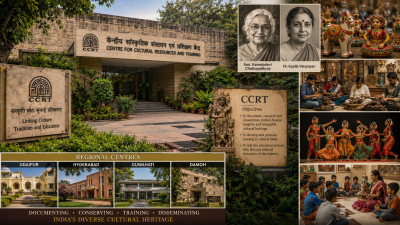
The Centre for Cultural Resources and Training (CCRT) is a premier autonomous organization established in 1979 at the initiative of Smt. Kamaladevi Chattopadhyay and Dr. Kapila Vatsyayan. Functioning under the aegis of the Ministry of Culture, Government of India, its headquarters is located in New Delhi, with regional centers in Udaipur, Hyderabad, Guwahati, and Damoh. It serves as a vital link between the formal education system and the diverse cultural heritage of India.
Mandate and Core Philosophy
The primary objective of CCRT is to revitalize the education system by creating an awareness of the fundamental unity of Indian culture. It operates on the philosophy of “Cultural Education,” aiming to integrate the artistic and cultural expressions of the country into the classroom curriculum. It emphasizes that education should not merely be academic but should also foster an emotional and spiritual connection with the nation’s heritage.
Key Functions and Activities
The CCRT performs a variety of functions aimed at teachers, students, and educational administrators:
- Training Programmes: It organizes specialized training for in-service teachers, teacher educators, and administrators to help them understand the nuances of Indian art, music, dance, and crafts.
- Production of Educational Material: The centre produces and distributes a wide range of audio-visual and printed materials, including kits, charts, slides, and films on Indian culture.
- Cultural Talent Search Scholarship Scheme: This is a flagship initiative aimed at identifying and nurturing young talent in various artistic fields.
- Workshops and Refresher Courses: These are designed to update teachers on new pedagogical tools for teaching history and culture.
The Cultural Talent Search Scholarship (CTSS) Scheme
One of the most significant contributions of CCRT to the preservation of Indian heritage is the CTSS Scheme.
| Feature | Details |
| Objective | To provide specialized training to talented children in the age group of 10 to 14 years. |
| Coverage | Includes traditional performing arts (music, dance, drama), fine arts, and rare art forms. |
| Focus Area | Special emphasis is given to children from tribal communities and families practicing traditional arts. |
| Duration | The scholarship is awarded initially for two years and is renewable up to the age of 20 or completion of the first degree. |
| Scope | Covers training under gurus in recognized institutions or private masters. |
Major Schemes and Initiatives
Beyond its primary training modules, CCRT manages several specialized projects:
1. Cultural Volunteers Scheme
This scheme involves the creation of a pool of trained volunteers who can assist in cultural activities at the school level, ensuring that the impact of CCRT training reaches the grassroots.
2. Community Feedback Programme
CCRT engages with local communities to document dying art forms and oral traditions, ensuring that regional cultural identities are preserved within the national educational framework.
3. District Resource Unit (DRU)
These units act as localized centers for disseminating cultural information and organizing regional workshops, making CCRT’s resources accessible to rural and remote areas.
Educational Resources and Publications
CCRT is a major publisher of high-quality cultural content. Its resources are categorized into:
- Cultural Kits: Specialized boxes containing books, slides, and tapes on Indian history and culture, provided to schools across India.
- Teachers’ Handbooks: Manuals that provide practical ideas on how to integrate arts into subjects like Mathematics, Science, and Social Studies.
- Films and Documentaries: CCRT has an extensive library of documentaries on Indian monuments, classical dances, and folk traditions.
Significance for UPSC Prelims
- Administrative Status: It is an Autonomous Body under the Ministry of Culture.
- Founding Figures: Kamaladevi Chattopadhyay (a pioneer of the handicrafts movement) and Dr. Kapila Vatsyayan (scholar of Indian classical dance).
- Interdisciplinary Linkage: It bridges the gap between the Ministry of Education and the Ministry of Culture.
- Inclusivity: It has a specific mandate for the North-Eastern Region (NER) and provides scholarships specifically for the Physically Challenged and Tribal children.
- Cultural Mapping: CCRT contributes to the national mission of mapping India’s cultural assets and heritage.
Trivia and Facts
- CCRT’s training modules are based on the NEP (National Education Policy) guidelines regarding the promotion of Indian languages and arts.
- The centre maintains a Digital Library of Indian Culture, providing open-access resources to researchers worldwide.
- It celebrates its Foundation Day on May 22nd every year.
- CCRT is the only institution in India that focuses exclusively on the methodology of teaching through the medium of culture.