
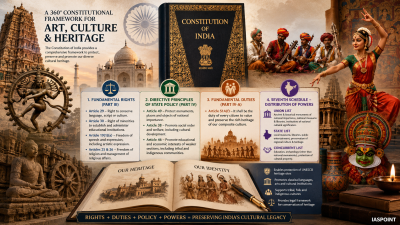
The Constitution of India provides a robust framework for the protection of art, culture, and heritage. These provisions are distributed across Fundamental Rights (Part III), Directive Principles of State Policy (Part IV), Fundamental Duties (Part IV-A), and the Seventh Schedule, ensuring a 360° approach to conservation and cultural identity.
Fundamental Rights: The Bedrock of Cultural Identity
These rights are justiciable and primary safeguards for the diverse cultural fabric of the nation.
Article 29: Protection of Interests of Minorities
- Article 29(1): Any section of citizens (both minorities and the majority) residing in India having a distinct language, script, or culture has the right to conserve the same.
- Broad Interpretation: The Supreme Court in Ahmedabad St. Xavier’s College v. State of Gujarat held that though the headnote mentions “minorities,” the text applies to “any section of citizens,” including the majority.
- Article 29(2): No citizen shall be denied admission into any educational institution maintained by the State or receiving aid out of State funds on grounds only of religion, race, caste, language, or any of them.
Article 30: Right of Minorities to Establish Educational Institutions
- Article 30(1): All minorities, whether based on religion or language, shall have the right to establish and administer educational institutions of their choice.
- Article 30(1A): Inserted by the 44th Amendment Act (1978), it ensures that if the State compulsorily acquires the property of a minority educational institution, the compensation amount must not restrict their right to exist.
- Article 30(2): The State shall not discriminate against any educational institution in granting aid on the ground that it is under the management of a minority.
Directive Principles of State Policy (DPSP)
While non-justiciable, these principles are fundamental in the governance of the country and mandate the State to act as a custodian of heritage.
Article 49: Protection of Monuments and Places of National Importance
- Mandate: It is the obligation of the State to protect every monument, place, or object of artistic or historic interest (declared by Parliament to be of national importance) from spoliation, disfigurement, destruction, removal, disposal, or export.
- Legislative Outcome: This Article is the constitutional source for the Ancient Monuments and Archaeological Sites and Remains (AMASR) Act, 1958.
Fundamental Duties: The Citizen’s Responsibility
The 42nd Amendment Act (1976) introduced Part IV-A, making heritage conservation a collective societal obligation.
Article 51A(f): Valuing Composite Culture
- It shall be the duty of every citizen of India to value and preserve the rich heritage of our composite culture.
- Note for Prelims: The term “Composite Culture” (Samskriti) signifies the syncretic nature of Indian civilization, including diverse linguistic and religious influences.
Linguistic and Cultural Safeguards: Special Provisions
Beyond broad cultural rights, the Constitution contains specific directives for linguistic preservation.
Special Directives for Language
| Article | Provision | Key Fact for Aspirants |
| Article 347 | Special provision relating to language spoken by a section of the population of a State. | President can direct official recognition of a language if a substantial proportion of people desire it. |
| Article 350 | Language to be used in representations for redress of grievances. | Every person can submit a grievance in any language used in the Union or State. |
| Article 350A | Facilities for instruction in mother-tongue at the primary stage. | Inserted by 7th Amendment (1956); imposes a duty on States and local authorities. |
| Article 350B | Special Officer for Linguistic Minorities. | Appointed by the President to investigate matters relating to safeguards for linguistic minorities. |
| Article 351 | Directive for development of the Hindi language. | Duty of the Union to promote Hindi so it may serve as a medium of expression for the composite culture. |
Seventh Schedule: Division of Legislative Powers
The Constitution divides the responsibility for heritage conservation between the Centre and the States.
List I (Union List)
- Entry 67: Ancient and historical monuments and records, and archaeological sites and remains, declared by or under law made by Parliament to be of national importance.
List II (State List)
- Entry 12: Libraries, museums, and other similar institutions controlled or financed by the State; ancient and historical monuments and records other than those declared of national importance.
List III (Concurrent List)
- Entry 40: Archaeological sites and remains other than those declared by or under law made by Parliament to be of national importance.
Trivia and Key Concepts for UPSC Prelims
- Eighth Schedule: Currently lists 22 languages. Originally, there were 14. Sindhi was added by 21st Amendment; Konkani, Manipuri, Nepali by 71st; and Bodo, Dogri, Maithili, Santhali by 92nd Amendment.
- Classical Languages: The Government of India has currently accorded “Classical” status to 11 languages (Tamil, Sanskrit, Kannada, Telugu, Malayalam, Odia, and the 2024 additions: Marathi, Pali, Prakrit, Assamese, and Bengali).
- Intangible Heritage: While the Constitution focuses on “monuments” and “objects,” Article 29(1) provides the legal basis for protecting Intangible Cultural Heritage (ICH) like folk songs, oral traditions, and traditional knowledge.
- Doctrine of Cultural Relativism: Through Articles 25 and 26 (Religious Freedom), the Constitution also protects the “essential practices” of various cultures as long as they don’t violate public order, morality, or health.